
EOS is proposing a very different light source for polymer powder bed fusion: a carbon monoxide laser.
That may sound like a small variation on the usual CO2 laser (e.g. just the “2” is removed), but it’s a lot more than that. EOS says the shorter-wavelength radiation produced by the CO laser should produce a smaller focus, allowing finer details without mixing an absorber into the powder.
The application, US20260307327A1, is for use with polymer powder, with PA11 and PA12 mentioned as examples in the patent. The patent also names polypropylene, polycarbonate, PEEK and several other polymers as possible materials.
Today, polymer powder bed fusion typically uses a CO2 laser because many plastics absorb its 10.6 μm radiation reasonably well. Shorter wavelengths are attractive for resolution, but many polymer powders may not absorb them efficiently. One workaround is to add carbon black or another absorber.
EOS doesn’t want that workaround. Absorber additives increase material cost, have to be mixed consistently and can complicate print parameters. They also make light-colored parts more difficult. A powder that is naturally compatible with the laser could produce white or colored parts without relying on a dark ingredient. And white parts are typically used in production applications when color dyeing is required. No white parts, no production.
Their proposed solution uses a carbon monoxide laser operating somewhere in the roughly 4 to 8 μm range, with five to six μm given as an example. The beam is focused onto each powder layer and scanned across the cross-section of the part, as is typical. Because the wavelength is shorter than that of a CO2 laser, the patent says the spot can be smaller for comparable optical hardware.
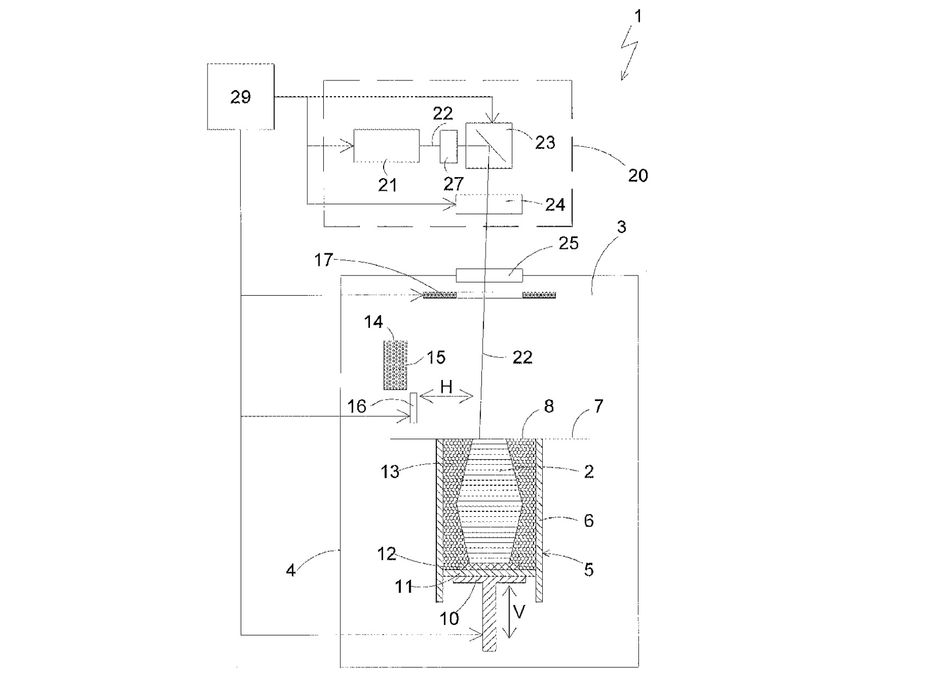
There is a catch, though. Carbon monoxide lasers are not necessarily as easy to switch rapidly as CO2 lasers. Powder bed fusion requires the beam to turn on and off repeatedly while it follows scan lines. EOS therefore places an acousto-optic or electro-optic modulator downstream of the laser, in the beam path.
The modulator changes how much power continues toward the scanning mirrors. Their diagram shows how the system change the delivered power quickly without constantly moving the beam position.
The claims specify a power increase in less than 300 microseconds, or potentially more than 50 nanoseconds, and a reduction in less than 100 microseconds, or potentially more than 100 nanoseconds. The reason for the fast switching is easy to understand: the laser must respond while the mirrors are already moving.
The patent combines that fast power control with small optical components. EOS suggests focus diameters from about 80 to 300 μm, layer thicknesses from 10 to 80 μm, and a preferred layer thickness of 25 μm. It also describes hatch-line spacing below 0.18 mm. A 25 μm layer is half the thickness of a typical 50 μm layer, so the machine would need twice as many layers for the same part height. The faster scan and switching system is meant to recover some of that lost time. However, it’s likely we’re facing a tradeoff between resolution and job time here.
Smaller galvanometer mirrors could help as well. The patent’s reasoning is that lower mirror mass permits faster acceleration and reduces tracking error at the start and end of scan lines.
If the approach works as described, EOS could build more detailed polymer parts while avoiding absorber additives and therefore keeping lighter colors. The complication is that a new laser, new optics, new powder behavior and high-speed modulation all show up at the same time. That could be a substantial process-development task, so you’re not going to be able to just drop a CO laser in for a CO2 laser.
EOS is trying to make the optics, scanning system, switching electronics and polymer powder serve one purpose: smaller features without giving up the operating speed that makes powder bed fusion useful. Perhaps we will see a coming EOS machine with this new laser concept soon.
Via Espacenet