
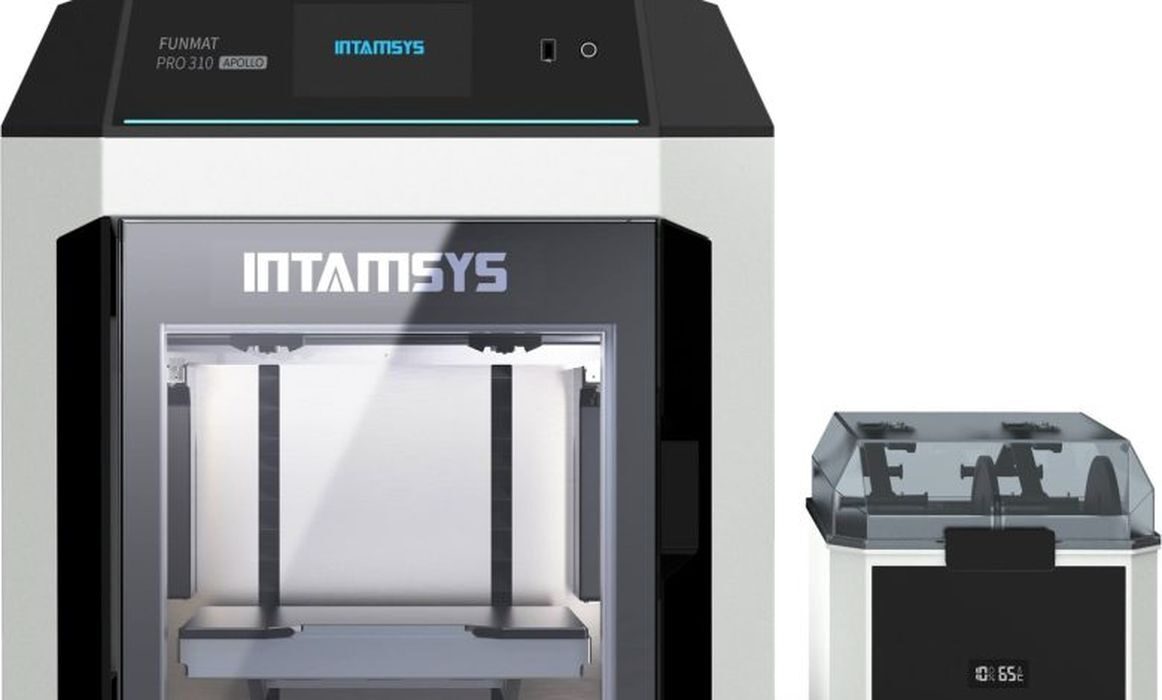
The system delivers up to 4x faster print speeds and more than double Z-axis strength (exceeding 40 MPa).
INTAMSYS, a Chinese developer of industrial FFF 3D printing, has launched its next-generation high-performance materials 3D printer, the FUNMAT PRO 310 APOLLO, at Formnext.
In 2016, INTAMSYS launched its first high-temperature printer, the FUNMAT HT, becoming one of the earliest companies to achieve stable FFF printing of PEEK. Since then, the company has continuously expanded material compatibility – from PEEK to the broader PAEK family and a wide range of engineering-grade thermoplastics.
The 310 APOLLO is a system-level upgrade in high-performance materials manufacturing. With its unique multi-physics process control and optimization, it delivers up to 4x faster print speeds and more than double Z-axis strength (exceeding 40 MPa).
It features dual 3kg active-drying filament boxes, RFID material recognition, and the newly launched INTAMQuality traceability system – all working together to ensure process stability and production consistency.
On the software side, the INTAMSUITE NEO slicing platform offers intelligent path planning and process adaptation, with precise control of temperature, flow, and path, for reliable, repeatable high-performance material prints.
To meet growing industrial demands, the 310 APOLLO is now equipped with the new INTAMQuality manufacturing quality assurance system. By recording everything from filament source to print parameters and full runtime logs, it creates a unique digital fingerprint for every printed part. Whether for certification-grade delivery or multi-printer production consistency, INTAMQuality enables confidence across batches and sites.
PAEK materials are becoming indispensable in applications such as humanoid robots that require lightweight yet high-strength structural parts; eVTOLs demanding components that are light, strong, and weather-resistant; and aerospace parts needing to push the limits of high-performance composites.
Read the rest of this story at VoxelMatters
