
What if a metal 3D printer could adjust its laser before something went wrong?
That’s the concept proposed in an interesting study from researchers at University College Dublin, who have developed a predictive control system intended to reduce defects in laser powder bed fusion (LPBF) 3D printing.
The researchers, Danial Pazoki, Denis Dowling and Pezhman Ghadimi, were investigating the usual problem in metal 3D printing: maintaining consistent melt pool conditions.
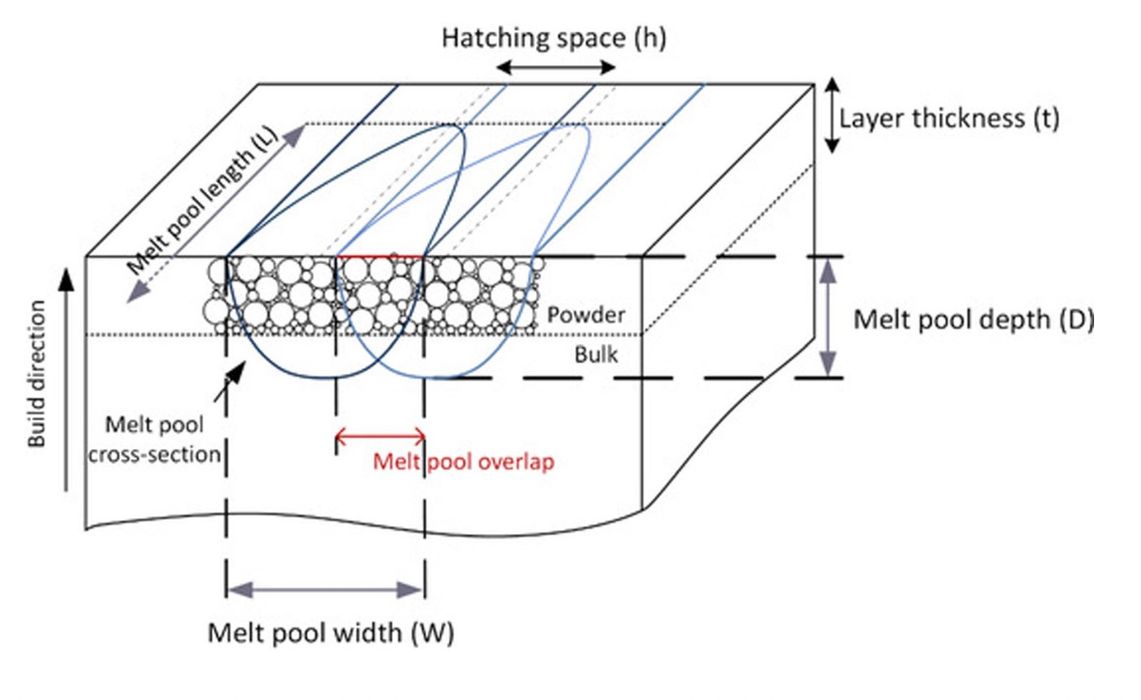
When the laser passes over metal powder, it creates a small pool of molten metal. If insufficient energy is delivered, the material might not fuse properly, resulting in lack-of-fusion porosity. Too much energy can produce keyhole porosity, where excessive heating creates unstable cavities that may leave voids. In other words, inconsistent melt pool behavior leads to lousy metal prints.
The most typical approach is to figure out the laser parameters before printing and use them in the build. Monitoring systems can watch what happens, but that information doesn’t necessarily result in immediate adjustments. It’s usually just monitoring, so you would know when something failed.
The Dublin researchers wondered whether a controller could predict the behaviour of the melt pool and adjust laser energy while printing each layer.
Their approach uses data collected from a Renishaw RenAM 500 metal 3D printer printing titanium Ti-6Al-4V spinal cages.
The printer’s InfiniAM Spectral monitoring system uses photodiodes to measure light emissions from the melt pool at a pretty impressive 100,000 samples per second. This light provides an indirect indication of melt pool temperature, a proxy.
The researchers used these measurements, together with recorded laser energy data, to construct a predictive controller.
It’s a smart approach because the controller doesn’t require a detailed physics model describing everything happening inside the melt pool. It just watches.
It uses the relationship between previous laser inputs and measured emissions to predict what the melt pool will do next. The controller can then calculate an adjustment to laser energy intended to maintain a desired emission level.
This could allow the printer to correct a growing print problem before things move too far outside tolerances.
The researchers tested the approach using a MATLAB simulation based on previously recorded printing data, and the results were quite remarkable.
In one layer, the original uncontrolled data contained 34,007 samples outside statistically defined thresholds associated with potentially defective conditions. With the predictive controller operating in simulation, that number dropped to just six. That’s a reduction of 99.98%!
The researchers also tested the controller against data from another layer of the same print, finding similarly encouraging regulation behaviour.
Actual defect reductions would need to be confirmed through physical testing, perhaps using CT scanning.
Something else: The controller didn’t actually operate a metal 3D printer. Although the Renishaw equipment provided the experimental data, its hardware and software don’t currently permit the required real-time access to laser controls. So the researchers had to simulate the controller’s operation.
We increasingly see sophisticated monitoring capabilities appearing in industrial metal 3D printers, but collecting process information is only part of the solution. You ultimately have to act on that data.
If manufacturers provide the necessary control mechanisms, predictive controllers like this could eventually adjust processing conditions automatically, potentially reducing defects, rejected parts and lots of costly post-print inspection.
This is a question for machine manufacturers: will they open their control systems sufficiently to allow technologies like this to operate?
Via International Journal of Advanced Manufacturing Technology