
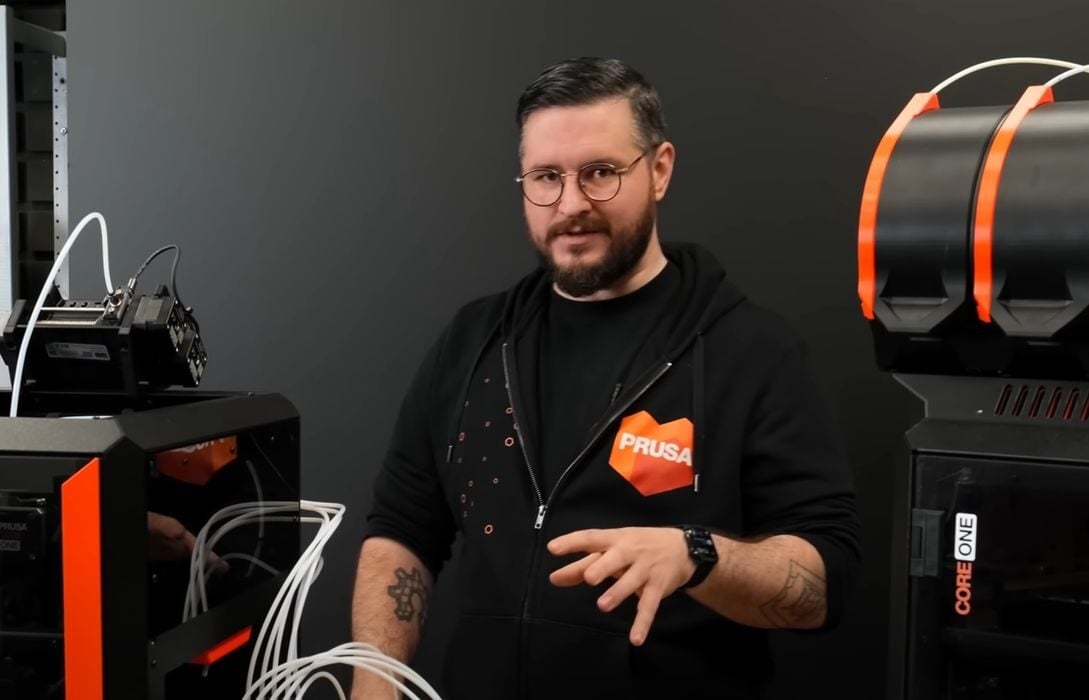
Is Open Source Hardware really dying? I believe the answer is yes and no.
There’s recently been a great deal of discussion over Josef Průša’s post about open source hardware. The post appeared a month ago and there was some discussion about it at the time, but for unknown reasons the discussion began again this past week.
In the post, Průša wrote:
“I cannot talk about all of the open hardware, but I can share experience from 3D printing. And it is not good! Open hardware in 3D printing is dead – you just don’t know it yet.”
There’s great wisdom in his words. He specifically focuses on the open hardware for 3D printing — not “all of the open hardware”. This is important.
There is a lot of positive sentiment for open hardware in the community, and that’s natural because of the concept of giving to others. In fact, most of today’s desktop 3D printing industry products grew from a series of increasingly sophisticated open source designs.
But things change when the scale reaches a certain point. When there are vast numbers of sales, when consumers begin to dominate the customer base, and when corporate objectives take hold, things are a lot different.
Open hardware, by definition, can be used by anyone — even companies. It just turns out that some companies are able to produce the hardware at far lower prices than others, even the folks that may have developed the designs. This is exacerbated when the scale of production grows, due to better economics.
I see this discussion as a symptom of a transition. There are plenty of products on the market today that really don’t have a robust open hardware equivalent.
Let’s look at a common example, the 2D paper printer. You probably have one, and you print pages with it, perhaps not as much as in the past with things going electronic lately.
Would you consider using an open hardware 2D paper printer? Does such a thing even exist? Is there a community of people that are working on making 2D paper printers better?
If there are any, they must be very few.
The reason for that is because they can’t compete against larger companies that have largely perfected the designs of 2D paper printers. They are available anywhere, operable by anyone, and cost next to nothing. There’s little point to having an open hardware project for 2D paper printers.
That, I believe, is where we are heading in desktop 3D printing. At some point, there will be little point in trying to design better 3D printers because the commercially available units will be powerful and inexpensive.
We’re not there yet, but the trajectory is very clear. The only question is which companies will get to that transition.
Open hardware projects on desktop 3D printers will still proceed for some time, but over time, they will have increasing difficulty in providing systems that have the capabilities of commercial systems, and the proportion of people using them will decrease.
