
Something strange is happening in my inbox.
For years, Fabbaloo would occasionally receive a message from someone who had developed an interesting software utility for 3D printing. It might be a cool way to manipulate 3D models, a specialized design tool or some other application that solved a minor problem often encountered by 3D printer operators.
These were relatively uncommon, and often worth investigating. Sometimes worth a story, too.
But over the past several weeks, something has changed dramatically. We’re now receiving these suggestions multiple times per day, and sometimes almost hourly.
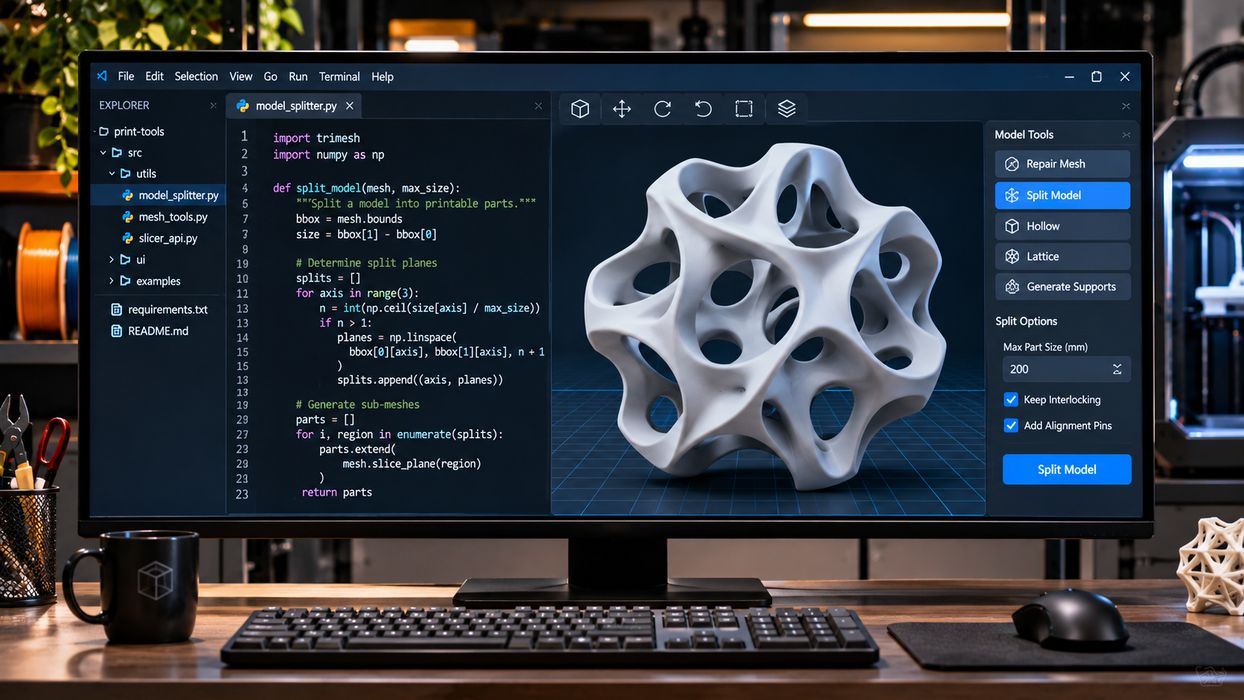
The variety is astonishing. One person has developed a utility to split large 3D models into printable sections. Another has created an alternative interface for CAD software. Someone else has built an entirely new CAD system. Others are producing AI powered print management systems, model repair tools, filament management systems, workflow automation utilities and seemingly anything else imaginable.
Where are all these applications coming from?
I suspect we’re witnessing the first major effects of vibe coding on the 3D printing software market.
Vibe coding is the increasingly popular practice of using AI systems to rapidly generate software from natural language instructions. Tools from Anthropic (Claude) and OpenAI (ChatGPT) have made it possible for people with limited programming experience to create really sophisticated applications.
Someone encounters an annoying problem in their 3D printing workflow. Instead of searching for software that might solve it, they describe the problem to an AI system and have it build a solution.
Sometimes this takes days. Sometimes hours.
Sometimes it is actually faster to simply build the software you need on the spot than searching for it elsewhere.
And then they share it with everyone else.
What Happens To Software Companies?
For decades, the 3D printing software market has operated on a standard assumption: developing software requires substantial expertise, time and money.
This meant that relatively few companies produced the tools that everyone used. Some software was free or open source, but specialized commercial applications could be quite expensive.
Customers paid because developing equivalent functionality themselves was simply unrealistic. It would take too long, require too many resources, and the skills to do so were just not there.
That assumption is beginning to collapse.
Consider a utility that performs a specific geometric operation on an STL file. Previously, someone might have spent months developing, testing and packaging such an application, then attempted to sell licenses.
Today, anyone might create something functionally identical in an afternoon. Or an hour.
If they publish the utility as open source, thousands of others can potentially use it without paying anything.
What, then, is the commercial value of that functionality?
I’m beginning to think the answer, at least for simple 3D printing utilities, is approaching zero.
But note that generating code is a lot easier than producing actually reliable software. A rapidly generated application might fail on unusual input data, delete or damage files, create security issues or become unusable after a some dependency changes.
Meanwhile, sophisticated CAD systems, industrial simulation software and production management platforms are way more than just a collection of features. Their value also includes reliability, integration, support, collaboration, existing workflows and years (maybe decades) of accumulated engineering knowledge.
Those things won’t disappear overnight. But they are the “big guys” in this space.
I suspect the lower end of the software market is headed for an incredible shakeup.
Why would someone pay US$99 for a specialized utility when several free alternatives appear every month? Why would a developer invest heavily in a specialized application when a competitor (or literally anyone) can build the same functionality by Wednesday afternoon?
The economics of this software market segment have collapsed.
A Different Software Industry
I can imagine the 3D printing software world looking very different within just a few years.
Instead of selecting a reliable app from a relatively small set of major applications, operators might instead assemble their own workflows from hundreds or thousands of specialized utilities, many generated by other operators facing similar problems. That assembly, of course, would be done by even more AI tools.
Some will just create their own tools whenever necessary.
Software companies may increasingly have to sell something other than their app’s functions: proven reliability, verified outputs, integrated workflows, security certifications, 24/7 technical support or maybe licensed compatibility with industrial equipment.
There may even be a growing business in finding, testing and maintaining the massive number of AI generated utilities appearing online. Having a thousand tools available doesn’t help much if you can’t find/figure out which ones actually work for your problem.
I’m also wondering what happens to existing software companies when their customers begin building the missing features themselves instead of waiting for the next paid upgrade. These companies have surely noticed this trend, but I have yet to see any visible strategy to counter it. Maybe there isn’t one.
They have some time, however. Today’s vibe coding activity seems to be targeting relatively low complexity functionality. However, as we’ve continually seen with AI tools, that will obviously shift into the increasingly complex zones, eventually matching and maybe exceeding today’s advanced tools.
We’ve spent decades watching 3D printers become cheaper and more accessible. Now the software for those machines seems to be having a similar transformation, perhaps much faster.
The most amazing possibility is that in several years software itself may cease to be a product for many everyday 3D printing tasks. It might become something you make when you need it.
Welcome to the world of on-demand software.