
Researchers have developed a generative CAD system specifically for 3D printing.
Generative CAD tools have been around for several years, and they are fun to use. They’re quite different from normal CAD tools, where the user literally builds all the components. Instead, a generative system designs the entire structure itself.
A generative system typically accepts as input:
- The objective (e.g., maximize stiffness, minimize compliance)
- The constraints (e.g., target relative density, isotropy, load points, symmetry)
- The material properties
Then the generative system iterates through a number of stages to arrive at an optimal design.
But there’s a problem. Generative systems operate on an idealized physics model, and make a number of assumptions:
- Material is continuous, isotropic, and infinitely divisible
- tool has no awareness of the manufacturing method
- A “design” might include shapes impossible to fabricate directly
This means that manufacturing constraints are applied after the fact — like smoothing, offsetting, or slicing. In other words, they can generate designs that are not 3D printable. Small features “disappear” when printing; surfaces deform; strength drops because the anisotropy is not accounted for. Simulation does not match reality.
That’s a problem because the ability to print radical designs (like those produced by generative tools) are the sweet spot for the technology.
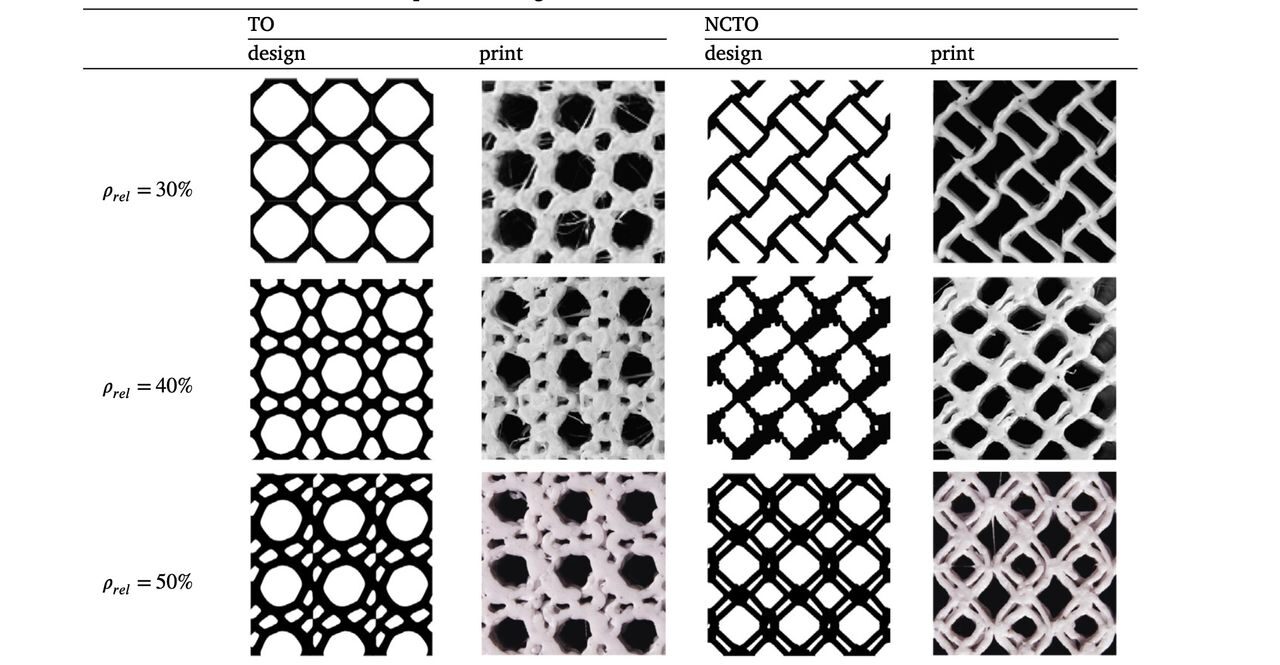
Enter Nozzle-Constrained Topology Optimization (NCTO). It’s a new generative tool devised by researchers at MIT. It is essentially the same as previous generative tools, but adds one key feature: it is aware of the manufacturing constraints. In addition to the inputs mentioned above, NCTO requires the manufacturing parameters (nozzle diameter, bead spacing, number of orientations, etc.).
The tool then properly models the generation by filtering through a projection mechanism that ensure the deposition width is recognized, bonds between layers, etc. The optimizer therefore decides where material exists and how it would actually be extruded by a nozzle.
The output is a proper toolpath that should actually be the optimal printable result.
While conventional generative tools would “Design whatever you want, and I’ll try to print it”, NCTO instead designs only what the printer can physically lay down, bead by bead.
The research focused on FFF 3D printing, and it is possible that alternative versions might work on other 3D print processes.
This is a significant breakthrough, and would clearly provide massive benefit to 3D printer operators. If incorporated into workflows, parts could be produced that are stronger and more reliable.
I’m hoping that this technology is commercialized — or open sourced — as soon as possible.
Via ScienceDirect
