Charles R. Goulding and Kate Esposito showcase how groundbreaking 3D printing technologies like ORNL’s SkyBAAM and EMPOWER wall are redefining building energy efficiency and reshaping the future of sustainable construction.
Introduction: Building Energy Efficiency
The Oak Ridge National Laboratory (ORNL), a multiprogram research facility located in East Tennessee, has been making great progress towards introducing energy-efficient wall technologies for buildings. Under the tax code, buildings are evaluated for energy efficiency by looking at three main systems: lighting and lighting controls, HVAC and HVAC controls, and the building envelope. ORNL’s primary focus is on improving building envelopes to reduce the amount of energy needed for heating and cooling.
The building envelope, which refers to any component on the perimeter of a building that touches the outdoor environment, is the main determinant of the energy required to heat, cool, and ventilate a building. In the past, the main components of the building envelope that impacted energy efficiency were the roof, insulation, and windows. However, thanks to ORNL’s development of new technologies, wall products are being created that will impact energy usage. Through their development of 3D printed tools and materials, ORNL has manufactured groundbreaking technologies with the potential to revolutionize energy consumption.
Energy Efficient Walls Meet 3D Printing Technologies
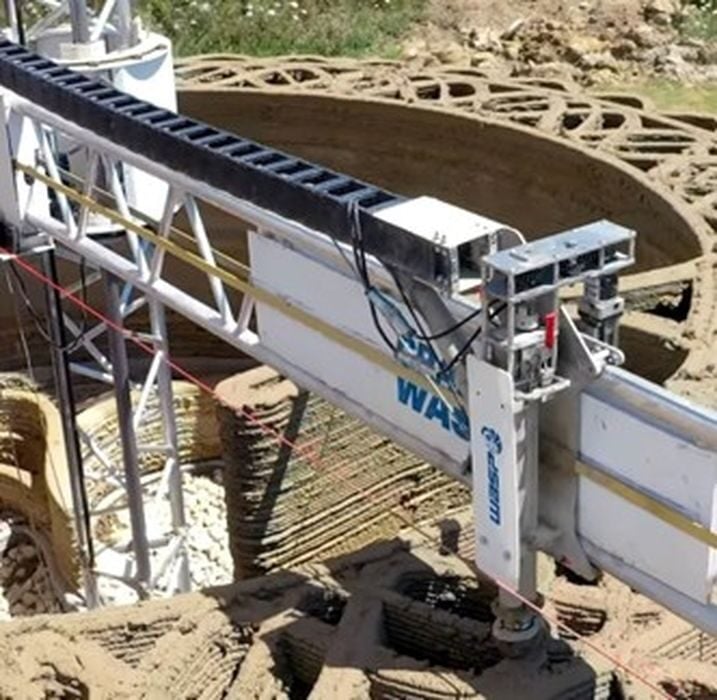
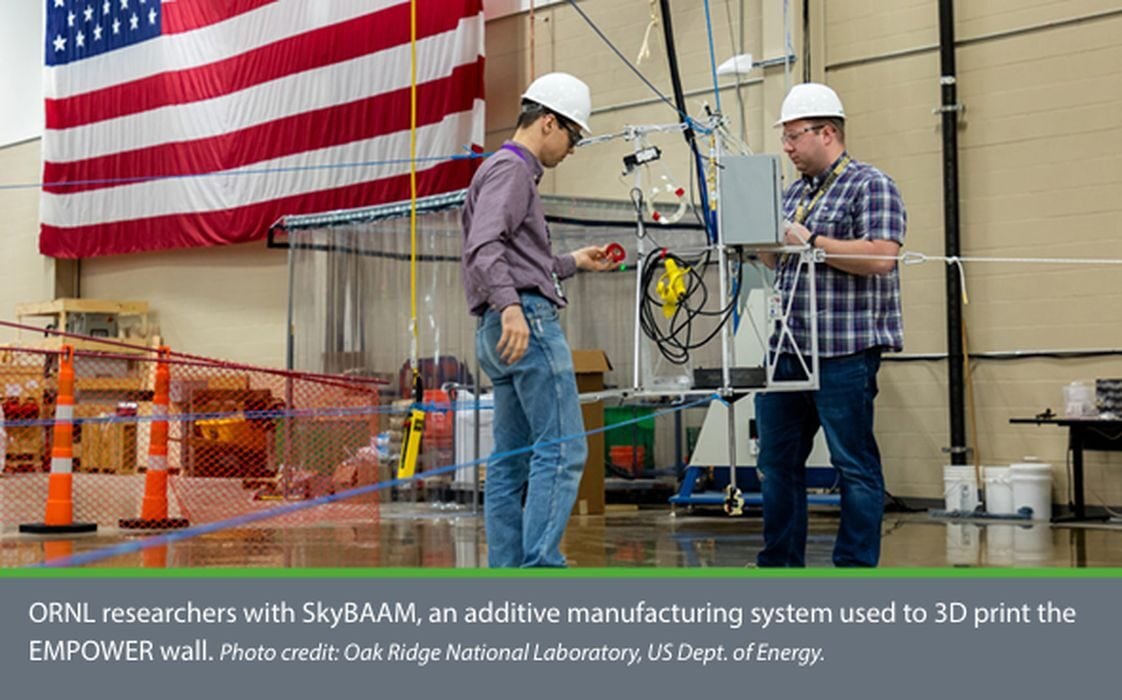
ORNL researchers have developed a Sky Big Area Additive Manufacturing, or SkyBAAM, technology capable of 3D printing buildings and smart walls. SkyBAAM is a low-cost, large-scale, field-deployable system capable of adapting to any construction site. The system uses concrete that is uniformly dispensed and deposited in layers from a nozzle suspended in midair (Oak Ridge National Laboratory, 2020). Unlike most other technologies applied to 3D print walls and buildings, SkyBAAM is relatively easy to use, as it does not require a gantry framework to support it and instead relies on a cable-mounted setup (Hanaphy, 2022).
SkyBAAM also offers key advantages compared to concrete construction. Building with traditional concrete requires the use of a mold, which takes time to create and often requires the use of more concrete than is necessary. Furthermore, traditional concrete puts restrictions on the geometries that can be constructed (AM Media | The Cool Parts Show, 2022). In comparison, 3D printed concrete does not require a framework and instead optimizes concrete use, helping to reduce concrete waste by up to 95% (Wang, 2025). SkyBAAM can take many complex shapes and structures, which often enhance thermal insulation and reduce heat transfer (Góra et al., 2024).
In August 2020, ORNL used SkyBAAM to print their first EMPOWER wall. This 3D printed smart wall combines building innovations, advanced manufacturing, and power electronics. The wall is designed to reduce energy use, decrease peak time energy consumption, harness renewable energy, lower energy bills, and guarantee occupant comfort. Because the sections of the EMPOWER wall are 3D printed one at a time, water lines can be placed between each layer. These water lines enable the wall to raise or lower internal temperatures on demand. During off peak periods, water circulates through, and the temperature is held in place with controlled insulation. When outdoor temperatures rise, the insulation is turned off and the water flow lowers internal temperatures (AM Media | The Cool Parts Show, 2022). In addition to this, EMPOWER has a Model Predictive Control (MPC) system to optimize the operation of these active insulation and thermal storage lines based on predictions of future conditions, including weather, occupant behavior, and HVAC system behavior. This method minimizes energy cost and consumption during peak hours, making it more sustainable both environmentally and financially (Atkins et al., 2022).
The EMPOWER wall also uses a smart inverter, which powers the wall’s cooling components. The inverter is connected to a battery that stores energy from the building’s main power grid during times of low electrical demand and makes energy available when it is needed during peak demand times (Oak Ridge National Laboratory, 2020). Because of the smart inverter, the wall can use renewable energy systems such as wind turbines, fuel cells, and solar power. By combining the battery’s energy storage with a renewable source, the inverter can power the wall without depending on the main electrical grid (Oak Ridge National Laboratory, 2020).
The University of Notre Dame’s 3D printed Walls
The University of Notre Dame is also working towards developing energy efficient 3D printed walls. Ashley P. Thrall, Professor of Structural Engineering, leads the project along with David B. Go, Professor of Aerospace and Mechanical Engineering. They are working in conjunction with Eric Kreiger and Brandy Diggs-McGee, two engineers from the U.S. Army Corps of Engineers, Engineer Research and Development Center, Construction Engineering Research Laboratory. They are working to improve thermal efficiency in 3D printed walls while achieving the ductility and strength required for commercial, public, and residential buildings (3D printed Concrete Walls for Improved Energy & Construction Efficiency, 2025). The proposed technology aims to achieve superior thermal efficiency without compromising structural performance or raising costs, with a target of 50% improvement in thermal resistance.
Achieving an energy performance of 50% higher thermal resistance while providing the same strength and ductility as conventional walls at no added cost will greatly further U.S. building construction. The project will have an immense impact on all building types, but especially commercial, public works, and multistory residential buildings in cold, mixed-humid, and marine climates, as these structures have the highest average energy use intensities. Successful implementation of the project could lead to widespread adoption of more efficient building practices, providing a huge financial and environmental advantage.
Testing Technologies and Materials for Energy Efficiency
ORNL has been working with specific technologies and materials to determine which can be used alongside EMPOWER walls to create the most energy-efficient building envelopes. Among these are structural insulated panels (SIPs), composed of a foam plastic insulation core secured between two structural facings (SIPA, 2024). The foam core in a SIP is meant to provide structural support, insulation, and air-sealing in wall, floor, roof, and foundation systems. Tests conducted by ORNL have shown that SIPs significantly outperform 2×6 wood-framed and fiberglass-insulated walls, with SIP construction proving to be almost 15 times more airtight than wood-frame construction (Big Sky R-Control, n.d.). In addition to SIPs, ORNL has tested Dryvit Exterior Insulation and Finish Systems (Dryvit EIFS) to determine their effectiveness. Studies show that Dryvit walls are 84% more thermally efficient than any other wall system, including brick, wood, and concrete. This higher thermal performance can lead to significant energy savings, with the potential to decrease heating and cooling bills by 20% annually (Dryvit Systems, Inc., n.d.). By implementing these technologies and materials in their walls, ORNL can drastically improve the energy efficiency of building envelopes.
The Research and Development Tax Credit
The now permanent Research and Development (R&D) Tax Credit is available for companies developing new or improved products, processes, and/or software. 3D printing can help boost a company’s R&D Tax Credits. Wages for technical employees creating, evaluating, and revising 3D printed prototypes are typically eligible expenses toward the R&D Tax Credit. Similarly, when used as a method of improving a process, time spent integrating 3D printing hardware and software can also be an eligible R&D expense. Lastly, when used for modeling and preproduction, the costs of filaments consumed during the development process may also be recovered.
Whether it is used for creating and testing prototypes or for final production, 3D printing is a great indicator that R&D Credit-eligible activities are taking place. Companies implementing this technology at any point should consider taking advantage of R&D Tax Credits.
Conclusion: The Future of Energy Efficiency
Innovative 3D printing technologies such as those developed by Oak Ridge National Laboratory (ORNL) and the University of Notre Dame are essential for energy-efficient and sustainable construction. ORNL’s cutting-edge technologies, including SkyBAAM and the EMPOWER smart wall, represent a huge leap forward in reducing energy consumption and integrating smart control technologies in buildings. Notre Dame’s collaborative research highlights the potential of 3D printed wall systems to enhance thermal resistance without compromising structural strength or increasing costs. Combined with high-performance materials like Structural Insulated Panels and Dryvit EIFS, these technologies have the potential to revolutionize energy consumption and usher in a more sustainable and cost-effective future.