
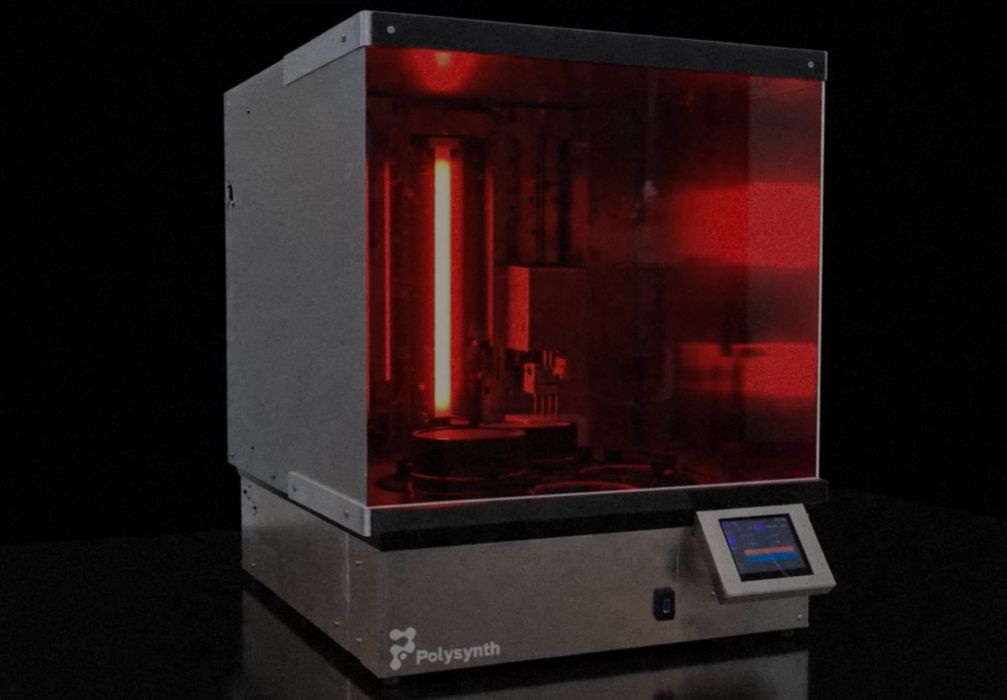
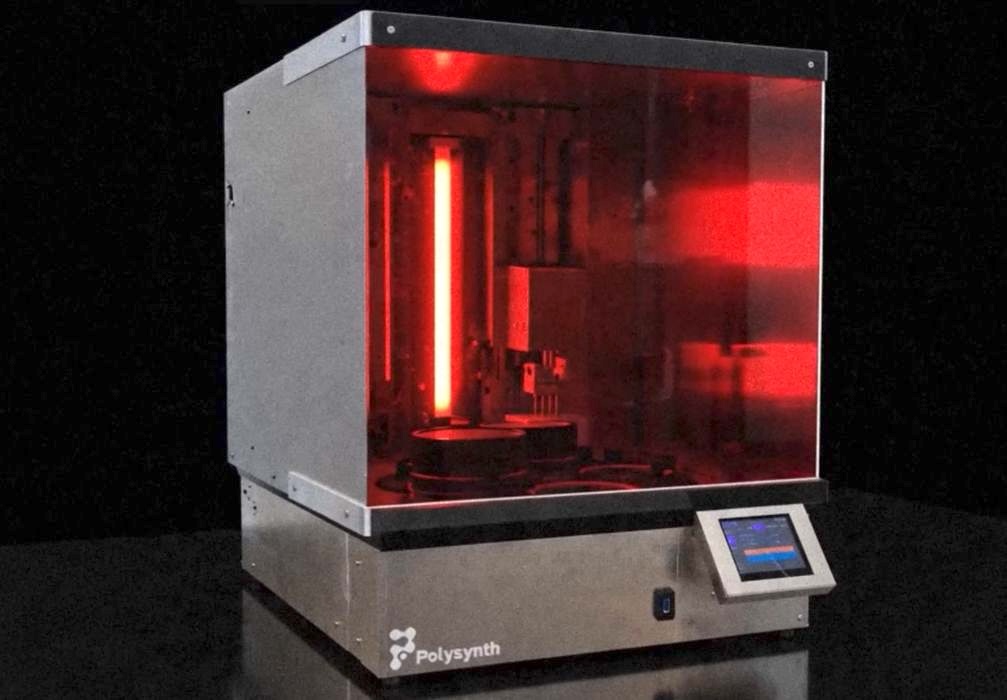
I’m looking at a new and upcoming device from Polysynth that claims to be a multimaterial resin 3D printer.
Last week I watched an introductory video from the company that showed how their technology works, which was my immediate concern upon hearing the words “multimaterial resin 3D printer”.
Resin 3D printers are NOT multimaterial. They have a resin vat that is full of, well, resin. One kind of resin. If you put another in it, it will mix and you will end up with a single resin again. A different one, but still one single material.
How could you print in multiple resins in the same job?
Their solution is ingenious and a bit crazy. Here’s how it works:
- The system uses the same bottom-up MSLA-style layer curing mechanism.
- Four circular resin tanks are mounted instead of one.
- Each tank is large enough to accommodate the build plate.
- The tanks are on a rotational platform.
- When it’s time to print in a specific resin, that vat is rotated around to be under the build plate.
- Printing occurs naturally with whichever tank is present under the build plate.
- Multiple materials on a single layer are possible by rotating vats without changing the Z level.
This is brilliant! But hold on, there’s a big question here.
What happens to the wet resin that will inevitably collect on the print as it is dipped into each vat? Would it not simply be moved to the next vat and mix in? That would corrupt the print and mess up the vat materials.
The answer is to remove the wet resin from the print before dipping in the next vat. This is done, incredibly, by spinning the build plate at a very high RPM. This is like your high-efficiency washing machine’s spin cycle. The resin flies off the model and lands on the walls of the original resin vat where it can be reused.
I can imagine some scenarios where there are cavities that would capture the loose resin and prevent it from flying off, but by and large, this could actually remove a lot of the resin. There may be some geometric restrictions or slicer orientation features to minimize this effect — or maximize spin effectiveness.
Apparently, the major technical issue was not the vat rotation, but instead, it was the build plate spin. After spinning, the plate would have to stop at exactly the original position; otherwise, subsequent print layers would not line up.
Polysynth seems to have solved this issue, making the system feasible. I encourage you to watch their video, which explains how all this works.
Multiple material resin 3D printing enables all kinds of new applications. For example, a conductive resin could be used to build electrical traces directly into a part. Flexible material could put grips or hinges into an assembly. Dental appliances could include multiple hardness levels. The possibilities are endless.
Their first machine, the Polysynth 1, is apparently capable of handling up to eight resins at a time, something quite unprecedented in the resin 3D printing universe. There are two variations; one is specialized for dental applications.
As you might imagine, the price point for this machine is going to be higher than your typical single resin device: US$4999.
You can’t buy one yet, but you can pre-order one.
I expect them to be receiving a lot of orders.
Via Polysynth
