
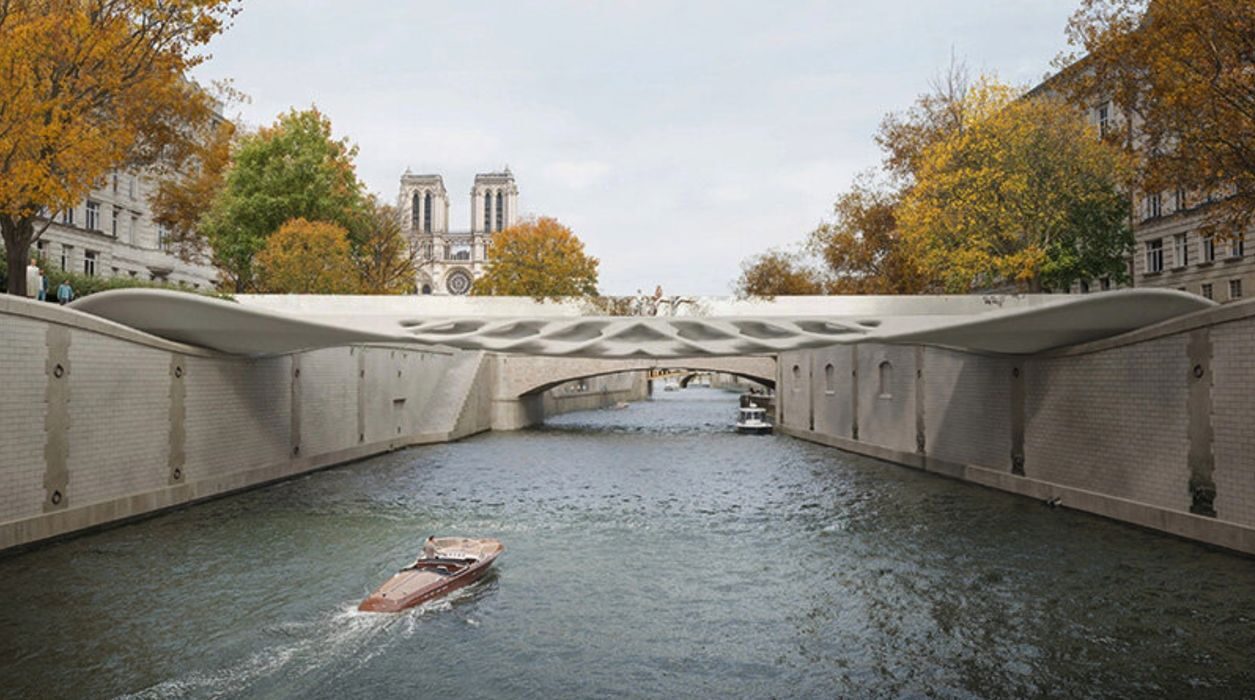
Researchers have developed what some call a “sustainable” 3D printable construction technique.
The work, done at the University of Pennsylvania’s Polyhedral Structures Laboratory, was highlighted this week with a 3D printed bridge made from concrete.
The Lab’s Project Diamanti is developing 3D printable post-tensioned concrete canopies, which ultimately became the aforementioned bridge, located in Venice. The project is intended to be a testbed for new construction technologies, including modular construction techniques. The bridge was made in nine prefab sections, which were assembled on site. The approach also enables later deconstruction of the bridge in an easy manner.
One of the features of the structure is that it is made from low-carbon materials. Normally concrete is quite CO2 intensive, for reasons I will explain in a moment.
The Diamanti approach lowers carbon use in several ways. First, the structure is designed using triply periodic minimal surfaces that can more efficiently distribute loads — meaning there is less concrete used in the structure than with normal designs. There is also less steel required for this structure.
Secondly, the unusual geometry exposes much more surface area to the atmosphere. This means that the structure can actually absorb some CO2 from the air, apparently a 30% increase.
In all, they say that the bridge decreased energy and emissions by 25%.
That’s good news, as concrete is one of the largest sources of CO2. That’s because the production of cement, used in concrete, requires massive amounts of energy. The first stage in making cement is to calcinate the limestone by heating it to 900C. This step not only consumes energy (typically fossil fuels), but also the chemical reaction releases CO2 from the rock into the atmosphere. A second stage requires heat up to 2000C to sinter the material.
That’s why concrete is so emission-heavy.
The concrete used in this bridge project seems to be typical, made in the same way as any concrete. It therefore went through the same energy usage, adding to the CO2 load.
The bridge project was widely reported as being “sustainable”, and that’s where I am wary. This is not a new material that is less energy intense; instead it is a way of using slightly less of the energy-intense material.
In other words, if we built the same number of structures in this way, we would lower concrete emissions by a decent percentage. However, this building approach is not suitable for all projects. There’s also the question of whether we would build the same number of projects. Typically when capacity is increased, it’s used.
A truly sustainable approach would be to instead change the materials so that they do not produce emissions.
