
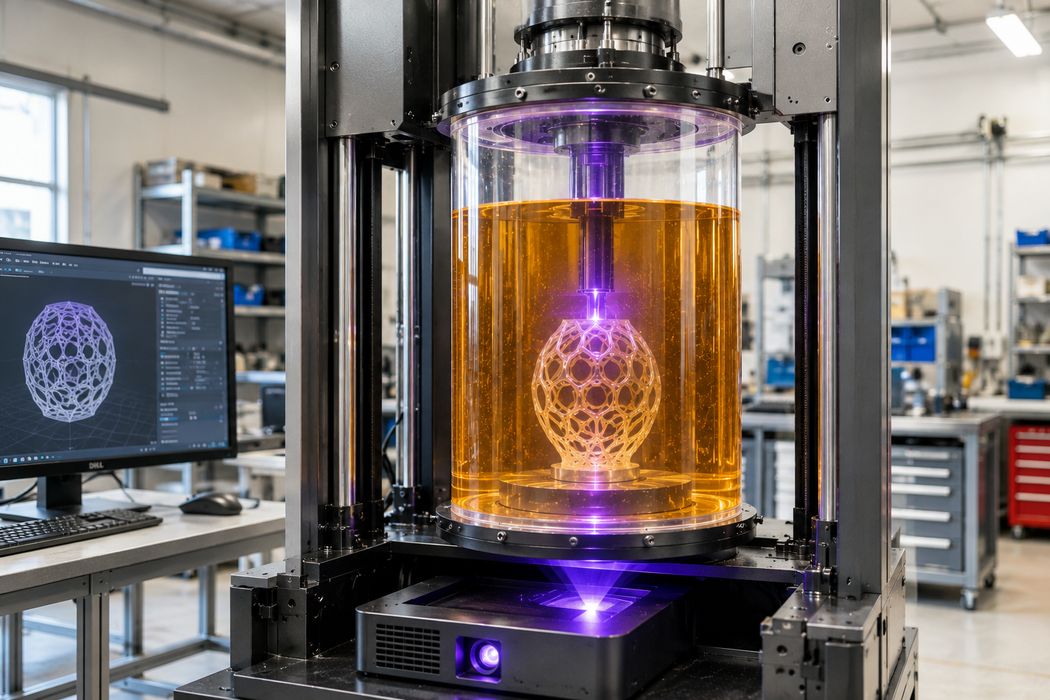
There’s been much talk about the incredible speed of volumetric 3D printing, but there are a number of issues with the approach.
If you’re not familiar with volumetric 3D printing, let me explain how it works:
- A photopolymer resin sits in a rotating cylindrical container.
- The container’s walls are transparent.
- A DLP-style projector displays patterns into the resin as it rotates.
- Over time, certain areas within the resin accumulate enough energy to polymerize.
- Eventually, an entire solid 3D object is built, and the process completes.
This is kind of like a reverse CT scan: instead of producing images of the inside of a patient, the images are projected into the patient — or resin, in this case.
Why do this seemingly crazy process? Because it can be extraordinarily fast: a print can take only minutes or even seconds in some cases. It is by far the fastest 3D printing process known.
So why aren’t we using it all the time? Well, there are quite a number of challenges that have yet to be overcome. Let’s take a look at them.
Light Penetration Versus Energy Absorption
The resin must be transparent enough for projected light to cross the entire build volume in the cylinder. However, photopolymerization also requires the resin to absorb light.
Those requirements are in direct conflict. If there is too much absorption, light cannot reach the far side or even the centre of the vat. If there is too little absorption, light passes through without depositing enough energy efficiently. Larger build diameters make this imbalance progressively worse.
This is a major reason most current volumetric systems make millimetre- or centimetre-scale parts, rather than objects tens of centimetres across like common 3D printers.
Scattering Destroys the Projected Patterns
Volumetric processes assume that a projected pixel travels along a reasonably predictable path through the resin.
Any particles, droplets, fibres, cells, pigments, phase-separated components, or refractive-index variations can scatter that light along that path. The pattern arriving inside the vat then becomes blurred and displaced, messing up the print.
This issue very strongly restricts the material possibilities. Problematic materials include:
- Fibre- or particle-filled composites
- Ceramic-loaded resins
- Highly cellular bioinks
- Pigmented and opaque resins
- Many toughened resins
- Emulsions and suspensions
- Resins that become cloudy as curing begins
The challenge is not only that less light arrives through the resin. Instead, light is scattered and arrives in the wrong places, potentially curing resin outside where it is supposed to. It is theoretically possible to predict this and compensate, but that becomes increasingly complicated with larger structures.
The Entire Vat Receives Background Exposure
A target voxel is cured because it receives intersecting energy contributions from many different projected views. But nearly every non-target voxel is also crossed by some light.
“Intended” voxels must exceed the polymerization threshold, and “unintended” voxels must remain below it. The problem is that the unwanted background dose is not zero. Exposure continuing even slightly too long can cause a rapidly growing haze or partially cured region outside the intended part. This means there is a relatively small exposure window.
Polymerization Is Not Perfect
Photopolymerization is not perfect and depends on:
- Photoinitiator concentration
- Inhibitor concentration
- Oxygen content
- Temperature
- Resin age and previous light exposure
- Radical diffusion
- Monomer conversion
- Local viscosity
- Exothermic heating
- Time between projected views
A voxel slightly below the threshold may already contain partially reacted material. A voxel above it may be only weakly gelled instead of being fully cured.
Resolution Deteriorates With Size
A projector has a fixed number of pixels and a finite optical space into which it projects.
If its image is enlarged to cover a greater build diameter, then each projected pixel takes up a larger physical area, and fine details become harder to resolve.
A 3D voxel in volumetric printing is not equal to one projector pixel. It is produced by the intersection and accumulation of many light rays, each subject to diffraction, focus, aberration, and resin distortion.
The Cylindrical Vat Itself Distorts Light
In a rotating-vial volumetric system, light passes through air, a curved glass wall, and resin. Each interface can refract the rays. The cylindrical wall can act like a lens, and any mismatch among the refractive indices of air, container, and resin changes the projected geometry.
This could cause all kinds of geometry issues in the print. It is possible that a projection algorithm could compensate for these effects. But a calibration that works for one set up probably doesn’t work for another.
Occlusion and Shadowing
One advantage of volumetric 3D printing is the ability to print around an inserted object. But that insert can block or distort the projection angles needed to form material behind it.
This creates “shadow regions” where the energy dose cannot be delivered. Reflective, opaque, or strongly refracting inserts are going to be even more problematic.
Even without an insert, already-polymerized material might change later light paths because cured resin can have a different refractive index or scattering behaviour from fresh resin.
Resin Changes While It Is Being Exposed
As polymerization begins, the resin environment may change inside the cylinder:
- Refractive index
- Density
- Temperature
- Viscosity
- Optical absorption
- Scattering
- Physical volume
That means the optical model used to calculate the projections becomes increasingly less accurate during the print. This means that the longer (or larger) the print job is, the worse quality will result.
Motion and Viscous-Flow Problems
Volumetric systems typically rotate a vial of resin. Ideally, the resin rotates as a rigid body along with the container so that the projected coordinates remain synchronized: you want the energy to land at exactly the same voxel in 3D space while rotating.
Low-viscosity resin usually reaches this state easily; it’s hard to move. But highly viscous resin can lag behind the container wall, create shear gradients, or require a long settling period. Rapid starts and stops can create sloshing in low-viscosity materials.
This means that the effective resolution is messed up because the previously energized resin is not where it is supposed to be.
Weak Green Parts and Difficult Extraction
A volumetric object usually emerges as a soft “green” part suspended inside uncured resin. It could require careful draining, solvent washing, secondary UV curing, thermal post-curing, and careful mechanical handling.
Because the object is not attached to a build plate, pulling it out can be awkward. Delicate objects may sink, float, distort, or break while being removed from the container.
The absence of supports is a substantial advantage, but the surrounding resin effectively serves as the temporary support. Once that resin is removed, the part must be strong enough to survive. This means there must be software changes to account for weak structures.
Material Properties Remain Constrained
Most photopolymer resin systems already have a bunch of challenges, including:
- Brittle thermoset behaviour
- Cure shrinkage
- Limited long-term UV stability
- Residual resin
- Ageing and yellowing
- Variable biocompatibility
- Difficulty recycling
Volumetric processes add a requirement for deep optical transparency and tightly controlled curing thresholds. A resin optimized for toughness, colour, fire resistance, or thermal performance might be optically unusable in these systems.
Fillers that improve stiffness, conductivity, heat resistance, or flame retardancy frequently scatter or absorb light. This means that many of the additives that make conventional photopolymers industrially useful make volumetric exposure way more difficult.
And that are some of the issues currently facing volumetric approaches. At first, the technology sounds incredibly exciting. But when you consider the issues, it seems it may end up being suitable only for niche applications.
