
Researchers have 3D printed structures inside a living cell.
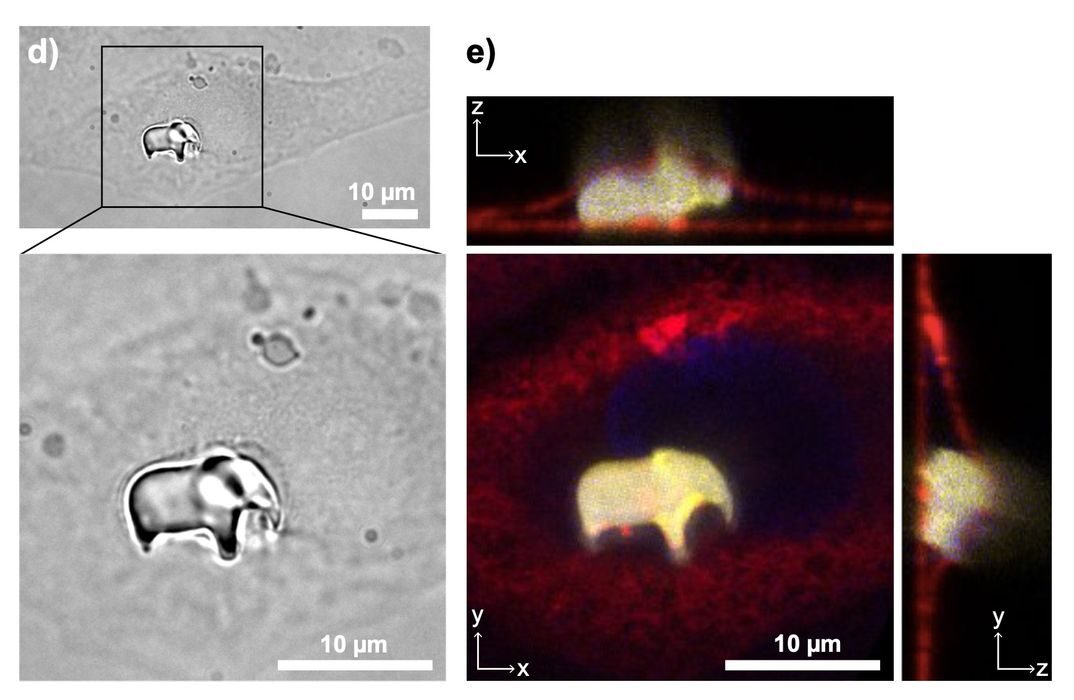
This seems to be the very first time this has been achieved, done by Slovenian researchers. They were able to 3D print multiple example structures inside live HeLa cells (a human cervical cancer cell line), including an elephant shape, barcodes, diffraction gratings, and more.
How is this done? It seems pretty straightforward, as they used the two-photon printing process. “TPP” involves tightly focusing a laser at a point in 3D space within a vat of material. Normally, TPP is done within a tub of photopolymer resin, and the laser traces out the solid structures in the 3D volume.
In this case, however, they placed a cell at the focus of the TPP process. The cell had been injected with a biocompatible photoresist, ready for polymerization. A femtosecond laser was used to selectively cure the material while inside the living cell.
The process maintains sub-micron resolution despite refractive index mismatches between the resin and the cytoplasm. Some of the living cells survive and even divide (!) after printing, although membrane penetration during injection significantly reduces viability. They found a ~50% survival rate.
This could be a significant development, as it moves the line of technology from “tissue level” to “intracellular”.
Possible Applications
What possible applications might be enabled by this new intracellular technology? The possibilities are endless.
One application could be cell tracking. By placing a barcode on a cell, it could then be later identified. This might be useful in a variety of medical applications, such as drug testing.
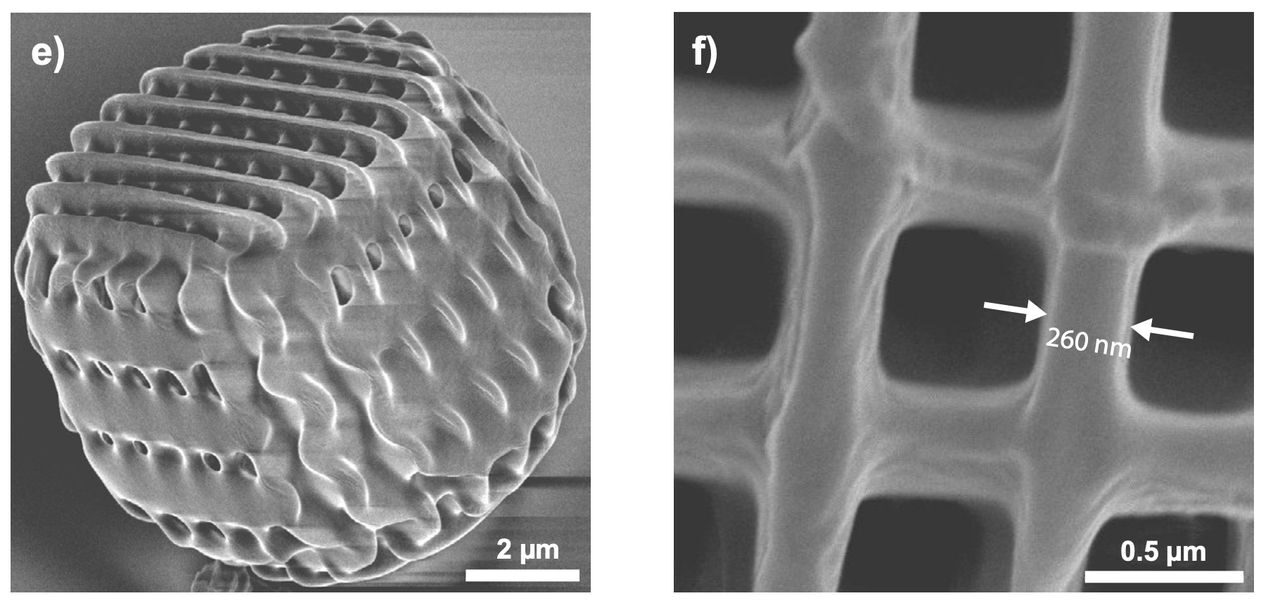
It might be possible to embed optical components, such as microlasers, waveguides, and lenses for real-time sensing, imaging, and communications inside living cells.
Mechanical levers, springs, or solid features could allow for dynamic alteration of the cell’s shape. This might enable the creation of some type of automated propulsion system for the cell. It may also be possible to use mechanical features to deploy drugs in specific body locations.
Use of 4D structures that can change shape after printing through external triggers could allow for external control of cell mechanisms. For example, specific light frequencies might cause mechanical activity to begin in the cell.
I think you get the idea. This technology opens up an immense number of possible applications.
Advanced Applications
But those are just the simple ones. If we opened our minds up a bit, we can envision some science fiction-level potential applications:
If the resolutions were sufficient, it might be possible to print logic gates, and therefore, simple processors could be “printed” into the cells. Now the cells would be “smart”.
With processors and mechanics, it might be possible to literally repair damaged DNA in the cell as it occurs. Radiation-resistant living cells might be possible.
If you can tweak the DNA, then it would be possible to change the DNA to do different functions on demand. Need a cell to absorb nearby water and release, say, hydrogen?
With the addition of optical transceivers, the cells might be able to communicate with each other. This could allow for coordinated swarms of cells to perform group functions.
Coordinated group cells could produce parts that could then be assembled into larger machines or tools — inside the body. Surgery might be done by injection instead of by human-held scalpel.
Stem cells might include mechanisms that alter the design of new cells produced by the stem cell. This might allow for dynamic body modifications that go beyond what the body’s natural DNA would generate.
That’s all wild speculation, but you can see that this development has unbelievable potential.
Via ArXiv
