
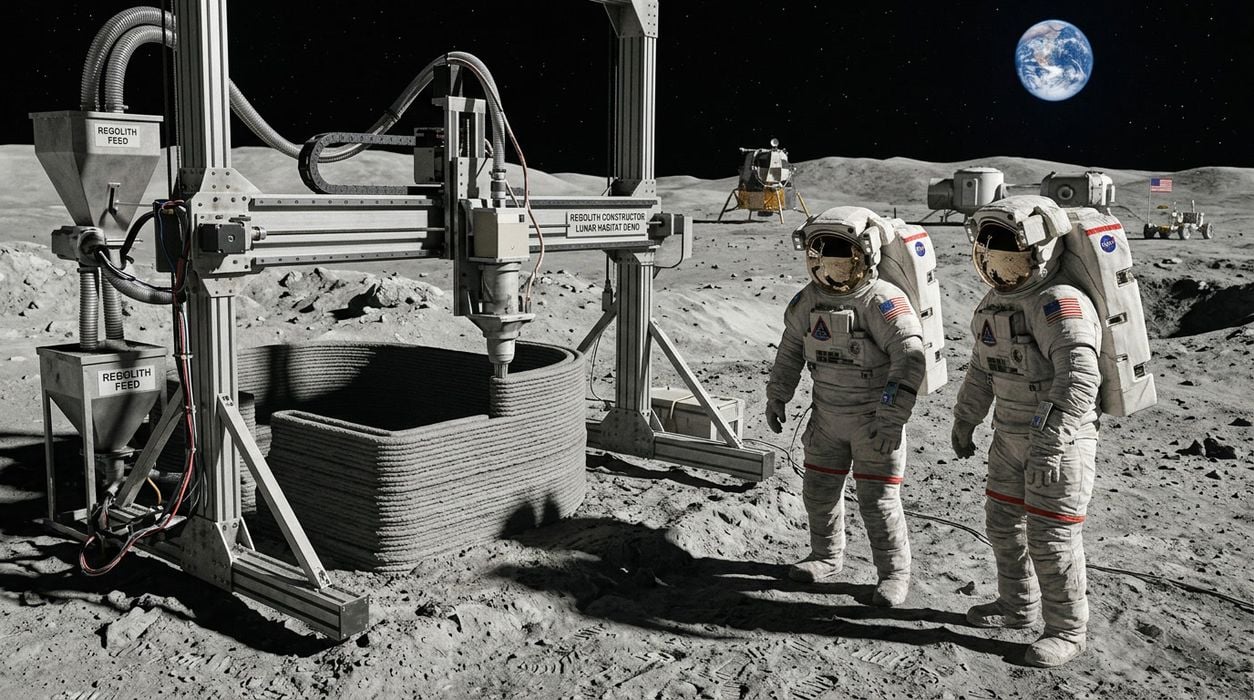
A new research review lays out how 3D printed, regolith based concretes could enable lunar and Martian structures — and where the toughest engineering gaps remain.
The paper comes from Punjabi University Patiala researchers Karanbir Singh Randhawa and Anhad Singh Gill, who synthesize recent material science, process, and robotics work for extraterrestrial construction. They connect a number of lab results in this area.
Launch mass is incredibly expensive, so on site resource utilization (ISRU) is the only credible path to large footprints off Earth. That means using local regolith as the aggregate, swapping out water hungry Portland cement for alternative binders, and relying on autonomous additive construction methods to reduce or even elimninate human labor, which is even more expensive.
Three classes of build methods are described. First, alkali activated geopolymers, which can cure at modest temperature and use aluminosilicate content already present in lunar and Martian simulants. They have shown encouraging mechanical and thermal stability, but behavior varies widely with site chemistry and admixtures, and vacuum plus thermal swings can increase porosity over time.
Second are protein based biobinders. Prior studies report extraterrestrial regolith biocomposites with human serum albumin and urea hitting around 25 MPa compressive strength, comparable to ordinary concrete. That is intriguing for initial missions, though scalability, production rate, and long term stability under radiation are still unanswered.
Third, binderless routes use focused energy to fuse regolith. Selective Laser Melting (SLM) and solar sintering can produce bricks, but reported strengths often end up below 5 MPa with high porosity and weak interlayer bonds. Better thermal management and controlled cooling are prerequisites before this becomes a primary load path.
There are also elastic regolith inks based on polylactic‑co‑glycolic acid showing moduli from roughly 1.8 to 13.2 MPa, useful for shock absorption and interfaces rather than primary pressure vessels. Across all classes, admixtures like urea can cut water demand and tune rheology, but they also change curing and final strength. The researchers are refreshingly admin that durability under repeated lunar day and night cycles is insufficiently characterized.
Printing Methods, Automation, And Control
On process, extrusion based construction AM is still the most practical near term option for large shells and berms, it turns out. Success depends on mix rheology — yield stress, viscosity — and on managing regolith particle size so layers hold shape in low gravity without sedimentation effects.
Binderless powder fusion offers geometric freedom and fast solidification, but energy budgets are pretty severe and cooling cracks are a real risk. Selective Laser Sintering (SLS) style control loops, robust thermal models, and aggressive insulation will be required to hit acceptable defect rates.
Robotics is the other half of this story. The paper points to NASA’s prize programs and ACME work as proof that autonomous deposition, site prep, and finishing are feasible in principle. Expect digital twins and embedded sensing to move from nice-to-have status to mandatory, driving closed loop control for layer bonding and dimensional accuracy in dust, vacuum, and big temperature gradients.
Economically, the logic seems convincing. If ISRU mixes deliver twenty plus MPa compressive strength with predictable curing and low energy input, you cut launch mass for binders and formwork while raising throughput with round‑the‑clock robots. Service providers in construction AM, sensing, and simulation could find a new market — albeit one where reliability becomes far more important than speed and aesthetics.
This sounds great, but several catches remain. Strength retention after thousands of thermal cycles and radiation exposure is largely unproven and will require on site testing over longer periods. Interlayer bonding and porosity are persistent weaknesses in both extrusion and sintering. Throughput, machine robustness, and dust‑hardening of mechanisms will decide whether demonstrations scale to habitats.
A credible pilot would combine autonomous mixing, deposition, in situ monitoring, and mechanical testing in a lunar analog with realistic temperature cycling. Hopefully we will see such a test take place in the near future.
Via International Journal for Multidisciplinary Research (IJFMR)
