
Researchers say a simple surface treatment could let two photon polymerization print working micro mechanisms without supports.
Two photon polymerization (TPP) is able to produce sub micron features in photopolymer resins with extraordinary detail. The catch is that printing moving parts in place is really hard, especially at small scales. Supports fuse where you do not want them. And at this scale, you cannot just pry a hinge free with tweezers.
The new research looks at this issue. The researchers describe using a “self assembled monolayer” (SAM) to reduce adhesion between the print and the build substrate. In other words, they create a molecular non stick release layer so printed components can separate cleanly during development without sacrificial supports. This is similar to how different materials are used in FFF 3D prints to ensure supports don’t stick to the model.
Why Supports Break Micro Mechanisms
In macro polymer printing, supports are certainly annoying but usually removable. At micrometer and nanometer scales, a support is essentially permanently attached. Even if it dissolves, capillary forces during rinse and dry can lock parts together. TPP users who have tried to print a hinge, a bearing, or a micro slider know the outcome: great detail, zero motion.
That is why many micro AM researchers design without motion, instead making compliant mechanisms and living hinges instead of true moveable parts.
How A Monolayer Fixes Stiction
A SAM is a single molecule thick film that chemisorbs onto a surface, often a glass slide or metal coating, presenting a low energy outer layer. It makes the substrate behave like Teflon at the nanoscale. With a SAM in place, the first printed layers do not bond as strongly to the base.
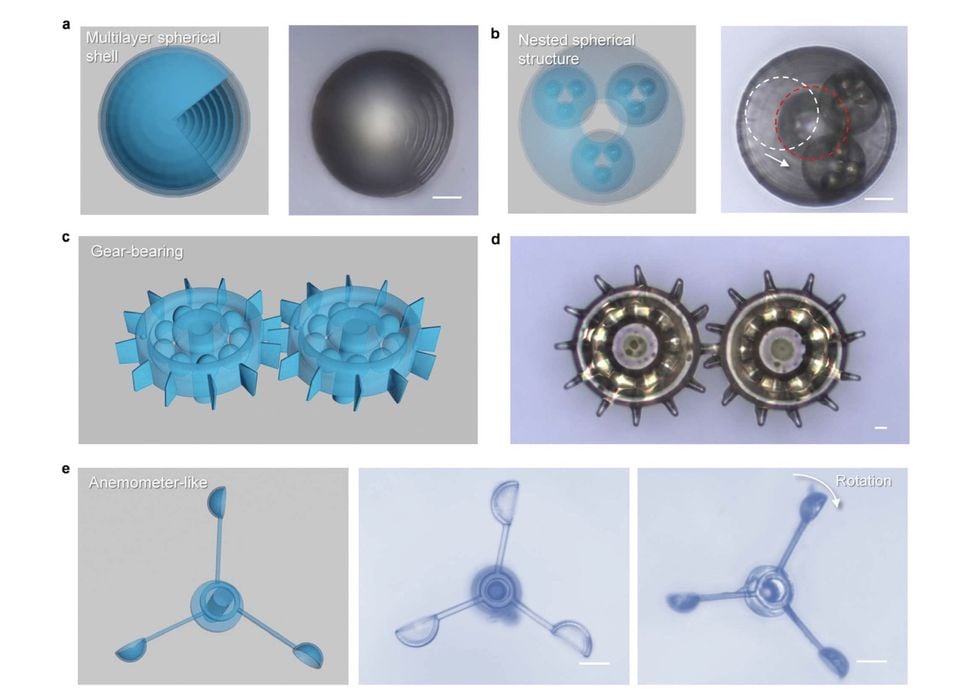
The researchers reports that this treatment lets them fabricate microscale kinematic pairs — hinges, sliders, rotational joints — with TPP and release them support free during development. After exposure and rinse, the joints remain intact but unglued, so the mechanism can move as designed. No manual freeing is required.
What This Could Change For Micro AM
If this research turns out to be commercialized, it would lower human touch time and raises yield for labs and service bureaus running TPP platforms. Think of systems producing watch gears, optical mounts, microfluidic valves, etc. Design freedom grows because clearances can be tighter when you do not need breakaway gaps for support removal.
Costs also shift. Less labor per part and higher first pass success can beat the added step of SAM preparation, especially for batches of identical parts on the same substrate. Automation becomes more feasible, too: pretreat a carousel of slides, then print and rinse without the need for expert intervention.
Commercialization paths are pretty straightforward. Tool vendors could offer pretreated substrates or SAM activation modules to make this easy-to-use. Service providers could standardize a release recipe and produce true moving micro parts printed in place.
Ultimately, this could lead to a whole new set of microscopic 3D printed machines.
Via OpenAlex
