
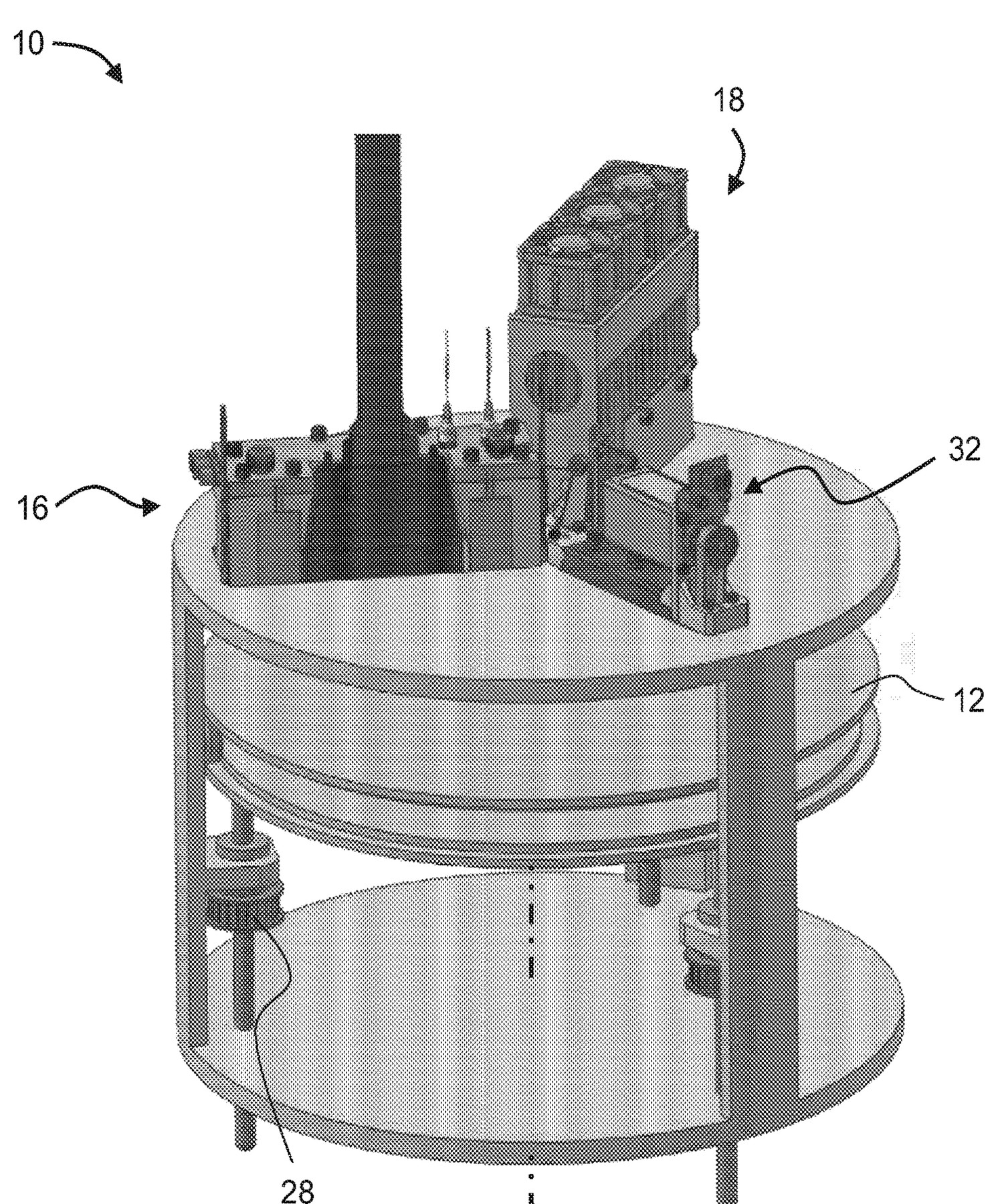
What if a color 3D printer could print two layers at once without doubling its number of printheads?
That is the concept in Stratasys’ published patent application US20260273856A1, titled “System and Method for High Throughput Three-Dimensional Printing.” It just might make the company’s PolyJet full color printing process a lot speedier.
At a particular target location, the printer dispenses material from two channels during the same travel of the printing block. One channel might provide cyan while the other provides yellow. Or one might provide a colored modeling material and the other clear material. Support channels can also be paired.
In today’s PolyJet process, a color inkjet 3D printer lays down one set of droplets, then makes additional passes to build up the required layer thickness and color mixture. Stratasys proposes slicing the model into paired layers, or otherwise arranging two sets of color data so that both can be deposited during the same movement. The result can be a thicker combined layer or fewer travels for the same layer thickness.
There is an awkward problem hiding in that simple description. If the same pixel calls for the same color on both paired layers, printing both data sets at the same spot could produce too much material. The application therefore describes altering one layer’s data. A repeated colored pixel may be replaced with clear material, support material, or a different channel. The software can also change the droplet pattern so two digital color mixes do not land directly on top of one another.
The printer is not firing every nozzle twice and hoping the material sorts itself out. The slicer compares corresponding locations in the paired layers, chooses an allowable pair of channels, and can distribute the color droplets spatially. In one example, excess coverage is replaced with clear material, reducing the amount of colored resin while preserving the intended appearance.
The patent’s example gives the idea of potential benefit here. A reference color print using 27 micrometer layers and four passes per layer took 8:05. A high-throughput mode using 55 micrometer layers and four passes took 4:39. Another mode retained 27 micrometer layers but used two passes, taking 4:52. Those results are close to a halving of print time in the stated test, although the application does not confirm that every object or color combination will behave the same way.
The system can use eight channels: two for support, one for clear material, and five for white, cyan, magenta, yellow and black. That is a substantial hardware arrangement, but the patent’s argument is that throughput can be improved without simply installing higher-flow heads or adding a second complete set of channels.
Pairing layers makes the slicer more complicated, and the printed result may show slightly softer color definition. The application’s own comparison images appear to show sharper colors in the standard mode. For a visual prototype, that may be acceptable. For a demanding full-color part, it may not be.
I find this more interesting than a conventional “faster nozzle” proposal. Stratasys is using software and material pairing to make existing dispensing hardware do more work per travel. If the color compromises stay within acceptable limits, that could be a useful production mode: maximum appearance when needed, and nearly half the printing time when throughput wins.
Via Espacenet
