
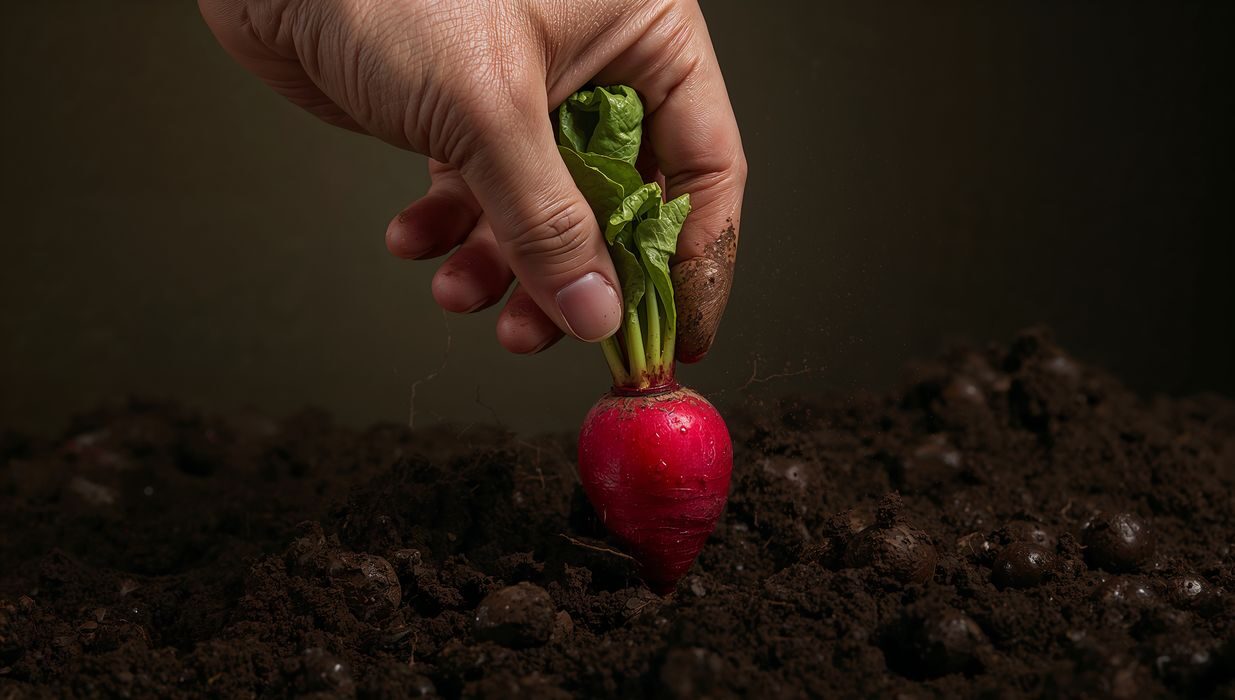
A new study reveals that microplastics can be absorbed by vegetables.
With the compounding amounts of microplastics in our environment, the researchers wondered whether they could make their way into growing vegetables.
Their experiment involved a hydroponic setup to grow radishes. The hydroponic solution contained water and the normal nutrients for growing, but they intentionally added nanoplastic particles for the experiment.
The particles were made from a lab-made 99.5% pure styrene. They also mixed in a very small amount of radioactive 14C styrene. This enabled them to track the path of the particles later by detecting the radiation. The resulting particles were chemically identical to normal polystyrene.
The plan was to expose the radishes to the nanoparticles for a five day period, and then use the radiation to measure if the plants absorbed any of the styrene.
Now for a bit of biology. Plants have a natural barrier called the “Casperian Strip”, which prevents large particles from entering the vascular system of plants. The expectation was that the Casperian Strip would block the nanoparticles.
However, that was not the case! The researchers found that five percent of the nanoparticles added to the solution were absorbed by the radishes in the five days of exposure.
Where did the particles end up? Some 65% were found in the non-fleshy roots of the plant, but 25% were found in the edible fleshy root — the part you would eat.
The authors conclude that nanoplastics can enter and accumulate in edible parts of crops, implying a potential route for human exposure through consumption.
This is a surprising result, and while they tested only a specific styrene, it is likely that other microplastic pollution can similarly end up in our vegetables. However, the take up rates could be vastly different depending on the material.
Their experimental setup was somewhat contrived: they used a flowing hydroponic system to expose the radishes to the pollutant, something very unlikely to occur in a garden. On the other hand, they did so for only five days, vastly shorter than the growing season for radishes.
There are a couple of implications for 3D printing here.
First, the scrap plastic generated by 3D printing, if improperly disposed of, will eventually end up as microplastics and possibly enter the environment and find their way into vegetables.
Secondly, a very popular category of 3D printable models is plant pots. Sometimes these 3D printed pots are used to grow vegetables. While the researchers did not test the possibility of a plant absorbing plastic particles shed from a plant pot, it might be a possibility. This is certainly something that should be tested, as well as the ability for different 3D printable materials to be absorbed.
Finally, environmental lifecycle assessments may have to account for uptake risks as a result of this and subsequent studies. Nanoplastic generation could be a much larger problem than we realize.
Via ScienceDirect
