
A new study looks at something many SLS operators already know oh too well: old powder piles up.
The paper, published in Physchem, examines ways to “valorize” waste powder from Selective Laser Sintering. That is the academic way of saying: can we turn this material back into something useful, instead of paying to throw it away? This matters a lot because SLS has a powder problem.
In polymer powder-bed fusion, most of the powder in the build chamber does not become part of the final printed objects. It surrounds the parts, supports them, and waits there through a long, hot build cycle.
That sounds harmless, but it is not.
SLS powder spends hours near its melting range. During that time it can oxidize, degrade, yellow, clump, and change its melt behavior. In some materials, polymer chains break down. In others, they may crosslink. Either way, the powder that comes out of the machine is not quite the same as the powder that went in.
Operators deal with this by mixing used powder with virgin material. This is the familiar “refresh” cycle.
But there is a limit.
At some point, the aged powder has drifted too far. Flowability declines. Caking appears. Melt flow rate shifts. Parts become less predictable. For shops producing regulated or high-performance components, that is usually the moment the powder is retired.
In other words, expensive polymer material becomes waste.
That is a real cost issue, not just an environmental one. Many SLS materials are not cheap, and the embedded energy in producing, shipping, heating, and handling them is significant. Throwing them away is a poor outcome.
The new paper does not present one miraculous recycling method. Instead, it lays out practical methods for getting value from off-spec SLS powder.
One route is to restore the powder for additive use. That could involve sieving to tighten particle size distribution, carefully blending with virgin powder, or using reactive extrusion and chain extenders to recover some molecular weight before reprocessing.
That sounds good, but it is not simple. SLS is quite sensitive to powder behavior. Particle shape, flow, melt response, moisture, and thermal history all matter. A material that is “still plastic” is not necessarily still good SLS feedstock.
The second route may be more realistic for many operations: move the powder into another process.
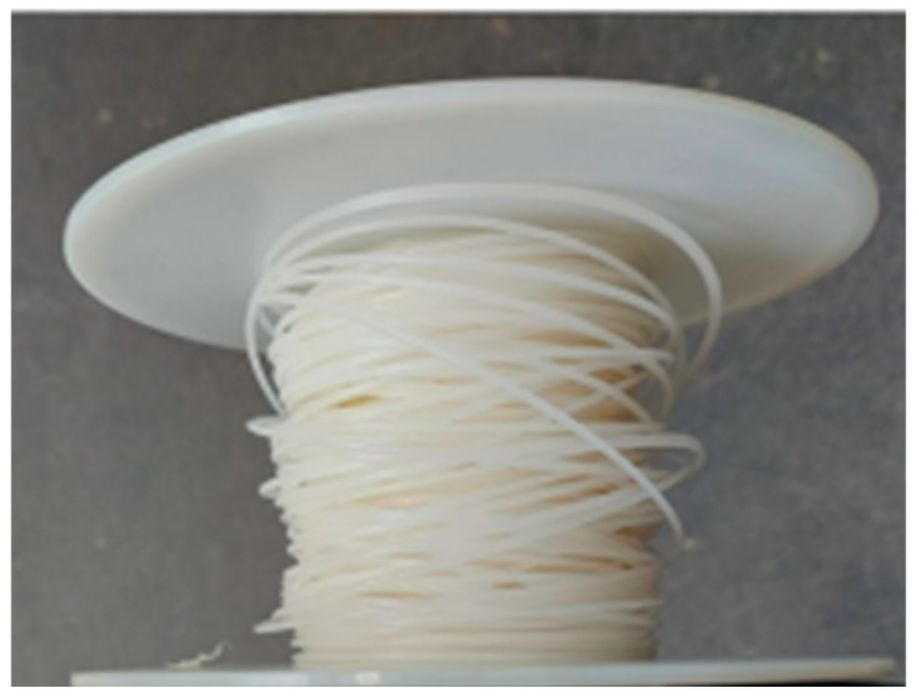
Aged PA12, for example, could be compounded into pellets and used for FFF filament or other extrusion-based applications. The resulting parts may not match fresh SLS material properties, but they could be entirely suitable for non-critical uses.
That is an important distinction.
The highest-value reuse may not be “turn old SLS powder into new SLS powder.” It may be “turn old SLS powder into something else that tolerates more variation.”
The paper also looks at using waste powder as filler in injection molded or extruded compounds, as reinforcement in thermoset composites, or as functional material in coatings and adhesives. Darkened or carbon-filled powders may be acceptable where appearance is not important.
There are more advanced options, too, including solvent-assisted purification, chemical recycling, and energy recovery. But those depend heavily on local infrastructure, material type, volume, and economics. They are not automatic wins.
The useful part here is the decision framework.
The researchers suggest evaluating retired powder using practical metrics: particle size distribution, flowability, melt flow rate or viscosity, DSC data, and FTIR carbonyl index. Those tests can help determine whether a given batch should be reused in AM, compounded into another material stream, or sent elsewhere. That is probably the right way to think about it.
A bin of old powder should not be treated as generic garbage. It should be treated as an uncertain material inventory that needs classification.
But there’s one issue: this only works if the material stream is controlled.
Mixed chemistries, unknown additives, old colorants, moisture, contamination, and inconsistent thermal history all make reuse harder. A recycler or service bureau would need to sort, dry, clean, grind, blend, and test material carefully. Reactive extrusion also requires equipment and process knowledge that many print shops simply do not have.
The paper does not appear to solve the business case, either. There are no universal cost models for labor, energy, equipment, logistics, or reclaimed material value. Those numbers will vary wildly by region and operation size.
Still, this is a very interesting area for SLS-heavy service bureaus, materials suppliers, and OEMs.
If a workshop is dealing with large volumes of PA12 or similar powder, even a partial reuse stream could reduce disposal costs and offset some virgin material purchases. For larger operations, it could also help with sustainability reporting, particularly around scope-3 impacts.
OEMs could play a useful role here. They could publish clearer end-of-life criteria, offer take-back programs, validate secondary applications, or provide recycled-content processing windows. Without that, every operator is left to invent their own powder retirement rules.
SLS has always looked efficient because unsintered powder supports the build and can be reused for a while. But “for a while” is not the same as circular.ddfdf
If retired powder can reliably become input material for useful secondary products, then polymer PBF becomes a little less wasteful and a little more economical.
There is one example of this already in production: Stratasys offers a way to do this for a certain combination of powder and machine with their ReLife concept. ReLife allows their SAF equipment to use leftover PA12 powder from certain other equipment.
There is a lot of work ahead, but the direction is quite sensible: stop treating aged SLS powder as an unavoidable disposal problem, and start treating it as a material stream that deserves a second use.
Via Physchem
