
SPONSORED CONTENT
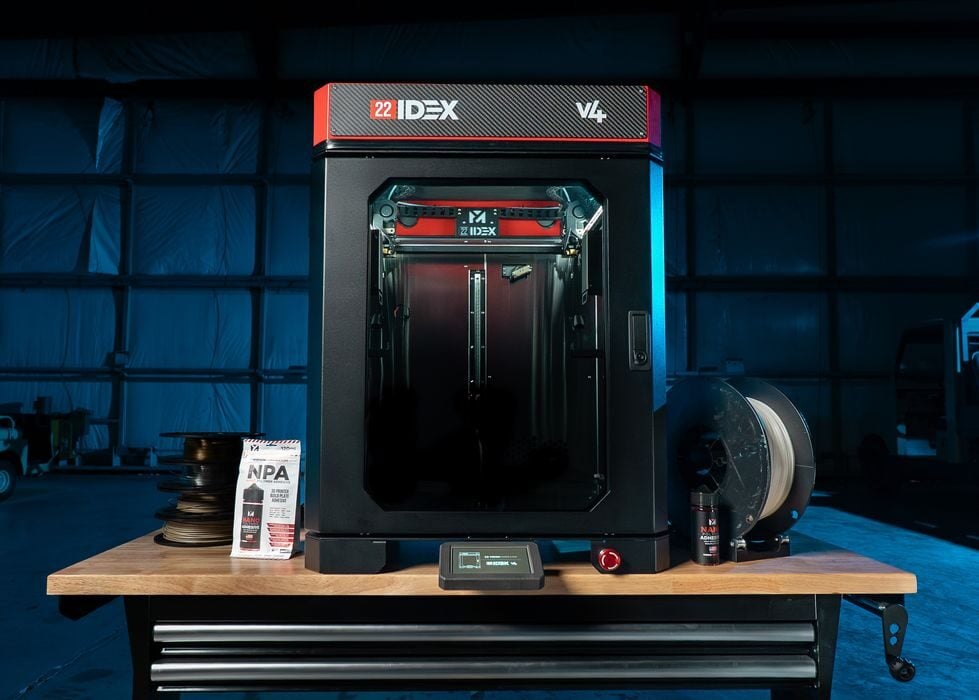
Vision Miner officially introduced the 22 IDEX V4, the newest iteration of its independent dual-extrusion 3D printer.
The device is built for high temperature polymers and continuous production. The system refines nearly five years of experience with industrial use into a more automated, ruggedized platform targeted at manufacturers that need PEEK-class performance without six-figure budgets.
There are competing high temperature systems on the market, but they tend to be much more expensive than Vision Miner’s alternative.
Industrial Performance at an Accessible Price
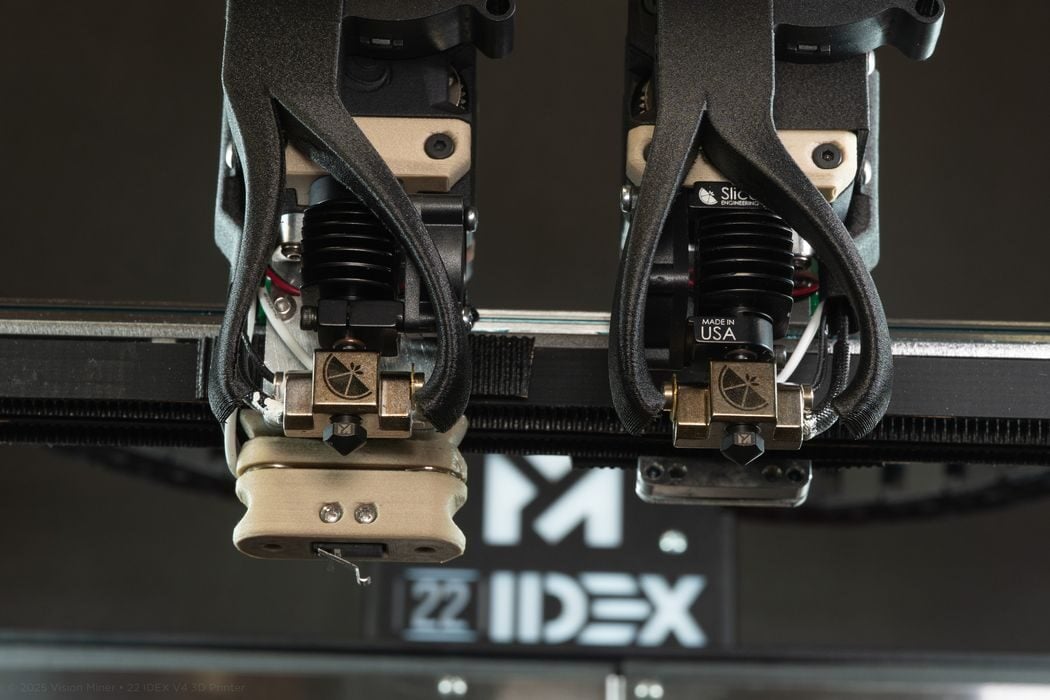
At US$14,900, the 22 IDEX V4 delivers high chamber, bed, and nozzle temperatures: 100C, 200C, and 500C respectively that are similar to far more expensive printers. They say that the V4 is “an oven by design”. Those conditions enable 3D printing of true engineering grade materials including PEEK, PEKK, ULTEM (PEI), PPSU, and carbon fiber composite nylons. Vision Miner said:
“This machine can print virtually ANY thermoplastic filament on the market.”
The V4’s triple wall insulation, welded steel frame, and stainless steel interior retain heat more efficiently, giving operators faster warm up and better dimensional consistency when printing engineering grade polymers. Dual pane door glass and a sealed enclosure stabilize chamber temperature while also improving safety and visibility.
Vision Miner says the V4 has already proven itself across industrial, military, oil & gas, and medical applications. The company’s goal is the same as it was when the company was founded nine years ago: to make high temperature additive manufacturing practical for small businesses while remaining scalable for enterprise fleets.
Refinements Over the V3 Platform
Compared to the long-running V3, the V4 architecture moves to externalized XY motors with advanced Trinamic drivers for higher torque and longevity, achieving travel speeds up to 500mm/s and accelerations to 15,000 mm/s/s. The triple Z motor bed provides mechanical self leveling, while new one-touch calibration routines automatically align both toolheads and tension belts.
Toolhead alignment on IDEX machines is critical, and often challenging on other equipment. The result of these changes is faster setup, reduced operator effort, and greater repeatability between jobs.
Other upgrades include built in HEPA and carbon filtration, automatic safety lockouts, and mounting points for mobile or containerized installations. These were likely developed due to Vision Miner’s growing defense and field-deployment customers, which often require such features. Despite the industrial capability, the printer still runs on standard 110V power and can operate via WiFi, Ethernet, or fully offline for secure facilities.
There are quite a few more minor improvements over the V3 that can be found in the machine specifications.
Production Use
Vision Miner reports that production users have already demonstrated notable cost reductions when switching to the 22 IDEX V4.
In medical manufacturing, parts once milled from US$1000 PEEK blocks now print for roughly US$14 in filament material, eliminating a huge amount of waste material and time. Automotive customers employ the system for carbon fiber nylon tooling and ABS prototype validation with soluble supports, and aerospace workers have reproduced air handling components in PEKK and PPS-CF for legacy aircraft.
These applications suggest Vision Miner’s goal of the system as a daily-use workhorse rather than something for occasional prints.
Automation and Throughput
As an independent dual-extrusion (IDEX) platform, the V4 supports duplication and mirror modes to double throughput or combine functional and soluble materials.
Vision Miner also lists “non-planar readiness” on the 22 IDEX V4, meaning the motion system should be compatible with future slicers driving variable-angle deposition. This is a unique feature I have not heard of on any other 3D printer, and perhaps it should be more widely deployed.
Input shaping and filament runout detection further reduce human babysitting, aligning the system with the industry’s push toward lights out polymer printing.
While similar temperature systems like the AON3D Hylo target massive certified parts and use closed ecosystems, Vision Miner positions the 22 IDEX V4 as an accessible middle ground, offering about 80–90% of that capability at approximately one-fifth the cost.
What to Watch
The company’s claims of “industrial performance without lock-in” will interest 3D printer operators looking to use open materials. Independent verification of throughput, mechanical properties, and long-term reliability will determine how much of the market this model can take from legacy high-temp systems.
Given its Duet based open source electronics and US based support, the V4 could become a favorite among American labs and small manufacturers, particularly those in regulated environments.
If the machine delivers the stability and performance its specifications suggest, it may do more than print PEEK parts — it may normalize high-temperature FFF as standard manufacturing equipment rather than an exotic niche.
If you are a small business manufacturer looking to affordably explore the world of high temperature 3D printed parts, the 22 IDEX V4 might be worth considering.
Via Vision Miner
