
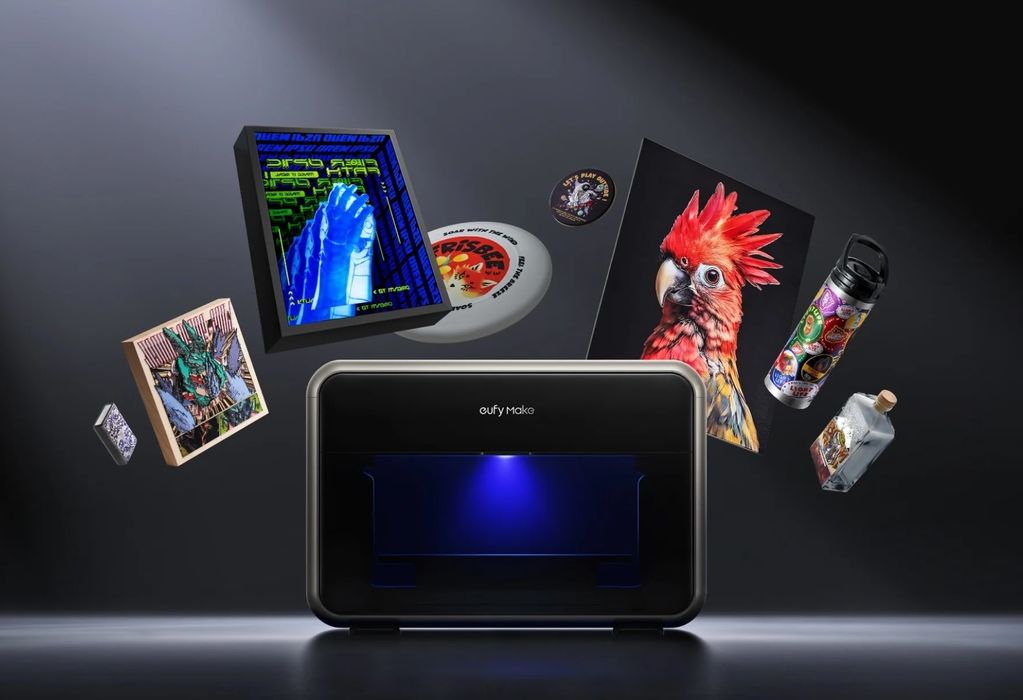
Why are there all these UV printers suddenly on the market? What are they, anyway?
You probably have heard the term “UV printer” lately, and it’s not the same as a 3D printer.
A 3D printer produces a whole 3D object as its output; while a UV printer (generally) produces a 2.5D object on top of another surface. For example, you might use a UV printer to print some colourful elements on top of a piece of wood to create a trophy plaque.
Meanwhile, a resin 3D printer uses photopolymer resin to build an object layer by layer, usually from a vat of resin. The UV printer has a print head that selectively deposits coloured photopolymer ink layer by layer. Both use the photopolymer effect by curing layers with UV light, but in different ways.
There have been UV printers around for quite a while. You might have seen Mimaki’s product line, which is an industrial device that can produce full-colour textured objects. Stratasys’ PolyJet systems are similar and can produce photorealistic objects. PolyJet is a bit different because it prints its own substrate as the first layers, whereas traditional UV printers require a surface.
So what’s changed?
It seems that there has been a bit of a technical perfect storm happening. A number of patents for various parts of the UV process have expired in the last few years, for example. In addition, powerful UV LEDs have appeared, and precision XY motion systems are common.
It is also possible to purchase very high-performance inkjet printheads from companies like Epson. This is the key development: in 2008, desktop 3D printer companies had to wait for 3D printing patents to expire before they could build the device. But now UV printer manufacturers need only buy, say, Epson’s printheads and use them. They don’t need to become Epson; they just use their components.
The availability of high-performance optical systems is also helpful. Traditional UV printers typically required jigs to align the surface so that the UV parts would be printed at the correct locations. Now, with advanced AI optical systems, you just drop in a piece of anything, and the AI will figure out where it is and print on it properly. That vastly simplifies the workflow.
So, we have a convergence of a bunch of technical enablers. Then there is a market signal, too.
Anker took a chance and launched a Kickstarter campaign for their Eufy UV printer. It leveraged their knowledge of 3D printers and consumer product design, producing an inexpensive and capable UV printer.
The Kickstarter was wildly successful, collecting over US$46M in orders.
That is an absolutely huge amount, and triggered a series of copycats that are just now piling in. They’re trying to get a piece of the market before it’s all soaked up. The new players include:
- EufyMake E1
- xTool O1 Omni
- Morpho
- HeyGears G1/G1X
The EufyMake campaign was so successful that they basically changed the company name from AnkerMake to EufyMake and discontinued their 3D printer entirely.
The HeyGears devices are quite interesting because they combine resin 3D printing with UV printing. This means you could attempt to print much larger objects that have full-colour surfaces. They just hit US$10M in orders, and they’re still going. The signal is still strong.
It’s likely there will be a few more players emerging in the next few months in the UV market, and it may be that the UV printer market will sit alongside 3D printing in the future.
