
Some news from Xolo: they want to go into outer space!
The German company is the developer of Xolography, a form of volumetric 3D printing. Volumetric approaches are very different: instead of creating an object layer by layer, the object is built all at once; there are no layers. It’s about the closest thing to a Star Trek replicator that’s currently available. Jobs finish in seconds or minutes, not hours or days.
That sounds magical, and it really is. I’ve seen a Xolo 3D print in person, and it does take only a minute or two to complete printing of a small object.
However, there are some constraints, mainly about the types of possible materials and the size of objects. The build volumes are small for technical reasons.
Recently I’ve seen Xolo swing towards bioprinting as a target market, as the technology is ideal for quickly producing items for biotech applications.
Then I saw this posted by Xolo CEO Dirk Radzinski:
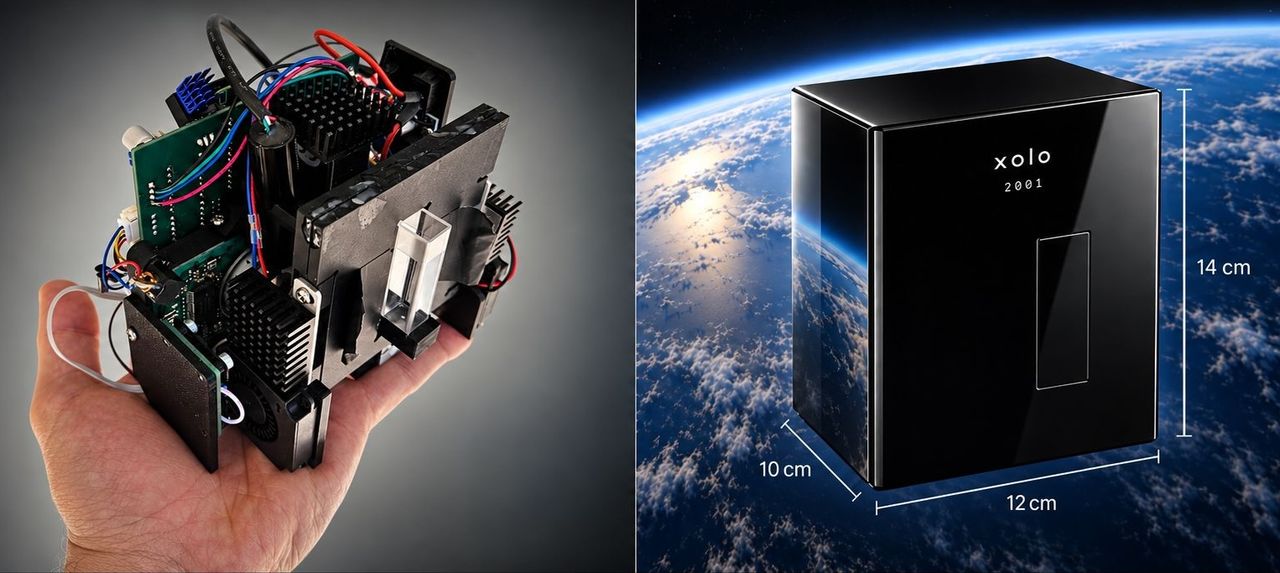
“Davide Marin, our engineer in Italy, took the printer we flew on the 47th DLR parabolic flight campaign, the optical core of our Xell [one of their 3D printer models], and asked how small it could get. On his own initiative, outside any project plan, he rebuilt it into a complete Xolography printer that sits in one hand. 600 g, 14 × 12 × 10 cm.”
You can see an image of this attempt at the top. It’s indeed quite small, and lightweight.
That’s ideal for use in space: small and lightweight. Now they only need an orbital application to make use of this unusual technology.
Radzinski explains:
“Its place is in orbit, on a shelf any scientist can book, printing living tissue constructs in seconds with Xolography. The logistics from lab bench to station are already sketched out, and they are simpler than you would think.”
The company is now reaching out to a number of space companies and organizations to gauge interest. It’s quite possible that a researcher may be able to make good use of this technology in a space-based biotech experiment.
