

Charles R. Goulding and Preeti Sulibhavi connect the dots between SLB, Kelvion, Apollo, AI data centers and 3D printing in a deal that could reshape how critical infrastructure is designed and cooled.
SLB, the global energy technology company formerly known as Schlumberger, is making a major move beyond its traditional oil and gas markets. On August 31, 2026, SLB announced an agreement to acquire Kelvion, a global provider of thermal management and heat-exchange technologies, for approximately US$4.1 billion, consisting of US$3.4 billion in cash and approximately US$700 million of assumed debt. The transaction is expected to close in the first half of 2027.
The deal is significant for the 3D printing industry because it brings together several technologies and industrial capabilities that are increasingly converging: energy engineering, modular manufacturing, advanced thermal management, AI infrastructure and additive manufacturing.
From Schlumberger to SLB
SLB remains one of the world’s largest oilfield technology companies. Its customers include national oil companies, major integrated oil companies and independent operators, and its technologies span exploration, drilling, production, reservoir characterization and digital services. The company was founded in 1926 by Conrad and Marcel Schlumberger and adopted the SLB brand in 2022 as it broadened its identity from a traditional oilfield-services company toward a global energy technology company.
SLB’s 2025 Form 10-K reported US$35.7 billion in revenue and a workforce of approximately 109,000 people. The company operates in more than 100 countries. Its corporate structure is international, with executive offices in Paris, Houston and The Hague, while Houston is commonly identified as the company’s headquarters.
For Fabbaloo readers, SLB’s evolution is particularly interesting because additive manufacturing is already part of that transformation. Our earlier article, “Halliburton, Schlumberger & Baker Hughes: Record Profits Fueled by 3D Printing Innovations”, examined how the major oilfield-service companies were using 3D printing for increasingly sophisticated equipment.
More recently, “SLB and the Future of Energy: Digital Platforms, AI Innovation, and Industrial 3D Printing” looked at SLB’s combination of AI, digital twins, robotics and additive manufacturing. That evolution is now taking the company into a very different industrial environment.
Kelvion Brings the Cooling Technology
Kelvion is a German-based industrial technology company with more than a century of history in thermal management and heat exchange. Its technologies include heat exchangers, cooling systems and related thermal-management equipment serving data centers, energy and industrial markets.
The company’s importance to this transaction is its growing exposure to data centers. SLB says data centers are now Kelvion’s largest and fastest-growing end market. Kelvion is expected to generate approximately US$2.3 billion to US$2.4 billion of revenue in 2026, with data-center revenue expected to reach US$1.2 billion to US$1.3 billion.
Kelvion is privately held, so there is no SEC 10-K providing a comparable 2025 revenue disclosure. Third-party data indicates a 2025 workforce of roughly 4,400 employees, but that figure should be treated as an estimate rather than an audited company disclosure.
The strategic attraction is straightforward. SLB already brings engineering, modular manufacturing, offsite construction and digital capabilities to data-center infrastructure. Kelvion adds sophisticated thermal-management hardware.
Together, the companies expect their combined data-center businesses to generate more than US$2 billion of revenue in 2026. SLB is targeting US$4.5 billion to US$5 billion in data-center revenue and US$700 million to US$800 million of adjusted EBITDA by 2028.
AI Creates a Cooling Problem
The underlying driver is the extraordinary growth of artificial intelligence.
Training and running increasingly powerful AI models requires enormous amounts of computing capacity. That means more GPUs, more servers and more data centers. The problem is that electrical power consumed by those processors ultimately becomes heat.
As we discussed in “3D Printed Copper vs. In-Chip Microfluidics: Which Cooling Technology Will Enable the AI Data Center?”, modern AI racks can exceed 100 kilowatts, pushing conventional air cooling beyond its practical limits. Liquid cooling, advanced cold plates and increasingly sophisticated heat exchangers are becoming essential parts of AI infrastructure.
That creates a major opportunity for companies that understand heat transfer.
It also creates major problems.
Data centers require enormous amounts of electricity, water and physical infrastructure. Communities are increasingly concerned about noise, water consumption, environmental impacts and the possibility that new infrastructure will raise electricity costs for existing customers. In 2026, local opposition has become a genuine constraint on data-center development, with projects being delayed or challenged in multiple U.S. states.
There is therefore a paradox at the center of the AI boom: the world wants more computing, but building the infrastructure required to support it is becoming increasingly difficult.
Cooling technology is one piece of that puzzle.
Why 3D Printing Matters
This is where SLB’s industrial background becomes particularly relevant.
Oil and gas companies have spent decades engineering equipment for extreme temperatures, pressures, corrosive environments and remote locations. Those same engineering disciplines can be valuable when designing equipment for data centers, power infrastructure and emerging energy systems.
Additive manufacturing can accelerate that transition because it allows engineers to redesign equipment rather than simply reproduce conventional components.
Heat exchangers are a particularly promising example. Conventional machining and fabrication can limit internal channels to relatively simple geometries. Metal additive manufacturing can produce complex internal passages, lattices and manifolds that are difficult or impossible to manufacture conventionally. Those geometries can improve heat transfer while potentially reducing material usage and pressure losses.
This is not simply a matter of printing replacement parts. It is about redesigning thermal equipment around the capabilities of additive manufacturing.
SLB’s existing AM experience gives it a useful foundation. Its Aegis technology, for example, uses electron-beam additive manufacturing to create specialized armor for drill bits. SLB has reported substantial improvements in strength and erosion resistance.
From Oil and Gas to Geothermal
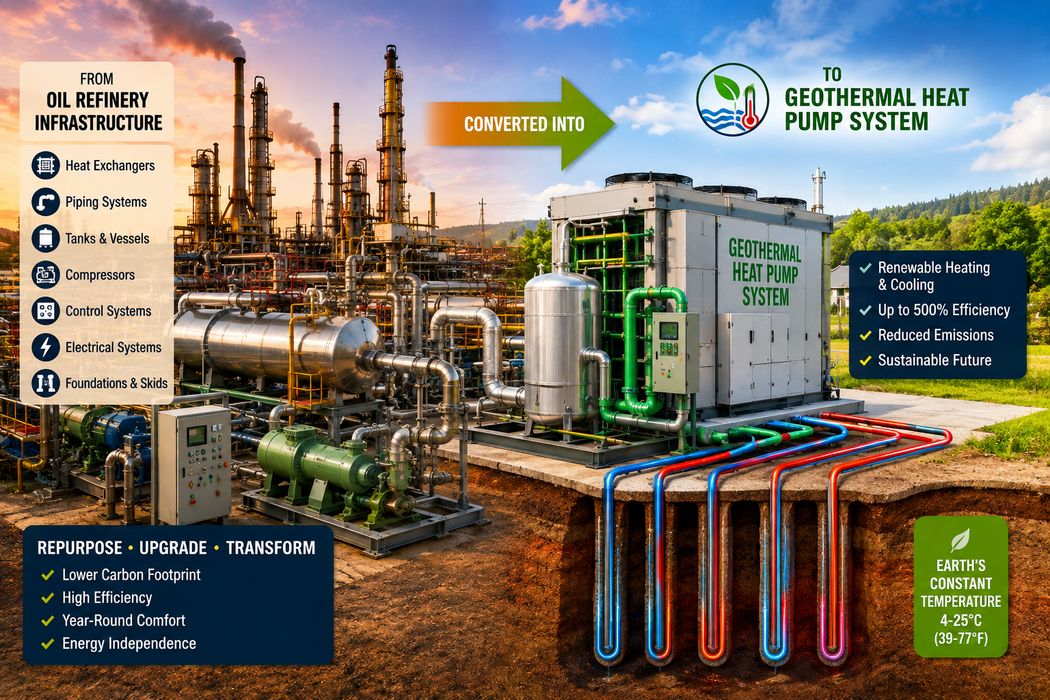
The same transfer of skills is occurring in geothermal energy.
Our article “How Oil & Gas Skills and 3D Printing Are Accelerating Geothermal Power” examined how drilling, completions, reservoir engineering, materials science and project-management expertise developed in oil and gas can be redirected toward geothermal.
The connection is logical. Geothermal projects require drilling deep wells, managing high temperatures, controlling fluids, understanding subsurface geology and manufacturing equipment that survives harsh environments. SLB itself points to its extensive oil-and-gas well-construction experience as a foundation for geothermal development.
Additive manufacturing can support this transition by producing specialized downhole components, high-temperature equipment and compact heat exchangers. The technology becomes a tool for transferring industrial knowledge from one market to another.
That same principle applies to data centers.
This is not a novel concept. Houston-based Fervo Energy uses technology developed by the oil and gas industry to create geothermal energy reservoirs. This power will ultimately be sold to Google.
Apollo’s Role
There is another interesting part of the Kelvion transaction: the seller.
Kelvion was owned primarily by funds managed by Apollo Global Management, with Triton holding a minority interest. Apollo had acquired Kelvion in 2025.
Apollo is one of the world’s largest alternative asset managers, with businesses spanning private equity, credit, infrastructure and retirement services. Its transaction history includes the US$7.1 billion acquisition of automotive supplier Tenneco, the acquisition of Yahoo, an US$11 billion investment for a 49% interest in Intel’s Fab 34 semiconductor manufacturing joint venture in Ireland, and the acquisition of a majority stake in Stream Data Centers.
The Stream transaction is especially relevant here. Apollo has increasingly positioned itself around the enormous infrastructure investment required by AI and data centers. Its Stream platform has a development pipeline exceeding 4 gigawatts.
That makes the Kelvion transaction look less like an isolated private-equity exit and more like another step in the broader financial race to build AI infrastructure.
The Research and Development (R&D) Tax Credit
The SLB-Kelvion combination highlights a practical way companies may generate activities that support federal R&D tax credits. The article describes SLB’s move into AI and data-center infrastructure through Kelvion, a thermal-management company focused on heat exchangers, cooling systems, and related equipment. This matters because AI data centers are creating major cooling challenges, with dense server racks driving demand for liquid cooling, cold plates, and more sophisticated heat exchangers.
For R&D credit purposes, the key is not simply using 3D printing to make parts faster. The stronger opportunity is using additive manufacturing to redesign products or production processes. The article notes that 3D printing can enable heat exchangers with complex internal passages, lattices, and manifolds that are difficult to make conventionally, potentially improving heat transfer while reducing material usage and pressure losses. Those goals align well with IRC §41 concepts because qualified research can involve developing a new or improved product, process, technique, or invention, especially where the work targets improved function, performance, reliability, or quality.
Companies may have qualifying activities when engineers face uncertainty about the best design, materials, geometry, print parameters, or cooling performance, and then test alternatives through modeling, simulation, prototype builds, or trial runs. Checkpoint guidance explains that qualified research generally requires technological uncertainty and a process of experimentation. Prototype or pilot-model costs may also support qualifications when used to evaluate and resolve design uncertainty. SLB’s existing electron-beam additive manufacturing experience may further position it to apply that know-how to new cooling designs.
Below is a table that presents the recent investments in R&D and human capital that SLB has made. It is SLB’s R&D book expense per capita.
| Company | Reporting Year | R&D Book Expense (USD millions) | Human Capital / Employee Count | R&D Book Expense per Employee (USD) |
| SLB (Schlumberger Limited / SLB Limited) | 2025 | 709 | 109,000 | 6,505 |
| SLB (Schlumberger Limited / SLB Limited) | 2024 | 749 | 110,000 | 6,809 |
| SLB (Schlumberger Limited / SLB Limited) | 2023 | 711 | 111,000 | 6,405 |
| SLB (Schlumberger Limited / SLB Limited) | 2022 | 634 | 99,000 | 6,404 |
A New Book About Apollo’s Founder
For readers interested in the financial institution behind the Kelvion transaction, a new book provides an unusually detailed look at Apollo and its controversial founder, Leon Black.
“Money to Burn: The Unvarnished Truth About Leon Black, Apollo, and the Rise of a New Wall Street” is written by William D. Cohan and is scheduled for publication on September 8, 2026 by Portfolio.
Cohan is a veteran Wall Street journalist, former investment banker and bestselling author of books including House of Cards and Power Failure. He was also a longtime special correspondent for Vanity Fair and is a founding partner and Wall Street correspondent for Puck.
The book examines Black’s rise, Apollo’s development and the controversies that ultimately led to Black’s resignation from Apollo in 2021.
For Fabbaloo readers, the connection is fitting. The Kelvion transaction sits at the intersection of finance, industrial technology, energy and AI infrastructure. Apollo helped build Kelvion into a growing thermal-management platform; SLB now plans to combine that platform with its own engineering, manufacturing and digital capabilities.
The result could be more than an oilfield company buying a cooling company. It may be an example of how industrial expertise developed for one technological era is being repurposed for the next one, with additive manufacturing potentially helping bridge the gap.