
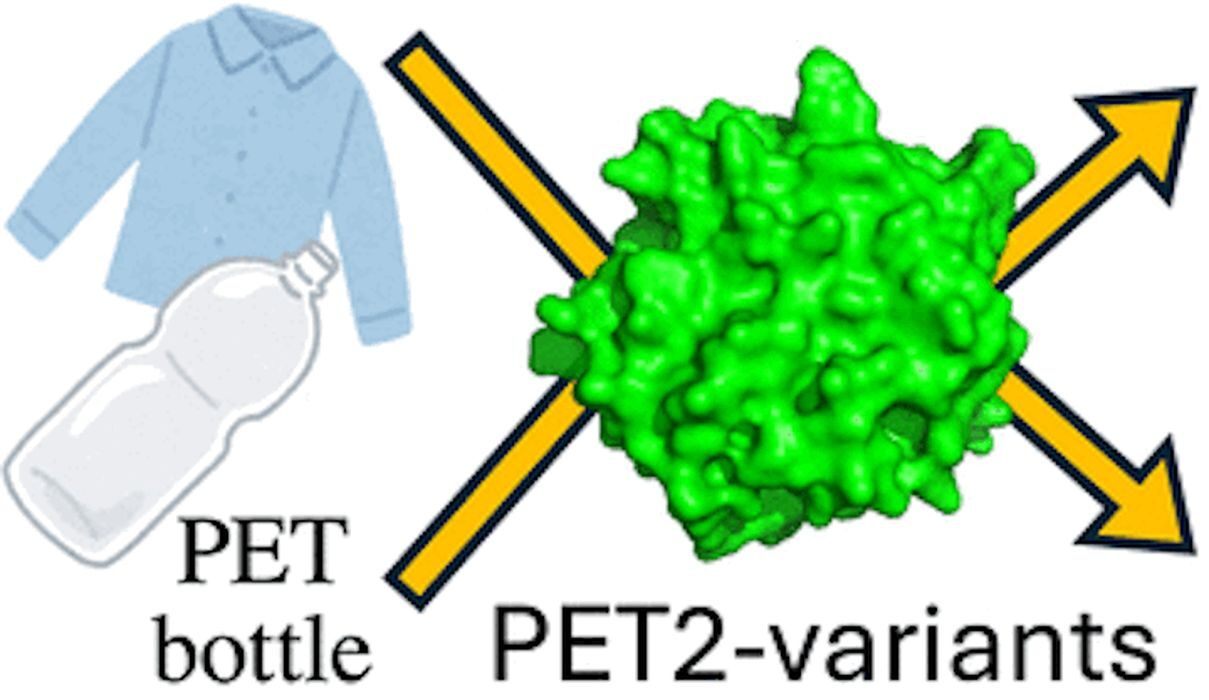
Researchers have developed a unique enzyme that can decompose PET material.
PET is a very common 3D print material, often with the somewhat easier-to-print PETG variant. It has higher thermal resistance than common PLA, and usually looks shinier.
However, like almost all 3D print materials, prints made from PETG are not typically recyclable. While the material can theoretically be ground up, re-extruded, and printed again, this almost always does not happen.
That’s because most 3D printer operators don’t have recycling equipment, which is large and expensive. Recycling centers typically do not accept 3D print waste because they don’t carry a formal recycling mark. As a result, recycled PETG filament is relatively rare and usually more expensive than fresh PETG.
The new development is a special enzyme that can much more easily break down PET material. The researchers developed the enzyme through no less than 14 separate mutations and other adjustments. This resulted in PET2-21M, which is able to decompose PET 28.6X more effectively than typical enzymes available today. It’s able to completely decompose PET material at lower doses and also lower temperatures (60°C).
The decomposition process results in monomers, which can later be recombined into PET material.
How could this affect the 3D print industry? One immediate thought is that it could make the process of chemically recycling PET more cost-effective, leading to new sources of PET for producing recycled filament.
It might also be possible to produce recycling stations for larger operations and makerspaces, where PET print scraps could be tossed into a small reactor for decomposition. The output could then be sent to chemical services for processing, perhaps even sold to them.
There’s one more really interesting feature of this enzyme: it’s selective. It decomposes only PET molecules. This means that you could avoid the sorting problem in PET recycling.
Sorting is an extremely difficult challenge: pickers collect random plastic objects, and it’s really impossible to determine which material makes up a given item. This effectively prevents random recycling material from being used. Instead, existing recycled filament is made only from single sources that guarantee consistent material chemistry (e.g. only Pepsi bottles, or cut-offs from a factory).
The enzyme works only on PET, so it would be possible to toss all the collected items into a reactor, and only the PET would be decomposed. The resulting monomers could then be extracted for further processing.
This is an incredible step forward. The researchers specifically designed an enzyme for a particular material, and it seems to work. This might open the way for enzymes to be developed that work on other 3D printed materials in the future.
Imagine that reactor with the random recycled materials: you could apply these different enzymes in sequence to pull out each material, leaving only a small residue of non-recyclable material. This could eventually be how recycling is done in the distant future.
Via ACS
