
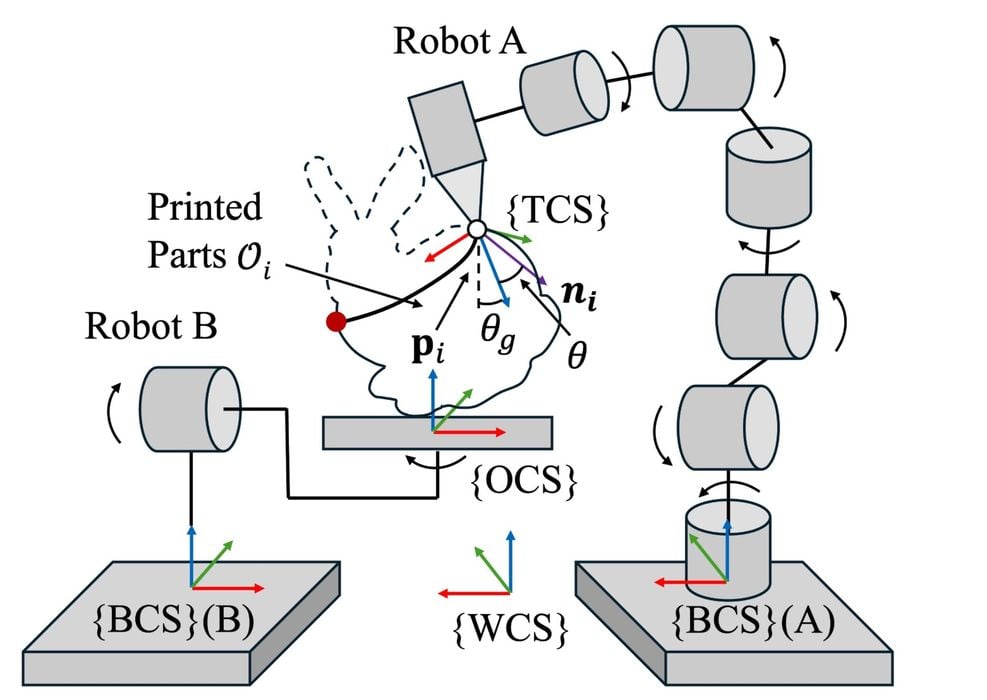
A new robotic AM optimization method tries to keep complex multi axis prints smooth, accurate and collision free.
The research, described in a preprint by Zhikai Shen and six coauthors, looks a complex problem in robotic additive manufacturing: a toolpath that looks perfectly valid in a slicer can become troublesome once a real robot, nozzle, workpiece and evolving print geometry try to execute it.
Multi axis additive manufacturing, or MAAM, is highly desirable because the part or deposition head can change orientation during fabrication. That can enable conformal deposition along surfaces and also support free structures that would be challenging or impossible on a conventional fixed axis FFF system. But it also creates a much bigger motion planning problem.
An eight degree of freedom robot has redundant motion. It can often place the nozzle at the same required deposition point through several different axial configurations. The best choice is not merely one that reaches the required position, but one that avoids hitting the part, maintains nozzle orientation, and does not make violent movements across a long toolpath.
Keeping The Nozzle On Path
The researchers create nozzle to workpiece motion using a relative Jacobian, then use a signed distance field, or SDF, to model collisions. Their collision model changes as fabrication proceeds, because the printed object itself becomes an obstacle with each deposited region.
In many planning demonstrations, collision checking is performed against a static scene. A robotic print, however, progressively fills its own build volume, changing shape all the time. The robot may have clearance at the start of a path and no clearance later.
The proposed approach treats deposition position as a hard equality constraint at each waypoint. It iteratively projects robot configurations onto the allowable self motion manifold, while restricting the optimization gradient to the tangent space of that manifold. In other words, the software seeks a better robot posture without allowing the nozzle to drift away from where material must be deposited.
The paper reports tests on an eight DOF MAAM platform with long horizon support free and conformal paths. The optimized trajectories maintained mean nozzle position error below 10 µm, eliminated sampled collision and orientation violations, and reduced maximum joint jerk by as much as 77.6 percent.
Fast Planning Could Be The Practical Prize
There is also a reported speed advantage. Against a sequential quadratic programming, or SQP, baseline, the method achieved up to a 10.2x speedup and improved convergence. For a short demonstration part that may not sound like a big deal, but planning time becomes a real operational issue when a robot must process a large and lengthy industrial toolpath or when operators are repeatedly testing fixtures or testing deposition strategies.
Lower joint jerk is potentially just as important. Robotic extrusion or wire deposition is sensitive to abrupt motion changes. Smoother trajectories can reduce mechanical stress and may reduce the visible deposition artifacts the authors observed in their physical fabrication trials.
This is a very interesting move because it addresses a problem in AM automation. A robot arm can provide a huge reachable envelope and flexible orientation, but its throughput depends on planning software that does not turn every complex part into a truckload of GCODE.
Integration will be a harder task. Production deployments need robust calibration between robot, tool center point and workpiece; dependable sensing of real deposited geometry; controller compatibility; and a workflow that connects slicing, simulation and robot execution. Thermal distortion and extrusion variation can make an ideal digital SDF diverge from the physical part.
Commercialization aside, this is an interesting study. Multi axis AM will not become routine simply by adding more robot joints; it also needs software optimization capable of producing fast and safe toolpaths.
Via arXiv
