
There are multiple difficult barriers to effective 3D print recycling.
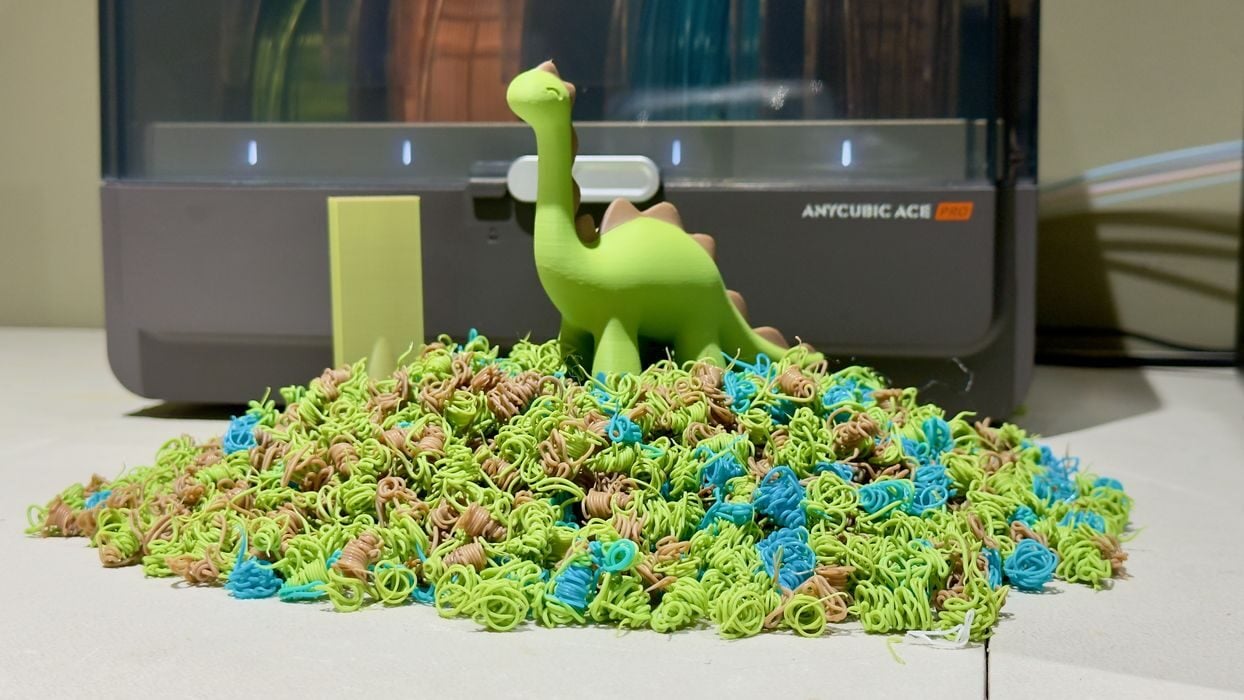
With the increasing use of “AMS-style” multicolor 3D printing, many 3D printer operators find themselves awash in mountains of 3D printer “poop”.
Poop is the waste material generated when a desktop FFF 3D printer flushes material during colour switchover. In many cases, there can be 10x as much poop as material used in the actual printed model.
The presence of all this waste material has caused most 3D printer operators to wonder whether there is a way to recycle this material. Aside from simply melting it into blocks and building a shed with them, what’s stopping a proper recycling program from being launched? Why can’t 3D printer poop be easily reused?
There are many reasons, and let’s go through the major issues:
Mixed Plastics: Operators often use different filament types (PLA, ABS, PETG, TPU), which can’t be recycled together.
Impurities: Failed prints often have embedded contaminants (glue, supports, dust, paint, adhesives, etc.) that interfere with recycling.
Additives: Many filaments include colourants, metal flakes, carbon fibre, or glow-in-the-dark agents that complicate reprocessing.
Irregular Pieces: Waste is often small, brittle, or oddly shaped, making it hard to handle and grind efficiently. While poop is mostly the same, support structures, failed prints, and other scraps are not.
Thermal Degradation: Plastics like PLA often degrade when repeatedly heated, reducing their mechanical performance upon reuse.
Moisture Absorption: Hygroscopic materials like nylon or PLA may degrade further if stored or handled improperly. Do you dry your poop?
No Municipal Acceptance: Most curbside recycling programs do not accept 3D printing plastics—especially PLA, which behaves differently from PET or HDPE. Anything without an official recycling mark is simply tossed in the landfill.
Few 3D Print Recycling Programs: There are very few dedicated collection/recycling services for 3D printing waste due to the technical and financial challenges.
Specialized Equipment Required: Recycling requires a grinder, extruder, and spooler, which are expensive and technical to operate.
Low Yield: Recycled filament often suffers from poor quality unless carefully processed and mixed with virgin material.
Cheaper To Buy New: Freshly made filament is relatively inexpensive, reducing the incentive to invest in recycling tools. In most cases, recycled filament costs more than fresh filament.
Time and Labor Intensive: Cleaning, sorting, grinding, drying, and respooling filament at home is slow and inconvenient.
Are there more challenges? Probably, but this list is so long that it is pretty clear we’re not going to see any form of mass recycling for 3D print waste any time soon.
While the AMS-style systems are quite popular today, it may be that in the near future, sentiment will change as the amount of waste becomes more known. If the cost of toolchanger 3D printers reduces in the future, we might see a shift towards them to stop wasting so much material.
