
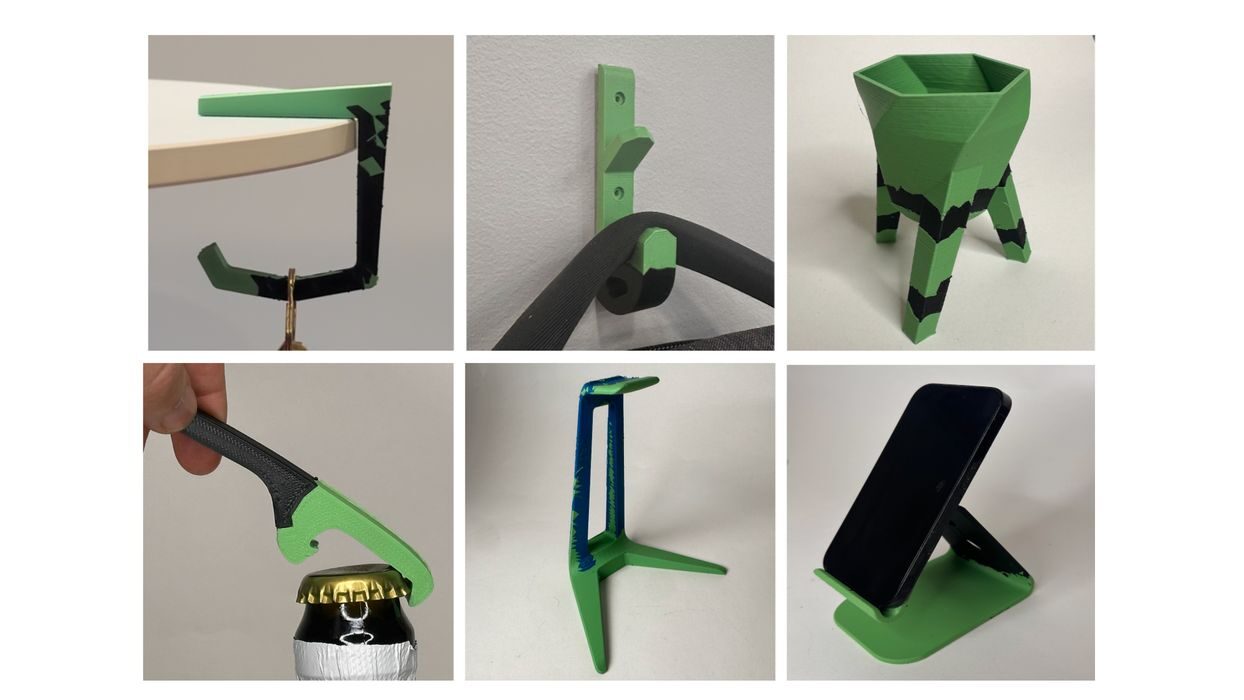
MIT researchers have developed a new system called “SustainaPrint” that increases the use of sustainable materials.
The design and production of 3D printed parts usually have a common goal: strength, sufficient for the intended application.
This is currently accomplished in two ways. First, the geometry of the part is designed to ensure the forces on the part can be handled. Secondly, the material the part is made from is sufficiently strong in that geometry to handle the loads.
Often mechanical parts use engineering-grade materials to achieve the required strengths. Unfortunately, most of these materials are made from petroleum products and are therefore not considered sustainable.
Is there a way to reduce the amount of non-sustainable material used in these prints? That’s the question answered by the MIT researchers.
Their concept was simple: print parts in two materials. The majority would be a sustainable but weaker material, and a minority would be a stronger, non-sustainable material. Printing in two materials is straightforward on many of today’s 3D printers.
However, the big unknown was to identify where these materials would be allocated in a part. That was solved by the development of SustainaPrint, a new software tool that provides an answer for a given part.
SustainaPrint examines a part’s mechanical performance through a force simulation. This identifies the areas that require more reinforcement, and are best made with stronger materials.
In their experiments, they printed parts in both PLA and Tough PLA, which is less sustainable. To ensure proper bonding between the two materials in the part, they made use of UltiMaker Cura’s interlocking interface structures. This slicing feature creates “teeth” of each material that fit together, making inter-material bonding far stronger.
Here’s the workflow:
- Load model: define loads (supports & force direction) in the UI.
- Run FEA: weak-filament properties drive the stress field.
- Pick eco%: slider targets how much of the model stays eco.
- Export two STLs: “strong” and “eco” regions.
- Slice for dual-material: enable Cura’s interlocking interface; optional uniform outer shell for looks; island removal to cut tiny swaps.
Does this approach work? They found that in the set of test parts they examined, the average strength increase over the weaker mono-material equivalent parts was about 22%. However, in some cases (a table hook), they found the strength increased 78%.
They found that the typical volume split between the two materials was about 80% sustainable and 20% not.
There is a cost to this process, however. The print times and material usage are a bit higher than simply printing in one material.
This is a fascinating way to optimize 3D prints, and could be used in theory with any pair of different materials. The team has developed a “DIY kit” where this technology can be integrated into other projects.
Apparently, the software is planned to be released in open source form. However, as of this writing, it has not yet been made public.
If and when it does go open source, then it’s highly likely the major open source slicer software teams will attempt to integrate SustainaPrint into their tools.
