
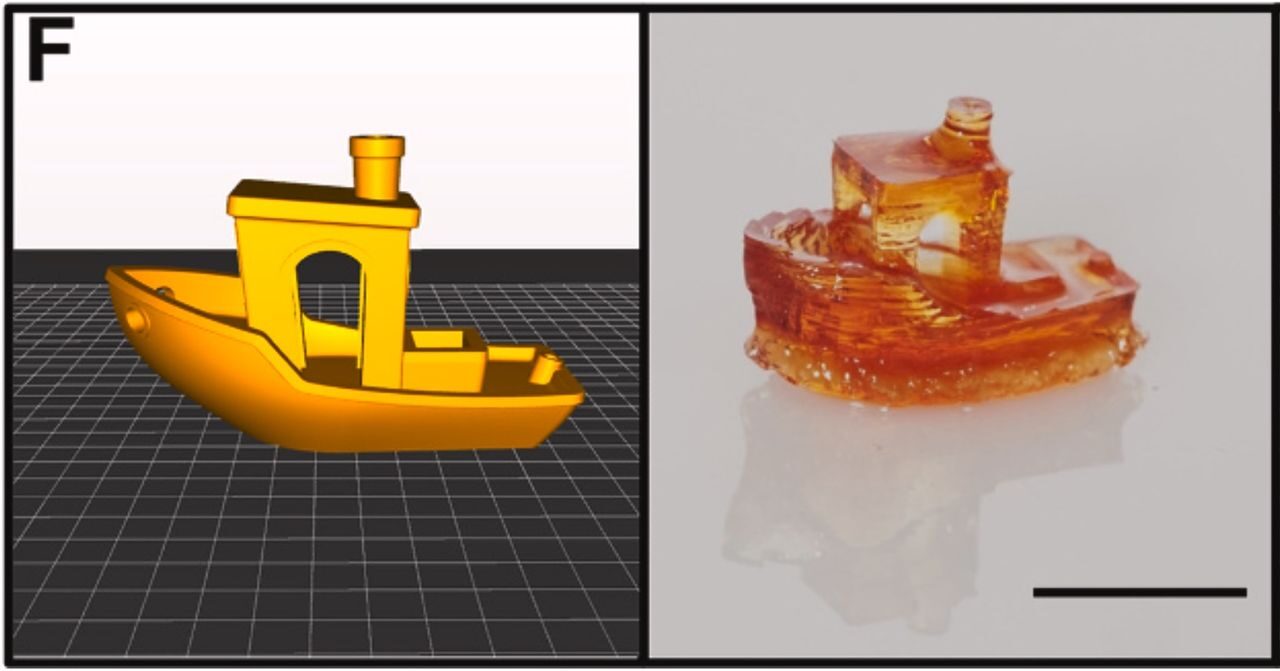
Researchers have developed an entirely new way to 3D print pure glass.
Current methods of printing glass take two forms.
The first is to simply have an extraordinarily hot nozzle melt glass and extrude it. This works very well, but produces relatively coarse extrusion lines. It also requires extreme heat and energy, and so it hasn’t really caught on.
The other approach is to use the typical photopolymer resin process. However, the resin will have a high ratio of fine glass dust mixed in. Prints will be a mix of thermoset polymer and glass bits. In post processing the prints first undergo debinding to remove the polymer, and then a sintering step to fuse the remaining glass particles together. This still requires extreme heat.
The new process is entirely different, and uses something called “sol-gel” chemistry.
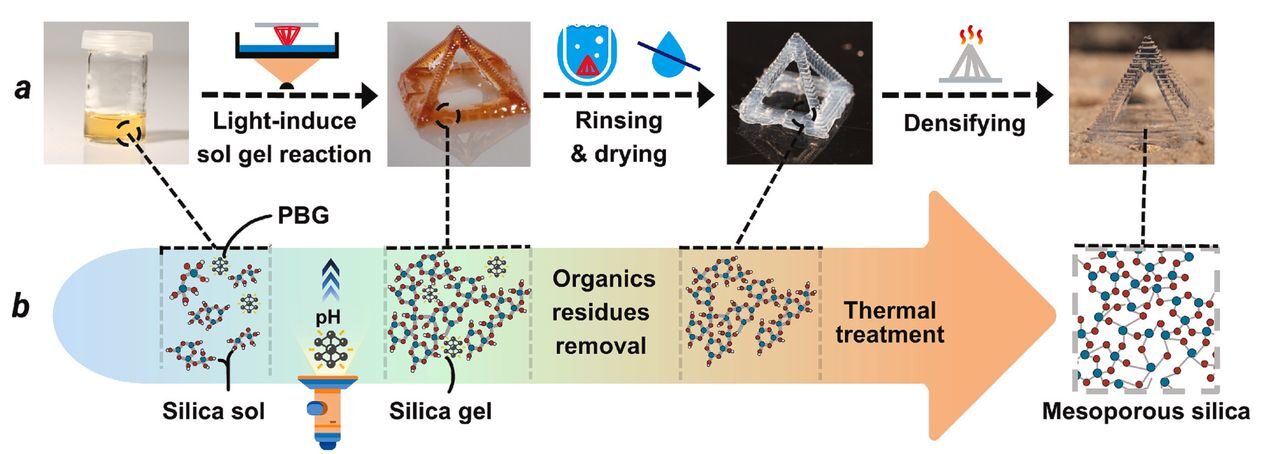
The process starts with tetraethyl orthosilicate (TEOS), a sol-gel industrial precursor used since the 1930s. It’s produced by reacting silicon tetrachloride or silica + ethanol in the presence of catalysts, and has been used to make glass coatings, aerogels and ceramics.
TEOS is essentially a stable liquid, molecular form of silica — melted glass in a bottle.
Now for the printing process. Here’s how it works:
- The TEOS is mixed with a careful ratio of ethanol and water. This step takes many hours, and results in fully hydrolyzed TEOS.
- Hydrolized TEOS is molecularly ready to bond together, and it just needs a trigger.
- N-methyl nifedipine (MN-PBG) is added to the solution.
- When a UV laser hits the MN-PBG, it releases hydroxide ions, raising the pH of the surrounding area.
- The higher Ph accelerates the condensation of the silica molecules, causing them to fuse.
At this point you have a solid silica gel!
By using a standard layer by layer 3D printing process, it is then possible to produce a solid 3D object made from silica gel. In fact, the researchers used a stock Asiga Max 385nm desktop resin 3D printer for their experiments.
But it’s still a gel at that stage. The next step is rinse the object in ethanol, which removes any leftover MN-PBG. This leaves only silica gel. The object is then dried at 250C, far lower than the temperatures required by other glass 3D printing processes. The final step is a low-temperature vacuum treatment, which causes the gel to densify into silica.
The resulting objects produced were chemically pure silica, however it was not fully dense as that would indeed require the much higher temperatures. They produced mesoporous silica, which is a sponge-like glassy network with nanometer-scale voids around 4-8nm in diameter.
This yet-unnamed process produces pure glass that is optically translucent — not perfectly clear. It would be possible to introduce a further post processing step to transform them into optically clear glass if required.
While not optically clear, there are tons of potential applications for this. These could include absorbent sensors, biocompatible scaffolds for bioprinting, microfluidic chips, catalyst substrates able to withstand high temperatures, optical diffusers and filters, and more.
Just when you think all 3D printing processes have been invented, someone finds another one.
Via Science Direct
