
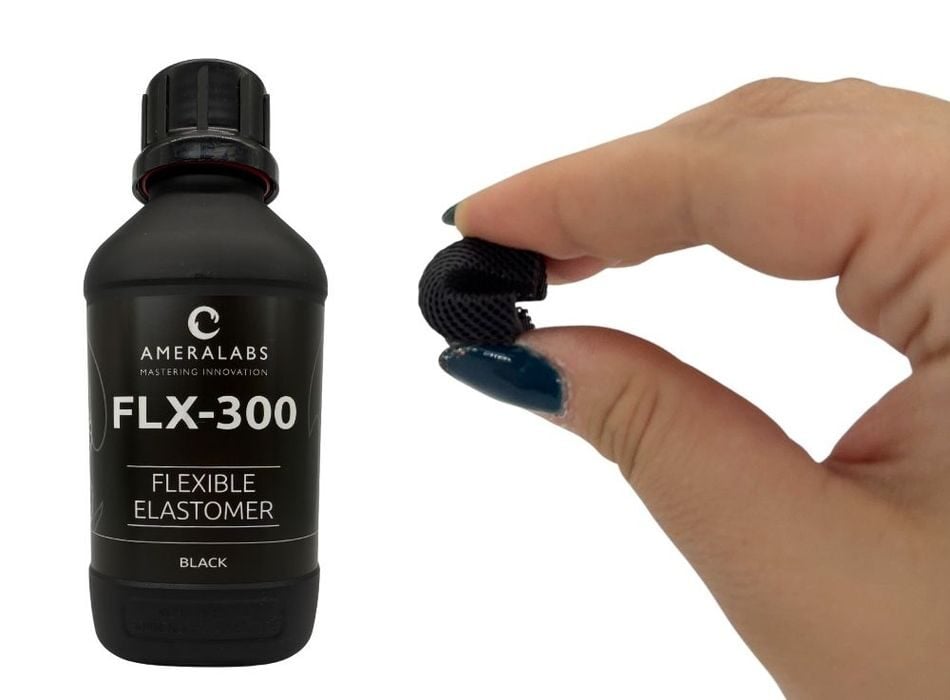
Ameralabs announced a new 3D printer resin with an unusual property.
The Lithuanian company has been producing advanced resins for many years. Today they offer a wide range of resins for 3D printing miniatures, dental applications and general engineering projects.
There are many types of resin, but one that is often used in engineering projects are flexible resins. These materials cure into soft structures that can bend and stretch, and are highly useful for certain applications.
But there’s always been a problem with printing flexible resins.
Today’s resin 3D printers use UV light to cure the resin during printing. In order to achieve good print speeds, the minimum amount of UV light is used to generate the object’s structure. After printing, an exposure to additional UV light in a curing station typically hardens the print to its final state.
However, most 3D printed objects are used in real life and are therefore exposed to UV light on an ongoing basis: that sunlight coming through the window is going to hit the print. When this sun-sourced UV light arrives at the molecules in the print, more curing takes place.
For rigid materials this is not that big of an issue: the rigid object gets a bit more rigid. In extreme cases you might see cracking appear, but that has largely been solved by resin manufacturers.
On the other hand, flexible resins also continue to cure through this method, and when they get harder, flexibility is lost. In other words, flexible resin prints tend to not functionally last very long if they are exposed to sunlight.
Enter Ameralabs new FLX-300 flexible elastomer resin. This is a very soft flexible resin, but Ameralabs has designed it to maintain its original softness. They explain:
“Unlike typical flexible resins that gradually harden after printing, FLX-300 maintains consistent flexibility and surface hardness over extended periods. Internal testing shows printed parts maintained both flexibility and hardness after three months with no measurable degradation, making it suitable for long-term use in demanding applications.“
In addition, the silicone-like material has a number of other useful properties, including terrific mechanical performance and low water absorption. It is usable on virtually any LCD or DLP 3D printer.
The implication of this material is that you can now consider printing flexible objects in resin for production end-use parts. Previous flexible materials allowed only temporary prototypes before they would expire. That’s a huge change that could open up all kinds of interesting flexible applications.
Ameralabs is selling FX-300 on their own site at €120 (US$140) per 1kg bottle, with discounts for larger volumes. In addition, they operate a network of resellers worldwide that carry FX-300 along with their other resins.
Via Ameralabs
