
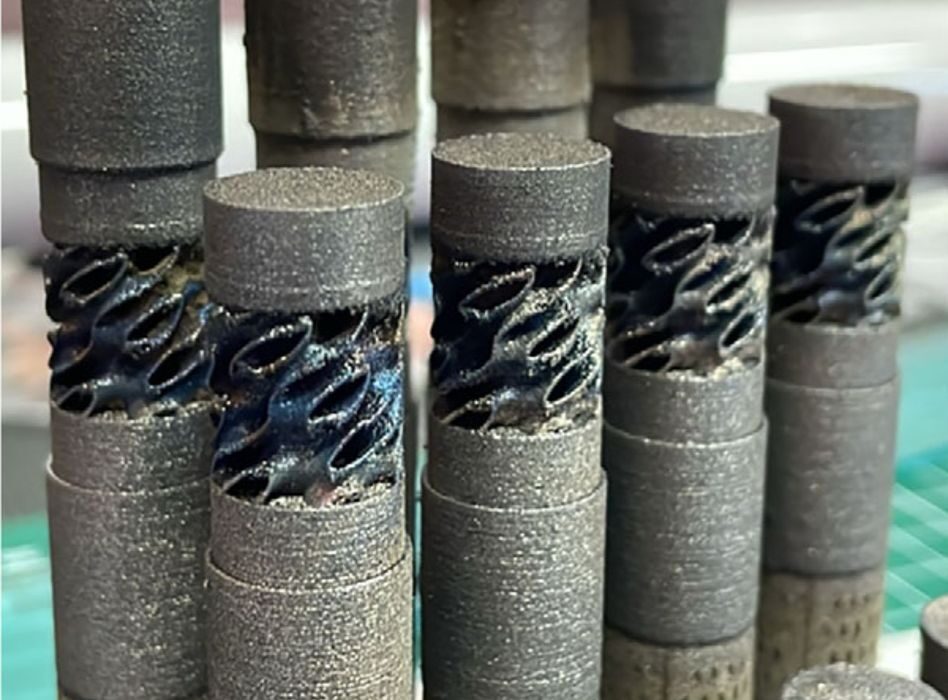
A new 3D print application has been developed by researchers: crash protection.
Researchers at the University of Nottingham have demonstrated a new class of twisting metamaterials that literally adapt their mechanical behavior on demand. The idea: 3D printed lattices that rotate as they compress — a mechanical coupling known as micropolar elasticity — giving designers a tunable response to impact or load.
In conventional lattices, compression just means squish. Here, each cell in the structure is pre-twisted, so pushing straight down induces a torsional rotation. The team’s “torque ratio” parameter controls how much rotation is allowed:
- Lock it for maximum stiffness and energy absorption,
- Free it to soften the blow,
- Or over-rotate to dissipate even more energy.
This mechanical dial transforms one material design into a whole family of behaviors. Under test, simply changing the boundary torque changed stiffness by 25%, collapse stress by 7%, and specific energy absorption by almost 40%.
3D printed specimens were produced in FE7131 steel with gyroid-like geometry. Micro-CT scans revealed partially trapped powders inside, but those didn’t meaningfully alter performance. The real-world crush tests matched their “ideal” CAD models remarkably well, which is encouraging for digital design workflows.
What’s intriguing isn’t the numbers — 15 J/g specific energy absorption, for example — but how they can be tuned. Instead of redesigning or re-printing a bumper, drone frame, or helmet insert, you could just change its rotational constraint in real time. Imagine an automotive crash system that locks up for a high-speed collision but stays soft for parking bumps, or a drone landing gear that stiffens mid-fall using a magnetic brake.
The researchers even suggest coupling these structures to flywheels or regenerative brakes to recover energy during deformation — a literal twist on energy harvesting.
This work hints at a coming shift where mechanical metamaterials stop being static “smart materials” and become dynamic mechanical systems. With additive manufacturing designers can already make these architectures; now the control logic might come from sensors or AI predicting what’s about to happen.
The future of manufacturing isn’t just printing shapes — it’s printing behaviors.
