
A newly published Chinese patent proposes an unusually elaborate way to protect an FFF 3D printer nozzle when the machine is idle.
Patent application CN122343546A was filed by Suzhou Zhisheng Model Technology Co., Ltd. and published on July 7, 2026. It describes a 3D printer equipped with an automatically retracting nozzle shield, along with a rotating nozzle intended to improve extrusion consistency.
The basic problem they are solving is real: An exposed nozzle can collect dust, suffer accidental impacts, or be coated with burned-out polymer. A protective cover could reduce those risks, particularly on machines operating in workshops, schools, or other less controlled environments.
But a fixed cover cannot surround the nozzle while printing. It could interfere with deposition, collide with printed features, or just reduce visibility around the toolhead. A powered door would solve that problem but would require another actuator and control system.
This patent attempts to avoid that extra motor.
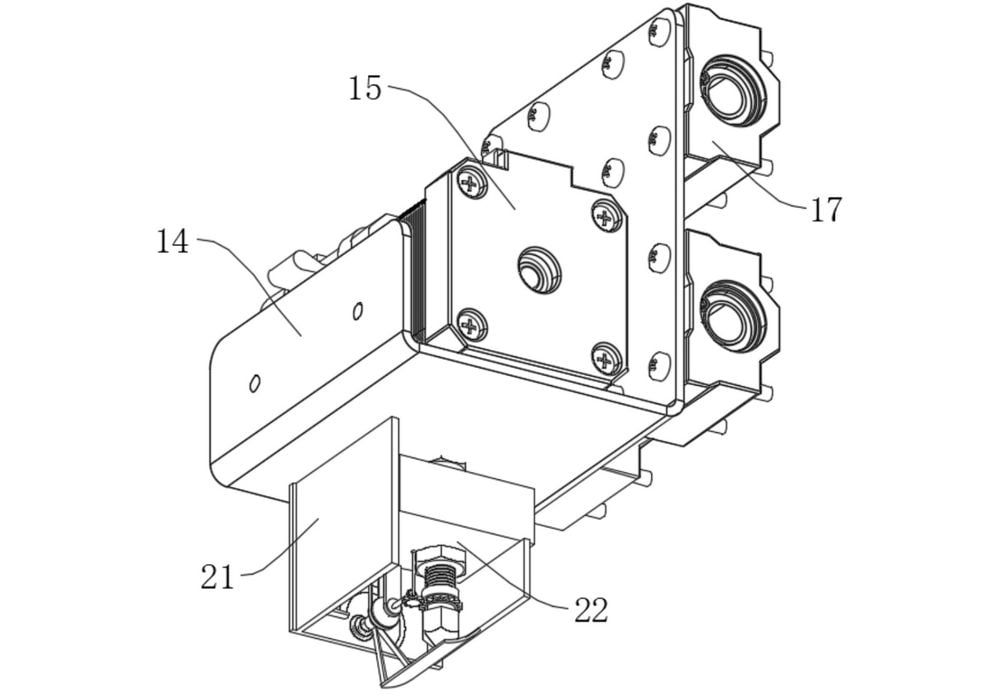
When the extruder drive operates, a belt and pulley mechanism converts some of its rotation into reciprocating motion. This drives a small piston assembly connected through a tube to a curved expandable chamber near the nozzle guard.
Repeated piston movement gradually removes air from that chamber, causing it to contract and pull the curved protective plate away from the nozzle. A valve arrangement limits how quickly air can return, keeping the guard retracted while extrusion continues.
When the extruder stops, air slowly re-enters the mechanism. A torsion spring then rotates the guard back over the nozzle.
In other words, extrusion activity itself opens the cover through air pressure. Stopping extrusion eventually closes it as air pressure drops.
That seems pretty clever, but what happens during normal retractions, travel moves, or especially when paused?
The patent suggests the pneumatic system retains enough vacuum to prevent the shield from immediately returning whenever the extruder briefly stops. However, no timing data is provided. What happens when the job stops and waits two hours for the operator to swap spools? The delay would have to remain reliable across temperature changes, seal wear, and manufacturing tolerances.
There is another feature in this patent that might be even more unusual.
The same transmission system drives gears surrounding the nozzle, causing the nozzle itself to rotate. Spiral grooves inside the nozzle are intended to move molten polymer downward as it turns. The patent claims this combination of rotation and helical channels can produce faster, more uniform extrusion.
I am a bit skeptical of this concept because rotating a hot nozzle is not trivial.
The design would need to prevent molten polymer from leaking around the rotating interface. Gears, bearings, and seals would operate close to the heater, while the entire mechanism would add mass and complexity to the moving toolhead. And how would you possibly fix this when it breaks?
The drawings show a relatively conventional open-frame Cartesian printer carrying a surprisingly complicated extruder assembly. That creates another concern: the protection system could become more troublesome than the nozzle contamination it is intended to prevent.
This is a rather strange patent that doesn’t seem to be practical — or even necessary. Why do companies patent such ideas?
Via Espacenet
