
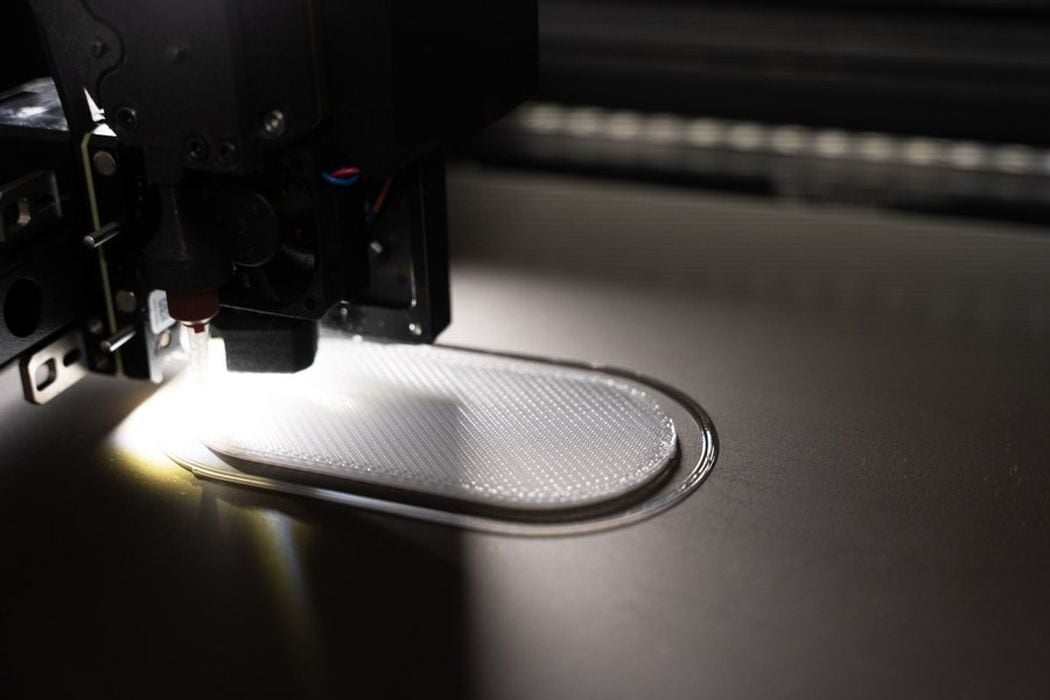
Prusa Research announced a new silicone 3D printing feature, but I wonder whether it will catch on.
Prusa Research did not invent the technology, but instead smartly partnered with an Israeli startup company, Filament 2. We had a good look at them last year to understand their technology, which effectively allows FFF equipment to print silicone objects.
How do they do that? It’s pretty ingenious: the “filament” is actually a hollow tube. Inside the hollow are two separated materials, which, when mixed, form flexible silicone. As the “filament” approaches the hot end, it is split open — the tube portion slides away, while the contents proceeds into the hot end for printing. The two materials mix, and voila, you have silicone coming out of the nozzle.
After printing you have a true silicone object, but also an empty tube that used to hold the two materials.
It’s a fascinating technology that can be used to print all kinds of paste materials, and, as you’ve heard, two part materials. Silicone is just one of the possibilities, although it’s likely the most useful.
Printing Filament 2 materials requires modifications to the toolhead, as the tube must be stripped off. In order for any FFF 3D printer to do so, you need a tweaked extruder. That’s precisely what Prusa Research has done as part of this partnership. They’ve introduced a new optional toolhead, the “Silicone Printing Toolhead”.
The toolhead is designed to be a plug-and-play option for their large XL 3D printer, which, by the way, is able to hold up to five toolheads. This introduces some interesting possibilities. Prusa Research explains:
“For the first time ever, you can combine traditional FDM printing with real silicone printing, all at the same time, in a single part. Or, load up your XL with five of these new toolheads and print a single object with different two-part silicones, each with a completely different shore hardness. This is something that was never remotely possible on a desktop machine before.”
Powerful indeed. But I wonder how successful this approach will be, even if it works perfectly.
There are two concerns.
First is the price. The price listed on Prusa Research’s store is US$1,009 per toolhead. That is quite expensive for a toolhead, and in fact more than the cost of entire FFF 3D printers. Two installed in a 5-tool XL system would likely push the cost of the platform to something around US$4600.
We don’t know that price, and we also don’t know the price of the material. The amount of material on a spool is unknown, but likely far less than the amount of PLA you’d find on a 1kg spool of normal filament.
The second problem is simply interest. Who is going to be printing silicone? I am sure there will be some businesses that would love to be able to print silicone items at that price point, but how many of them will there be?
The reason I’m concerned is that there have been several silicone 3D printer ventures in the past, and most of them fizzled out. Part of the reason for their troubles is no doubt higher costs — but Prusa Research’s will be lower.
Another reason is utility: are potential silicone customers actually aware of the possibilities? Do they need education on the new technology? How do you reach them? Would they even be interested in listening to the silicone story?
Those companies had trouble growing, so will Prusa Research experience that too?
Regardless, for Prusa Research this is a good move, as it provides another area they can sell into where there are few competitors, at least at the moment.
Via Prusa Research and Filament 2
