Charles R. Goulding and Andressa Bonafe highlight how TNC’s AI-driven Nuclear Operating System and Nucor’s certified steel supply could finally bring 3D printing to scale in nuclear energy.
In September 2025, The Nuclear Company (TNC) announced a strategic partnership with Nucor Corporation, the leading U.S. steel producer, to fortify the domestic supply chain for future nuclear infrastructure. Founded in 2023, TNC positions itself as a fleet-scale deployment and integration firm capable of managing the full lifecycle of gigawatt-scale builds across the country. With the goal of modernizing the deployment of nuclear power plants, it pairs proven reactor designs with digital innovation and a “design-once, build-many” approach to compress schedules, lower costs, and deliver safe baseload power.
The partnership focuses on locking in a reliable, certified steel backbone for upcoming reactor projects by evaluating and securing nuclear-grade steels and related infrastructure under stringent quality frameworks, while coordinating closely with manufacturing timelines. In practice, that means joint work on specialized grades plus tighter integration between steel production and nuclear construction schedules. The aim is straightforward: reduce bottlenecks, keep costs in check, and prevent the delays that arise when critical components must be sourced from fragmented or uncertain suppliers. It ultimately anchors more production at home and de-risks project delivery.
As we noted in our earlier Fabbaloo article, “From Scrap to Scale: How Nucor Turns Recycled Metal into Industry Gold,” Nucor’s vertically integrated model and relentless pursuit of efficiency position it well to extend its innovation culture into nuclear manufacturing, linking sustainable steel production with next-generation energy infrastructure.
This move is set against a broader policy and market backdrop. In 2025, with energy demand surging (driven in part by AI data centers) and the U.S. seeking to regain footing in large infrastructure, the federal government has emphasized nuclear power as a strategic asset. Executive orders in May 2025 directed the Nuclear Regulatory Commission to streamline regulations, fast-track new reactor licenses, and support nuclear deployment.
TNC Innovation: Bridging Research and Real-World Deployment Beyond its industrial alliances, The Nuclear Company has been building an R&D ecosystem that links advanced research to practical deployment. In 2025, TNC launched a partnership with the University of South Carolina to co-develop digital twin models, advanced manufacturing techniques, and new materials for next-generation nuclear construction. The collaboration aims to bridge academic innovation and commercial execution, ensuring that new reactor projects are supported by real-time data, simulation-based validation, and cutting-edge fabrication capabilities.
At the center of TNC innovation efforts is the Nuclear Operating System (NOS), an AI-driven platform co-developed with Palantir Technologies to orchestrate nuclear construction from design to completion. Built on Palantir’s Foundry infrastructure, NOS integrates scheduling, supply chain management, documentation, sensor data, and quality assurance into a single, real-time environment. Backed by a US$100 million commitment from TNC, it aims to keep large-scale projects on schedule and on budget by making the entire process visible, predictive, and auditable. Media reports highlight its potential role in preventing delays, automating regulatory workflows, and creating a unified data architecture across complex, multi-party projects.
Crucially, NOS aligns with the Nucor partnership by providing the digital layer that complements physical supply-chain resilience. While Nucor ensures access to certified nuclear-grade steel, NOS ensures that it is tracked, verified, and scheduled with precision. Together, the two initiatives create a closed loop of material and data integration: Nucor handles the tangible production backbone, while NOS synchronizes logistics, engineering inputs, and documentation in real time. In a sector where a misplaced shipment or delayed inspection can ripple through months of construction, this pairing of steel and software represents a fundamental modernization of how reactors can be built in the U.S.
Why NOS is a 3D Printing Opportunity
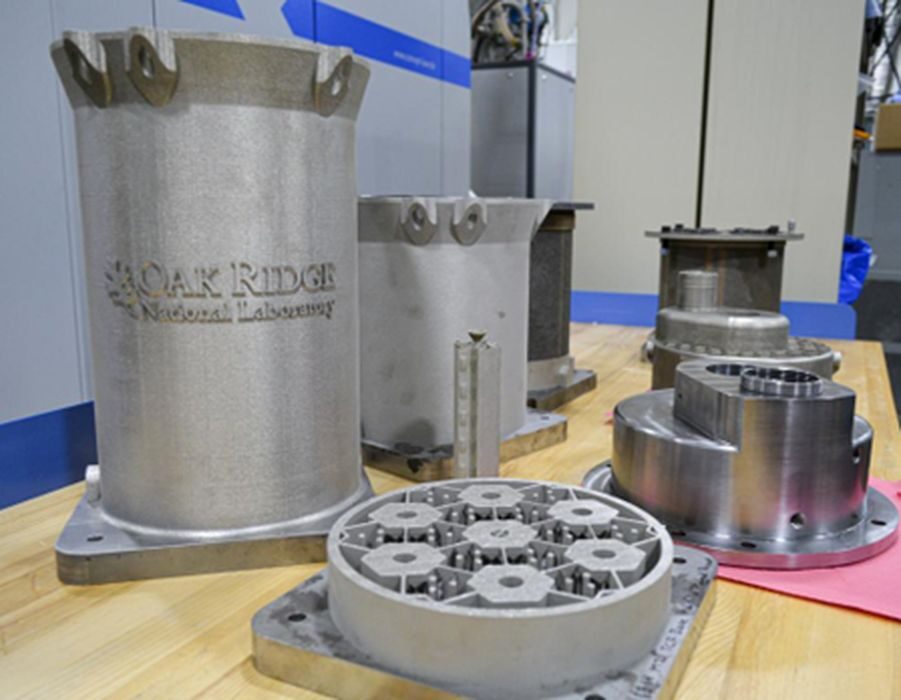
Over the past year, we’ve covered how 3D printing is reshaping nuclear energy, in France, Finland, and Sweden. Despite high-profile efforts like the Palisades reactivation, the U.S. has not built large reactors at scale in decades, leaving many programs outside the last wave of additive advances that aerospace, energy, and medical manufacturing already absorbed. That gap poses catch-up risk, but it also creates room to advance. With Nucor strengthening the materials backbone and NOS bringing execution under a common digital standard, the ingredients are in place for 3D printing to move from one-off pilots to fleet-level practice. Below are a few ways in which NOS can potentially help advance additive manufacturing in the nuclear industry.
Data governance and qualification. NOS can retain qualified CAD, build settings, NDE results, heat-to-part lineage, and inspection records for printed components, providing the through-line of evidence that regulators and operators expect before accepting AM parts.
Distributed, consistent production. A fleet platform allows the same validated geometry and process window to run at multiple approved print sites or regional hubs, with NOS enforcing version control and capturing build data end-to-end. That could shorten lead times for hard-to-source legacy parts and lower single-supplier exposure.
Predictive maintenance to on-demand AM. By fusing sensor data and digital twins, NOS can flag wear early and trigger pre-approved print jobs, shifting replacements into planned outages rather than emergencies and improving spare-parts economics.
Regulatory efficiency. Centralized documentation and automated checks can streamline the evidence packages required to qualify nuclear-service AM parts, accelerating repeat approvals across a fleet and turning one-offs into standard practice.
As nuclear and additive technologies converge, this new wave of digital-industrial integration also opens doors on the financial side. Many of the engineering, software, and materials-development efforts driving platforms like NOS, and the broader adoption of 3D printing in nuclear, qualify as research and development under U.S. tax law. That means companies investing in these innovations can potentially recover a portion of their costs through the federal R&D tax credit.
The Research & Development Tax Credit
The now permanent Research and Development (R&D) Tax Credit is available for companies developing new or improved products, processes and/or software.
3D printing can help boost a company’s R&D Tax Credits. Wages for technical employees creating, testing and revising 3D printed prototypes can be included as a percentage of eligible time spent for the R&D Tax Credit. Similarly, when used as a method of improving a process, time spent integrating 3D printing hardware and software counts as an eligible activity. Lastly, when used for modeling and preproduction, the costs of filaments consumed during the development process may also be recovered.
Whether it is used for creating and testing prototypes or for final production, 3D printing is a great indicator that R&D Credit eligible activities are taking place. Companies implementing this technology at any point should consider taking advantage of R&D Tax Credits.
Conclusion
Taken together, the Nucor–TNC partnership and the NOS platform represent the two halves of a new industrial foundation for nuclear power, steel and software working together to make large-scale deployment faster, safer, and more efficient. Nucor provides the physical backbone through certified, domestically produced materials, while NOS delivers the digital infrastructure needed to coordinate every stage of design, fabrication, and inspection. This combination creates the ideal environment for 3D printing to evolve from isolated demonstrations into a reliable production tool for the nuclear sector.