

A Danish company offers a high speed volumetric 3D printer.
“Volumetric” 3D printers are very different from typical 3D printers that produce objects layer by layer using various methods. Volumetric instead builds the entire object simultaneously, which is much faster.
How is this done? It involves a photopolymer resin, much like desktop resin 3D printers. However, the resin is in a transparent cylinder, and it’s rotating. As it rotates light patterns are projected through the resin. Gradually some regions in the resin accumulate enough energy to polymerize, and eventually the entire object is built.
This is the type of machine that has been built by PERFI, which is inspired by the words “Perfect Fit”.
Preparation of print files for the Lumin 3D printer is a bit different. A 3D model is converted into a hologram, which will later be projected into the rotating resin cylinder.
The system accepts “capsules”, which are small clear jars of photopolymer resin. They are inserted into the Lumin 3D printer for printing. The printing process is ridiculously fast, said to be 20-50X faster than conventional 3D print technology. This means prints finish in minutes, not hours.
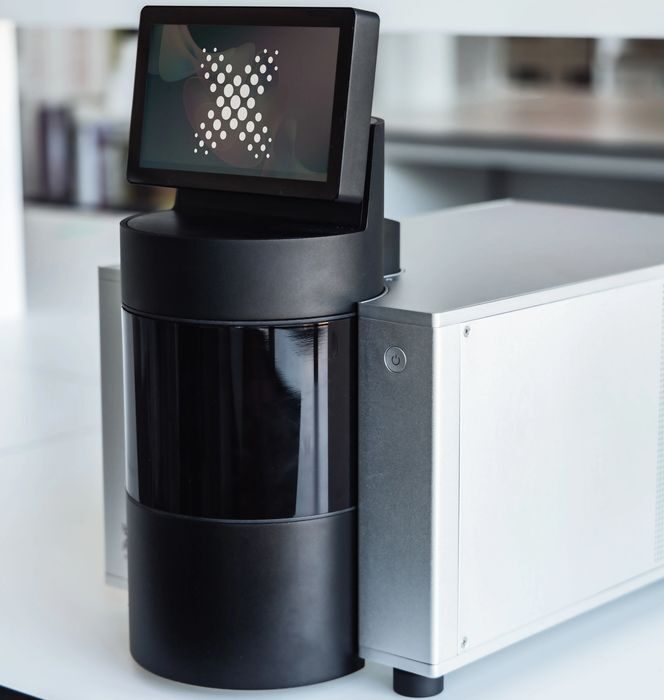
As you can see in the images, the build volume isn’t particularly large. However, it’s easily possible to quickly print small objects. If you think about this in terms of throughput, it makes sense: for example, a large conventional 3D printer might take 12 hours to print a plate of 100 small parts. Meanwhile, a volumetric system could serially print 100 parts in a similar time period. So which one is faster?
The obvious application for this technology is something that customers normally wait longer periods to receive. Typically that would be anything that is specifically designed to fit the customer, such as a shoe, dental appliance, clothing or ear devices, such as hearing aids.

Because of the build volume constraints the Lumin probably could not be used to print custom shoes or clothing, nor could it print dental appliances that require very specific (and hard) materials. However, the hearing aid market could be “perfect” for this technology.
In theory a hearing aid customer could be scanned and receive custom hearing aid attachments all in a single visit. That might revolutionize hearing aids, and enable many more people to use customized fit devices.
Via Perfi (Hat tip to Benjamin)
