
A new 3D printing concept has been developed — or is it just knitting?
Researchers from Cornell University and Carnegie Mellon have unveiled a working prototype that could redefine how textiles are made — and how additive manufacturing (AM) thinks about softness. The new “solid knitting” machine uses a dense 2D bed of motorized needles to produce fully three-dimensional knitted shapes — not just surfaces or tubes — marking a fundamental leap toward volumetric textile fabrication .
From Surfaces to Solids
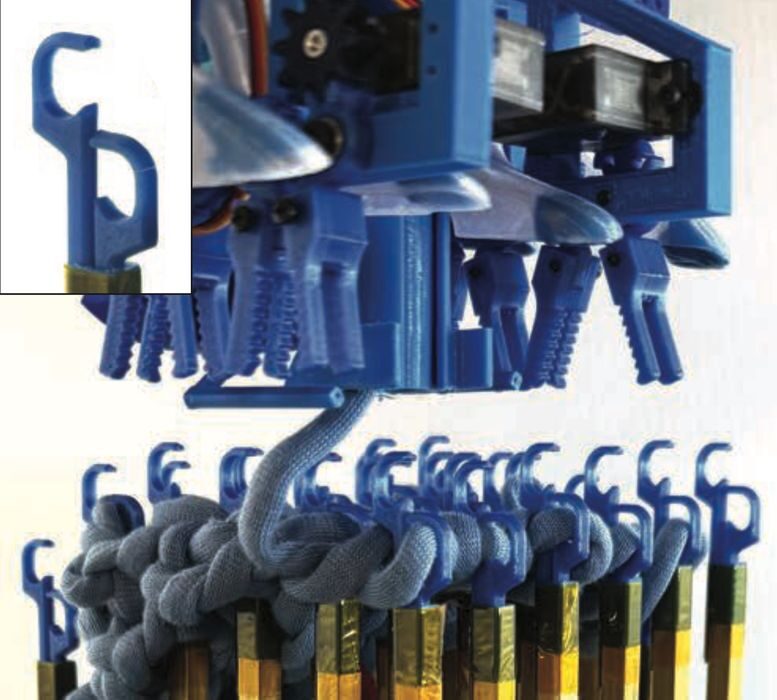
Traditional knitting, even with advanced industrial machines, is limited to flat or tubular surfaces. These are later joined or filled to form volumes. The Cornell–CMU team challenged that boundary by re-engineering the knitting head itself. Their prototype replaces the linear needle bed with a 6×6 grid of computer-controlled “symmetrical double-hook” needles, each capable of independently forming, transferring, and casting off loops in any direction .
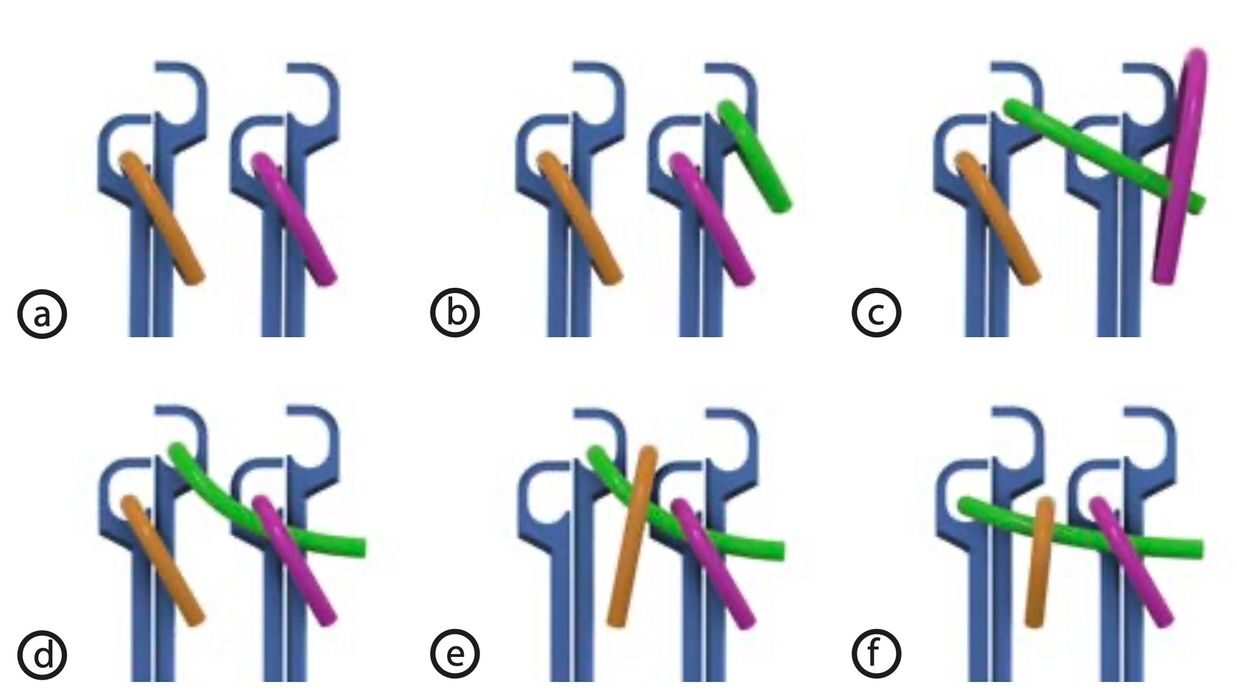
That design enables knitting in two orthogonal directions — vertically, like normal fabric, and horizontally across the needle field. By combining these directions, the system builds complete volumetric shapes such as boxes, overhangs, and even pyramids. Earlier “solid knitting” attempts from 2024 could produce simple prisms, but not complex solids or diagonal features.
A Maker-Friendly Mechatronic Design
The research team’s prototype is intentionally small and open-source-oriented: 36 needles, 72 motors, and a Raspberry Pi Pico controlling modular driver boards. Each needle’s movement is actuated by 3D printed lead screws and gear-motors with encoders, while the yarn path is stabilized by sweeping arms, loop-transfer grippers, a compactor, and even small air blowers to keep threads from tangling. Motion commands are expressed in GCODE, allowing the entire system to be driven with common 3D printer software such as Repetier Host .
The device knits from the top down: as rows form, the growing object is pushed between the needles and eventually drops free — much like an FFF printer ejecting a finished print. The researchers used the machine to produce a wrist warmer, open box, C-shaped beam, and an inverted quarter pyramid, all demonstrating stitch integrity in multiple axes .
Functionally Graded Textiles
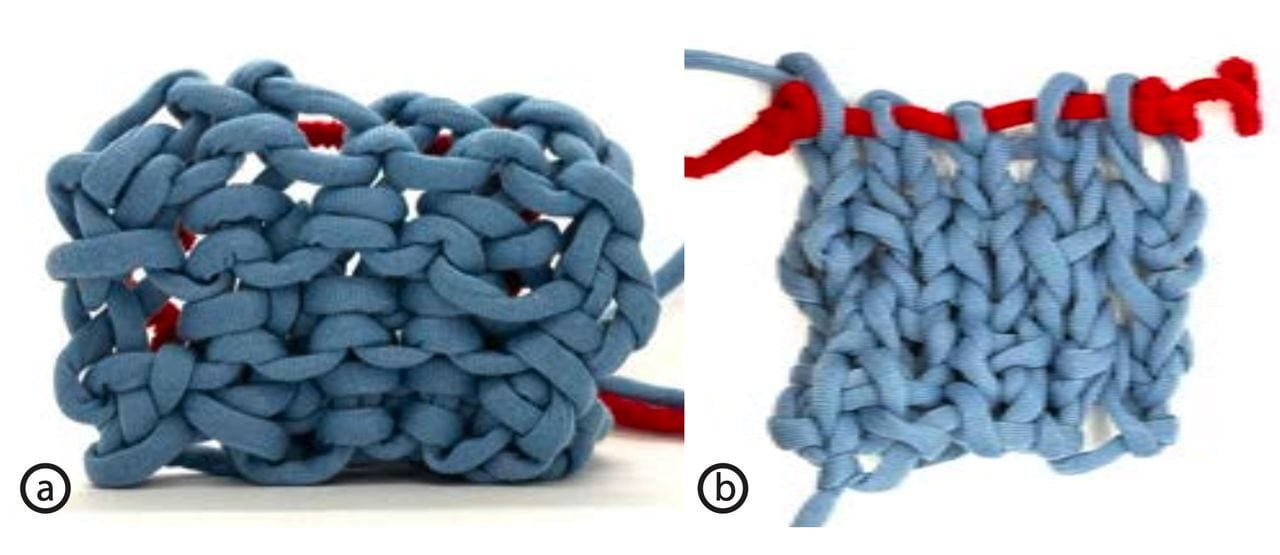
Knitting as a 3D printing analogue introduces new control dimensions beyond geometry. The orientation and combination of stitches directly influence local stiffness, density, and elasticity. The team notes that by mixing “vertical” and “horizontal” stitches or varying tension and pattern, designers could embed regions that stretch in one axis but resist in another — a kind of anisotropic compliance rarely achievable with continuous-fiber AM.
Potential applications range from soft robotics and wearable devices to custom orthotics, compliant joints, and lightweight structural padding. Because yarns can include active or sensing fibers, solid knitting could merge fabrication and function — building entire “soft sensors” or actuators directly into a body-fitted volume.
Still a Prototype, but a Promising One
Like any early AM platform, the Cornell-CMU system faces reliability hurdles. Yarn tension remains difficult to regulate, occasionally stretching loops or bending needles. Feed synchronization and dropped stitches still require manual correction. But the researchers are confident: scaling the array and improving the slicer software — which must optimize every stitch in context — could make the process as reliable as modern 3D printing.
If successful, solid knitting may define a new branch of additive manufacturing: one that weaves volume instead of depositing filament. Rather than printing soft polymers to mimic cloth, this technology literally knits the object itself.
Via ACM
