
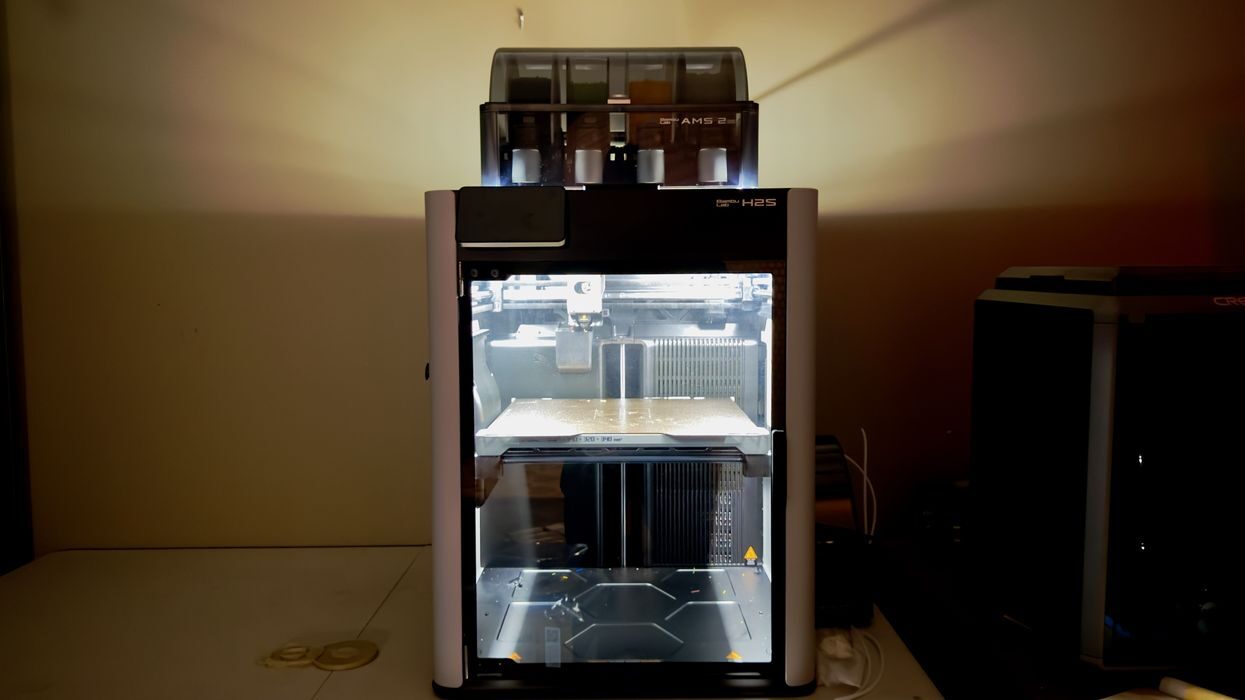
3DPrinterOS announced support for Bambu Lab’s H Series.
The California company operates a massive 3D printer management service, where customers can easily manage their own fleet of equipment. Jobs can be stored, sliced, dispatched, operations monitored, statistics gathered, and so on. It’s one of the oldest 3D printer management solutions, and today is one of the largest with a considerable number of features.
To do all of the above, they must work with a huge range of 3D printers and their manufacturers. This requires some configuration work on their end, which then allows customers to attach almost any 3D printer to their network.
This week 3DPrinterOS announced compatibility with Bambu Lab’s new H series of professional 3D printers. The H series, currently composed of the H2D and H2S, with an H2C coming later, are the flagship machines for Bambu Lab. Many Bambu Lab customers are upgrading from older machines to H series equivalents, which are larger and more powerful.
Why use 3DPrinterOS when you can use other remote management tools from the 3D printer manufacturers? There’s quite a simple reason. Let’s take a look at the Bambu Lab Wiki, which describes the company’s management software, Bambu Farm Manager. They say:
“’Bambu Farm Manager’ is an application suite designed for managing multiple printers. It supports real-time printing status display, batch operations, printer firmware upgade, print job queue management, multi-user management, helping you to optimize workflows and enhance production efficiency.
This suite includes two application software: ‘Bambu Farm Manager Server’ (Server) and ‘Bambu Farm Manager Client'(Client), and currently is compatible with Bambu Lab X1C/P1S/P1P/A1/A1mini.”
The last line is the most telling: it works ONLY with Bambu Lab equipment. This means that if any other devices were involved in the print farm, you’d need different software to manage them.
However, having multiple types of 3D printers is almost a given in most installations, particularly schools that are one of the primary markets for 3DPrinterOS. Wouldn’t it be a lot easier if ALL of the equipment was under a single management system?
That is the goal of 3DPrinterOS, which is quite different from the management services typically offered by 3D printer manufacturers: only our equipment will work.
They’re trying to protect their ecosystem, but the reality is that most people and organizations have many types of 3D printers operating.
Via 3DPrinterOS
