
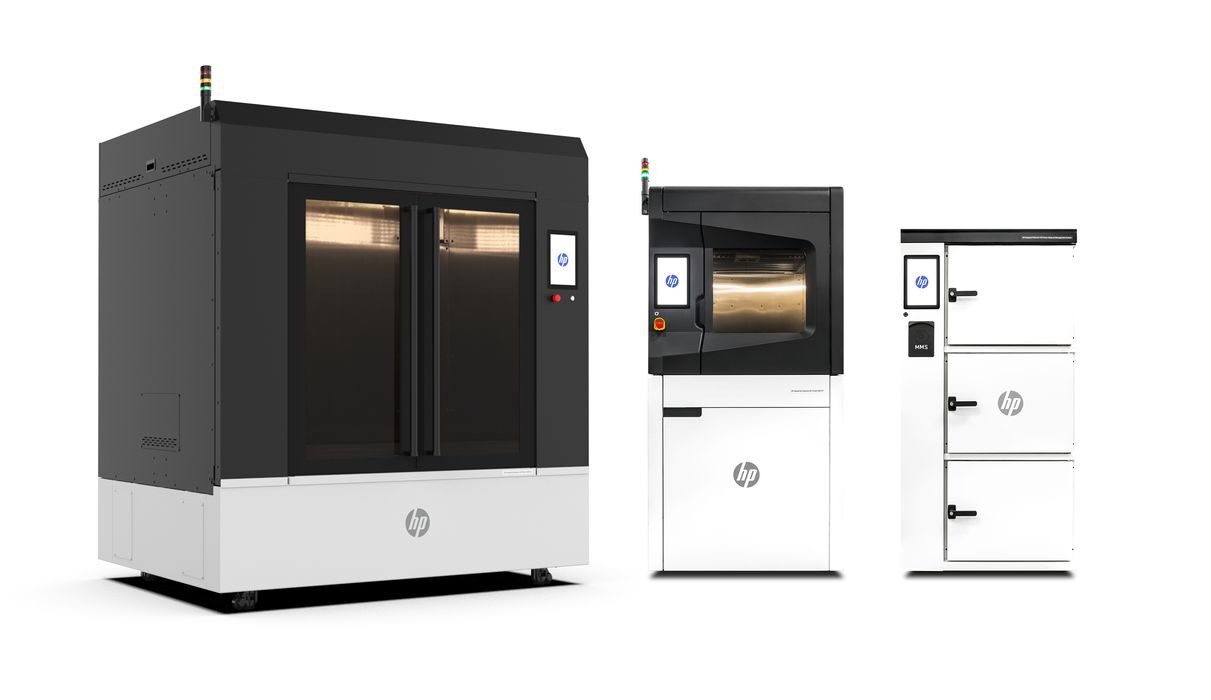
Surprise! HP has introduced a filament 3D printer, the 600 HT.
This is quite a development. The company has not had a FFF device in their product set since 2010, some 15 years ago. Back then, HP had set up a venture with Stratasys to relabel that company’s then compact 3D printer, the uPrint, under the HP brand. This is what that machine looked like:
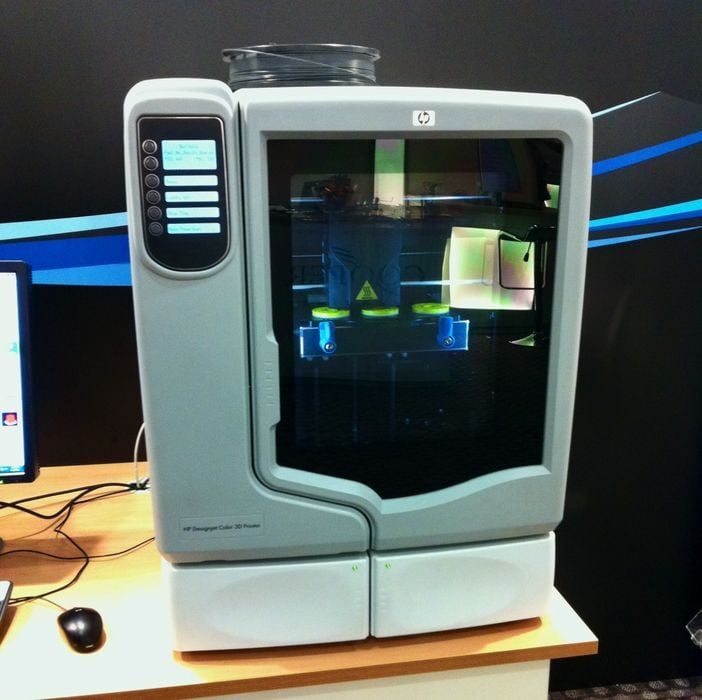
HP discontinued the relationship shortly thereafter, and went quiet for many years. Finally, they re-emerged in the space with their MJF technology, which has been the sole 3D print process they’ve used since then.
Until this week.
HP 600 HT
The company announced the 600 HT, shown at top. It’s utterly different from their prior FFF venture, as the 600 HT is designed as a production system for industry. Let’s look at the basic specifications:
- Large build volume of 380 x 380 x 420 mm
- Uses standard 1.75mm filament
- Two toolheads
- Maximum nozzle temperature: 500C
- Maximum build plate temperature: 190C
- Actively heated build chamber to 195C
- Dry box temperature 50C
The toolheads are interchangeable and there are three types designed to address different material groups. Essentially, these toolhead types each have a different maximum temperature: 280C, 360C and 500C.
This is clearly a high temperature system, capable of printing a wide range of materials that includes PEEK, ULTEM, PAEK, etc.
However, the system is not just these specifications. HP has gone to considerable effort to package the HT 600 in a way that will make it easy for industrial manufacturers to adopt.
HP provides a set of their own materials under the HP IF 3D Printer Materials branding. However, HP has also made the HT 600 an open materials machine, meaning it can accept any 1.75mm filament from any provider. It’s likely they are providing print profiles only for certain materials and operators will have to figure out their own print profiles for third party materials.
You may notice the HT 600 system is composed of three units in the image above. The printer is the largest unit, of course, but the tall box is the Material Management System (MMS). This device provides storage and drying for filament spools, and can even do post print annealing with a heat treatment.
The really interesting feature is that it provides “full traceability”. For manufacturers in regulated industries that must ensure a perfect audit trail of how each part was produced, this is ideal. The system would track which spool was used to produce each specific part automatically. It’s not clear whether this feature would work with third party spools, as it would almost certainly require a tracking tag on the spool for this to work.
HP has clearly done their homework here in configuring the HT 600 system. It seems very suitable for a specific niche of industrial manufacturers that make production parts in high temperature materials.
But why the divergence from their MJF platform?
This is clearly not a change in MJF strategy, but rather an expansion of the company’s footprint in the 3D print space. It’s their recognition that the FFF process has taken hold in manufacturing, and they want a piece of the action.
The HT 600 could certainly help HP get there.
Via HP
