
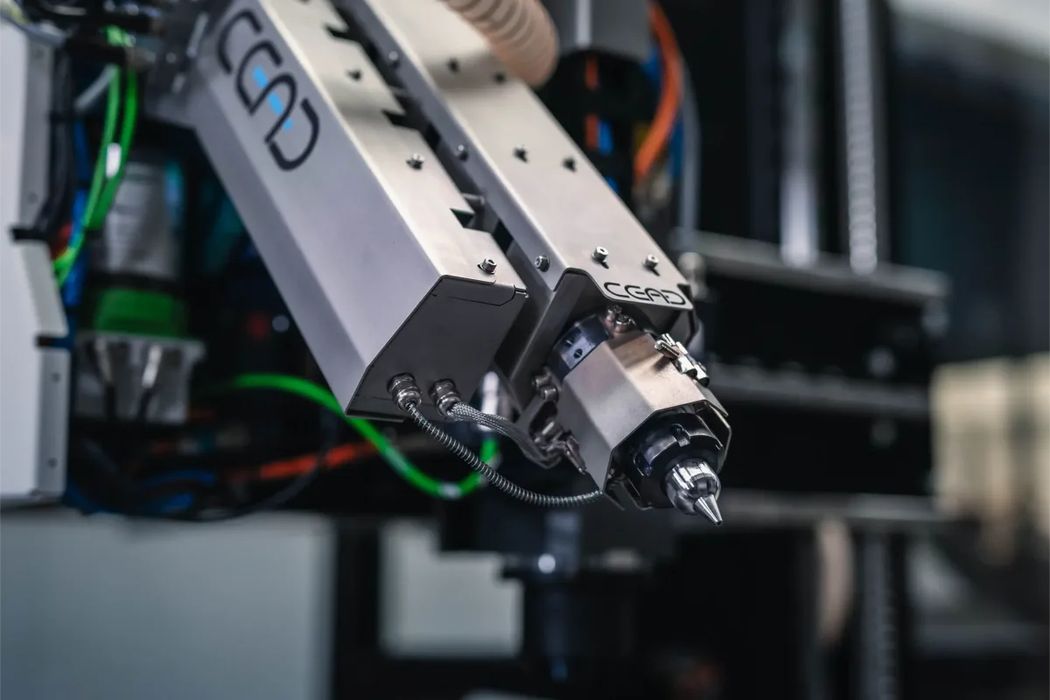
CEAD has patented an unusual slicing strategy designed for 3D printing materials that cannot easily stop flowing.
If CEAD isn’t familiar, they’re a Dutch manufacturer specializing in Large Format Additive Manufacturing (LFAM). The Delft based company builds large scale extrusion systems using both industrial robots and gantry architectures, along with pellet extruders that can be integrated into other equipment. Some of its platforms also combine additive manufacturing with CNC milling.
That makes this particular patent rather interesting. CEAD’s machines are intended to push considerable quantities of material through large extrusion heads, so seemingly minor toolpath issues can become very visible on a large part.
US patent application US20260225319A1, assigned to CEAD IP B.V., describes a method for calculating toolpaths across multiple layers rather than treating every layer as an isolated printing operation. The application was published on August 6, 2026.
The problem appears when printing viscous materials whose extrusion cannot be instantly switched on and off. The patent specifically mentions materials including elastomers, silicone, glass, epoxies and concrete.
Conventional slicing generally assumes extrusion can stop while the print head travels across an empty region, then restart at the next feature. That works reasonably well with thermoplastic filament.
With continuously flowing materials, however, the nozzle may keep dispensing during that travel move. The result can be strings, blobs or unwanted material dragged across the part. All undesirable.
Jumping Between Layers
CEAD’s proposed solution is pretty clever: when the print head reaches a point where it would normally make a non printing travel move, the toolpath can instead switch to another layer and continue extruding.
The patent describes slicing the object into an even number of layers and then calculating paths for smaller groups, commonly two layers at a time. Corresponding nodes on adjacent layers are identified so the print head can move between them using a short vertical or diagonal transition.
In other words, instead of printing a feature, stopping extrusion, travelling and restarting, the machine could print a feature, move to the adjacent layer, keep printing and return to the original layer later.
The diagrams show the print head repeatedly bouncing between two adjacent layers while tracing available geometry. The algorithm attempts to complete the lower layer relatively early, while using the neighboring layer whenever continued movement would require an empty travel path.
This is an interesting departure from the usual assumption that a layer should be substantially completed before moving upward.
CEAD also describes rules for deciding which line to follow when several paths meet at a node. Depending on whether the geometry contains branches or closed contours, the algorithm can select paths based on the smallest or largest angle relative to the previously printed line.
Software Solving An Extrusion Problem
A manufacturer could improve valves, pumps or extrusion hardware so difficult materials stop flowing more quickly. CEAD’s patent suggests a completely different approach: fix the toolpath so stopping the flow becomes less necessary.
That could be particularly useful for high throughput extrusion systems, where considerable pressure may remain inside the material delivery system and a commanded stop does not necessarily produce an immediate physical stop at the nozzle.
There are obvious limits to this, as it can’t work all the time. The technique depends heavily on geometry, because suitable paths must exist on nearby layers.
Most slicers spend enormous effort optimizing what happens within individual layers. CEAD is effectively asking whether difficult extrusion problems become easier when the slicer is allowed to think in three dimensions as well.
Via Espacenet
