
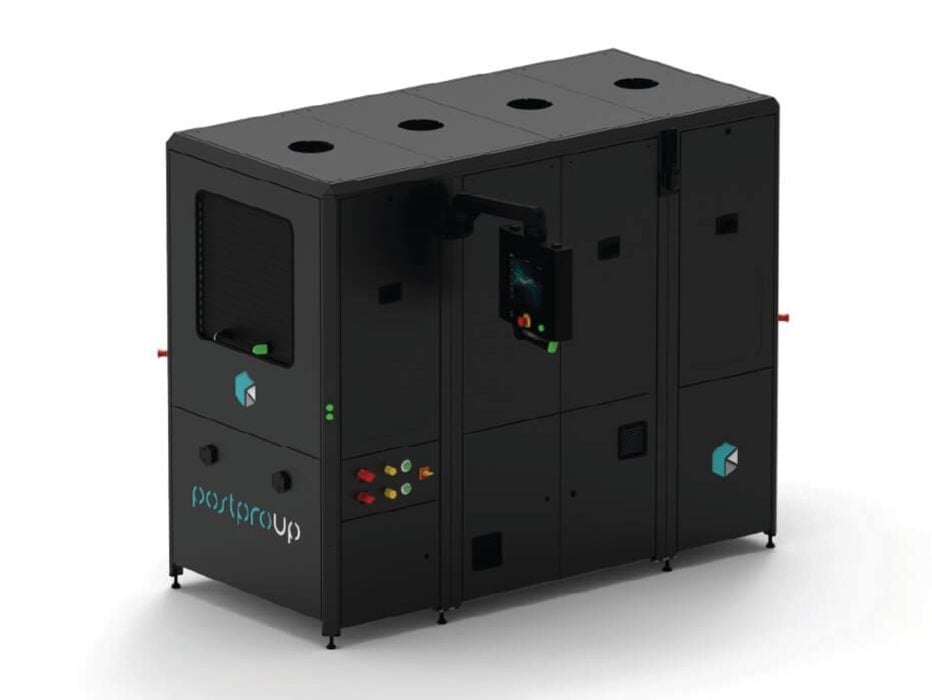
AMT announced two new post processing systems.
The UK-based company produces specialized equipment for powder-based production additive manufacturing. While the 3D printer manufacturers have spent many years refining their printing processes, the work required to finish parts after printing has been left to others.
AMT is one of the relatively few companies addressing those parts of the manufacturing lifecycle, and they’re doing so by leveraging AI techniques to increase efficiency.
Efficiency is the goal in the production parts game. If you can complete — and I mean right to the end use state — the parts faster and cheaper, then you’re better than your competitors.
One of the new devices is a powder removal system, the PostPro UP (Unpacking System).
AMT CEO Joseph Crabtree explained:
“Customers told us unpacking was the bottleneck. The PostPro UP eliminates it. As part of our Digital Factory vision, it’s the final missing link, enabling a complete, automated, and repeatable production process.”
How exactly is that done? The UP accepts build cakes — the chunk of powder and parts that results at the end of a powder-based 3D print job — from HP (MJF), EOS and Stratasys (SAF). The UP then agitates, rotates and blasts with air to remove all of the stray powder from the parts.
The removed powder is then collected for possible reuse, using their associated powder recovery system.
Amazingly, the entire process takes only ten minutes. This is quite rapid compared to typical manual processes, which involve an operator manually air blasting parts. In fact, the UP requires far less human intervention: loading, pressing start, and unloading.
The PostPro UP should be of interest to any operation serially producing production parts with powder-based polymer systems. It’s priced at €80,000 (US$92,000).
AMT SFX2
The second product announced by AMT was a more advanced version of their smoothing system, the SFX2. This system inherits the well-regarded process from the original SFX, which used a proprietary vapor to smooth parts, combined with AI algorithms to ensure the correct amounts, temperatures and timing are used.
What’s different with the SFX2? While it has the same footprint as the SFX, the SFX2 is able to handle twice the volume of parts.
This is quite interesting, because manufacturers are also typically interested in optimizing floor space. Although floor space is a fixed cost item, it’s wise to postpone expensive expansions to the latest possible date. By using floor space efficient solutions like the SFX2, there are savings to be had in the future.
The SFX2 is able, with AI algorithms, to complete smoothing jobs in 30-45 minutes, which is quite rapid compared to some other methods, particularly manual preparation. It is also more accurate than mechanical tumbling, where delicate structures can be damaged.
It seems that AMT has been listening to customers that are focused on efficiency, and these two new products follow that strategy.
Via AMT
