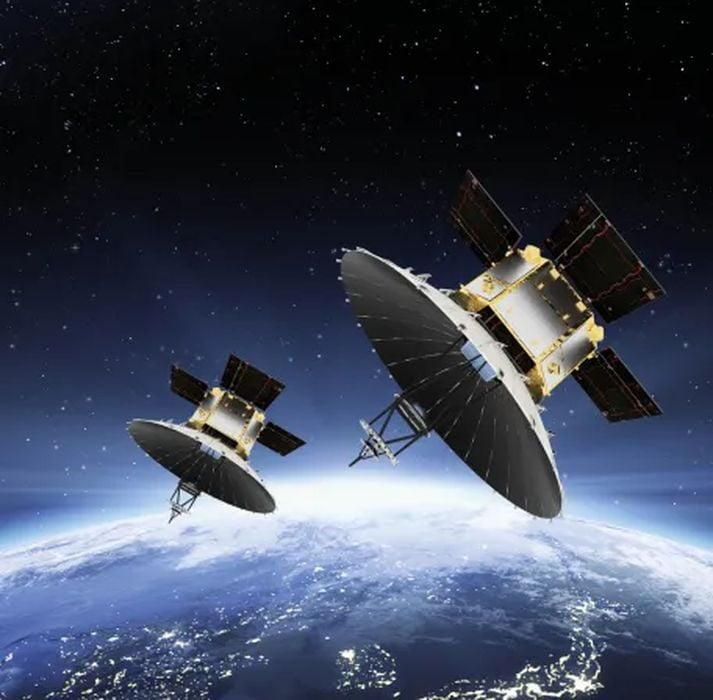
Charles R. Goulding explores how the merger of Airbus, Leonardo, and Thales could forge a new European space powerhouse — and why 3D printing is the technology holding it all together.
Europe is stepping up. On 23 October 2025, Airbus S.E., Leonardo S.p.A. and Thales Group signed a Memorandum of Understanding (MoU) to combine their space systems and services operations into a new joint business unit.
The aim: build a European-scale space-equipment manufacturer with the critical mass to compete with the likes of SpaceX and other global players.
A central piece of this strategy is additive manufacturing and 3D printing — a core technology for making lightweight space components, reducing costs and shortening lead-times. Here we unpack how each of the three companies has been using 3D printing in their space segments — then consider what this merger could mean for the 3D printing industry.
Airbus: Large-scale additive for satellites
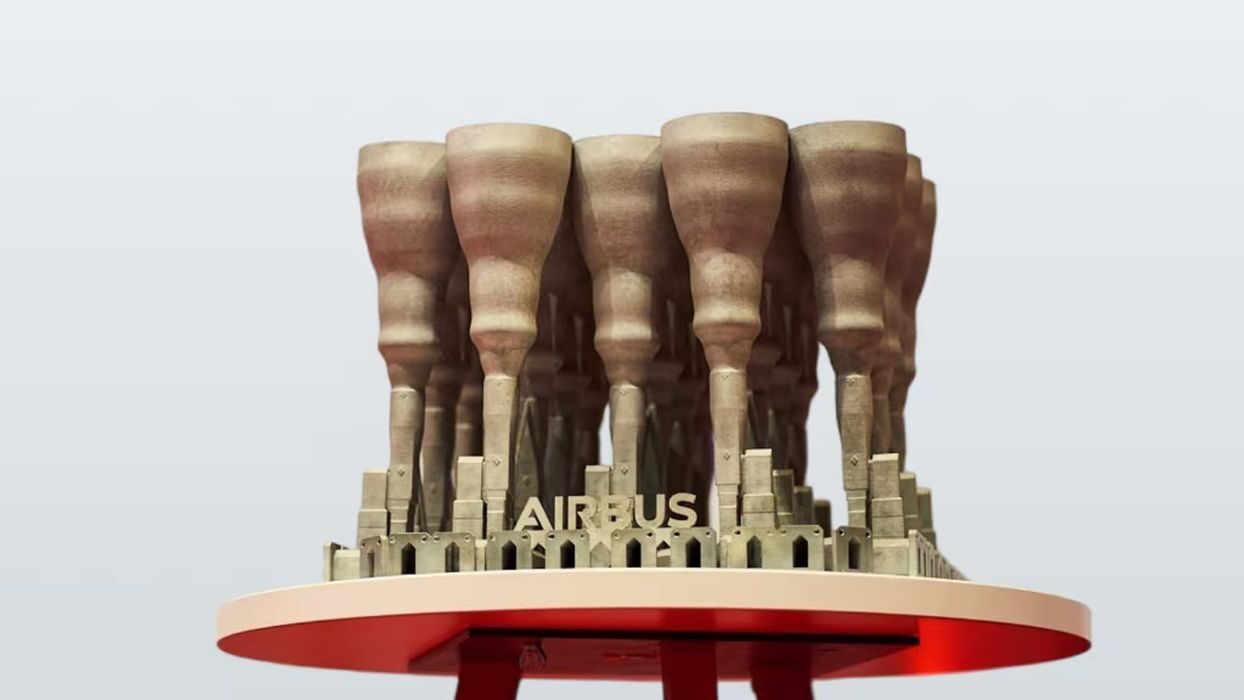
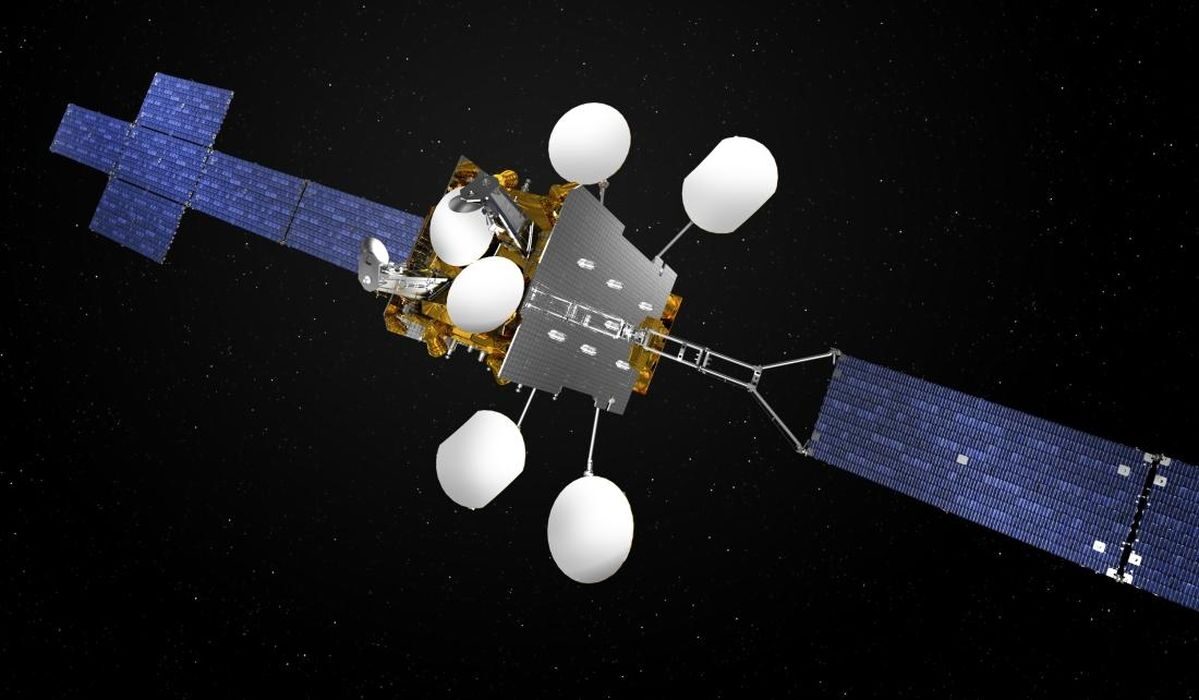
Airbus Defence and Space (part of Airbus S.E.) has long incorporated additive manufacturing (AM) in its satellite-production activities. For example, the Eurostar Neo-series telecom satellites included around 500 additively manufactured (AM) RF (radio-frequency) components — multi-waveguide blocks and switch-assembly networks — built in Portsmouth, UK.
These components were made from aluminium alloy (AlSi10Mg) via SLM (selective laser melting) and ranged in size from roughly 100 mm to 300 mm.
In 2023, Airbus signed a €3.8 million contract with Oerlikon AM for industrialised production of antenna clusters via 3D printing. The components are designed for next-generation communication satellites, demonstrating that Airbus is moving from prototypes to serial production of AM parts.
Another recent milestone: Airbus developed the first metal-3D printer for space, designed for on-orbit use on the International Space Station (ISS). Launched in 2024, the printer (80×70×40 cm) is intended to print metal parts in microgravity, a strong indication that Airbus sees additive manufacturing not only on Earth but in space as a key enabler.
Why this matters: Airbus’s AM programmes show how additive manufacturing helps reduce part count, weight and cost; enables complex RF components; and opens up in-orbit manufacturing possibilities. For a European space giant, these are core capabilities.
Leonardo: Centralising space, building future manufacturing capability
Leonardo S.p.A. has placed its Space Division at the centre of its industrial plan for 2025–29, with projected revenue growth of ~10 % per annum and emphasis on end-to-end (E2E) solutions in space.
On the additive-manufacturing front, while publicly fewer high-profile AM parts for satellites are cited compared to Airbus or Thales, Leonardo’s earlier work is notable: e.g., the “POP3D” project, developed together with Thales Alenia Space and the Italian Institute of Technology, produced a compact 3D printer intended for use on the ISS, printing polymer (PLA) parts in microgravity.
Although this polymer-based project dates from 2015, it shows Leonardo’s early recognition of additive manufacturing for space and its willingness to invest in “in-orbit” manufacturing capability.
Why this matters: Leonardo’s strategy focuses on creating a strong, integrated Space Division and is well-positioned to apply additive manufacturing within a broader, scalable European space business-unit framework. Their prior investments and strategic plan give AM a solid foothold.
Thales: Established heritage in space additive manufacturing
Thales Group (via its satellite-manufacturing joint venture Thales Alenia Space) has one of the most mature additive-manufacturing programmes in the European space industry. Thales Alenia Space has already sent dozens of 3D printed parts into orbit — including 79 metal parts and 350 polymer tube supports as of 2017.
The company’s “Spacebus Neo” telecom-satellite platform uses 3D printed aluminium and titanium brackets in series production: four reaction-wheel brackets made of aluminium and 12 pointing-mechanism brackets made of titanium.
More recently, Thales continues investing in additive manufacturing: for example, it is developing a 3D-metal-printing competence centre in Morocco (for Thales’s metal AM activities) as part of its industrial-acceleration plan.
Why this matters: Thales brings deep experience in additive manufacturing for space, especially in structural and mechanism parts, and is already in serial production. That gives the new European space entity mature AM capability to build upon.
Bringing It All Together: A Unified European Space Player & the Role of 3D Printing
With the MoU signed in October 2025, Airbus, Leonardo and Thales are targeting a combined annual turnover of ~€6.5 billion, approximately 25,000 employees, and full operations by about 2027 (pending regulatory approval).
For the additive-manufacturing industry specifically, this merger offers a “once in a generation” opportunity:
- Best-of-breed AM applications. The new entity can pick the strongest AM technologies from each legacy company: Airbus’s serial RF-component programmes and on-orbit metal printer; Thales’s mature mechanism/structure AM production; Leonardo’s future-oriented space manufacturing architecture.
- Scale and volume. A combined portfolio spanning Earth-observation, telecom, defence, services and constellations means more units, more parts, more opportunity for AM suppliers and integrators.
- Standardisation & cross-company workflows. With one business unit, AM processes, qualification regimes, supplier certifications and quality systems can be harmonised — a huge plus for the European AM supply-chain.
- In-orbit & next-gen manufacturing. Airbus’s metal printer on the ISS and the “printing in space” vision become scalable under a larger space-entity umbrella. This opens pathways to printing mission-specific parts in zero-g, reducing launch mass and enabling agile manufacturing.
- Lower unit costs. One of the driving forces behind this European consolidation is to reach the scale needed to counter low-cost, rapid-deployment competitors (like SpaceX’s Starlink). AM offers cost-savings via fewer parts, lighter weight, shorter lead times — an advantage in that battle.
The Research and Development Tax Credit
The now permanent Research and Development (R&D) Tax Credit is available for companies developing new or improved products, processes, and/or software. 3D printing can help boost a company’s R&D Tax Credits. Wages for technical employees creating, testing, and revising 3D printed prototypes can be included as a percentage of the eligible time spent on the R&D Tax Credit. Similarly, when used as a method of improving a process, time spent integrating 3D printing hardware and software counts as an eligible activity. Lastly, when used for modeling and preproduction, the costs of filaments consumed during the development process may also be recovered.
Whether it is used for creating and testing prototypes or for final production, 3D printing is a great indicator that R&D Credit-eligible activities are taking place. Companies implementing this technology at any point should consider taking advantage of R&D Tax Credits.
Conclusion
Europe’s space industry is undergoing a major structural change — and additive manufacturing is baked into the fabric of that transformation. The merger of Airbus, Leonardo and Thales’s space segments will not only create a European “space giant” capable of competing globally but will also elevate AM from niche innovation to core production technology.
For the 3D printing industry, this means a clear signal: the time to position for large-volume space-qualified manufacturing is now. Suppliers of metal-AM machines, qualified alloy powders, post-processing and qualification services have a large new customer on the horizon.
These European companies should outline the roadmap to space qualification standards, develop interfaces for large aluminum and titanium structures, and aim to plug into the upcoming European space-entity supply chain. Because when this new business unit goes live in 2027, it might be Europe’s linchpin for the next decade of space manufacturing — and you’ll want to be in their ecosystem from day one.