
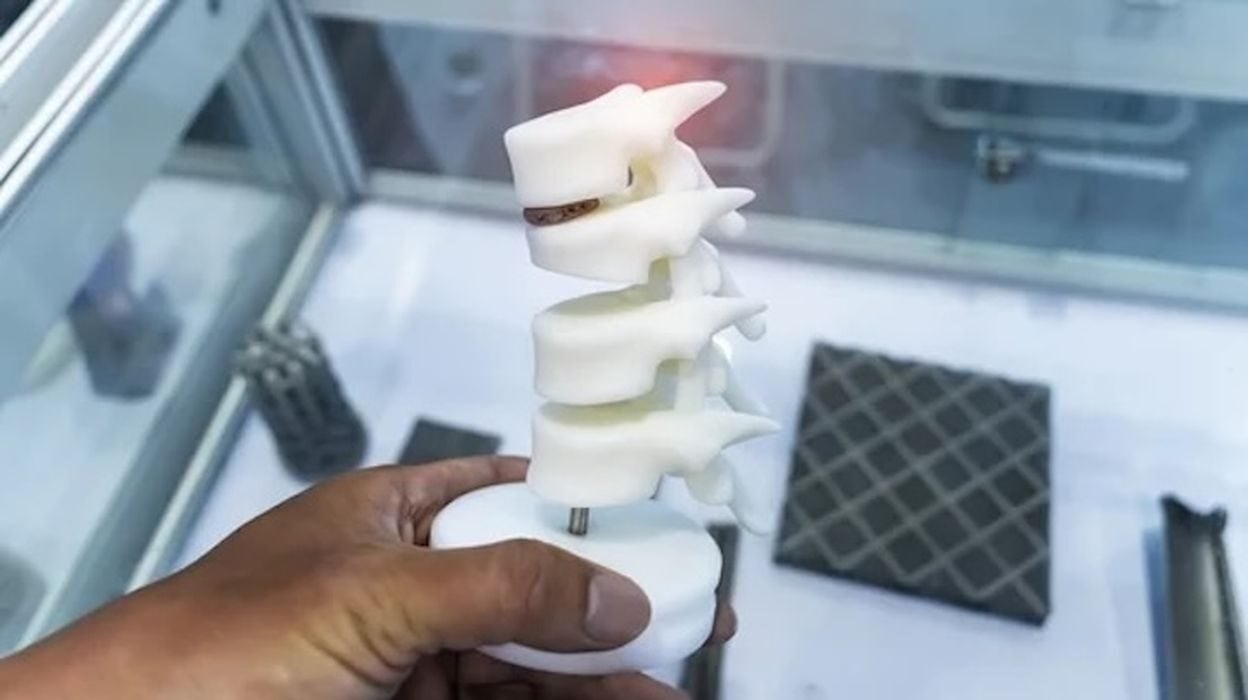
A 3D printing usage story suggests the days could be numbered for some expensive 3D printing options.
Those involved in the 3D printing industry tend to focus inward on news and developments within the industry. However, the purpose of the technology is and always has been to achieve the production of some type of parts, whether for professional or individual use.
For professionals it is always about obtaining the correct type of parts at a reasonable price. Multiple 3D print companies and services have evolved to address those needs, and continue to do so.
But then I read a story from Radiology Business, which, as you might guess, provides news and ideas to the Radiology industry. This is one of countless industries that make use of 3D print technology.
In the story, they suggest that radiology departments could “slash costs by up to 70% per model” by using in-house 3D printing instead of expensive external services.
In the story, Kristian Quevada, MD of Cooper University Hospital in New Jersey explained:
“Understanding complex anatomy is critical to practicing radiology and surgery, but access to detailed 3D models is often limited. Commercial models are expensive, have long turnaround times, and are often not tailored to individual patient anatomy. Radiologists have the expertise to implement 3D printing into educational and clinical workflows to provide deeper education and multidisciplinary support.”
Evidently this group acquired an inexpensive desktop 3D printer and was able, through some experimentation, to prepare 3D prints suitable for their operation. This eliminated the need for using external 3D print services in some situations, saving both time and money.
This could be an important turning point for the 3D printing industry. Let’s look at what’s happened here.
In the beginning there were only large, patent-protected commercial 3D printers and associated services. Then as patents expired we saw inexpensive desktop systems emerge, but they were largely terrible and usable only by hobbyists. Professional operations exclusively used the expensive commercial systems and services.
Over time, due to intense competition, the desktop systems gradually evolved into far more capable machines. Today’s desktop gear is often more capable than yesterday’s professional equipment, but at costs 10X less.
Now the Radiology report suggests that users are beginning to discover this evolution, and are beginning to adopt the inexpensive equipment over the expensive systems and services.
This is obviously very bad news for the suppliers of the expensive commercial systems, as it demonstrates that the “quality wall” between the two worlds of 3D printing is starting to crumble.
We’ve seen how some of the 3D print services and a few unique manufacturers have switched (or launched) operations to using arrays of inexpensive desktop 3D printers instead of expensive commercial systems. But here we see a user doing the same thing — and one in a normally profitable professional segment.
It may be that this practice continues and expands — and why shouldn’t it, as desktop systems keep getting better?
Could this be one of the reasons we’ve suddenly seen major Chinese megacorps investing in several desktop 3D printer manufacturers? Are they seeing these trends and believe the market for desktop equipment will rapidly expand into multiple professional markets?
