
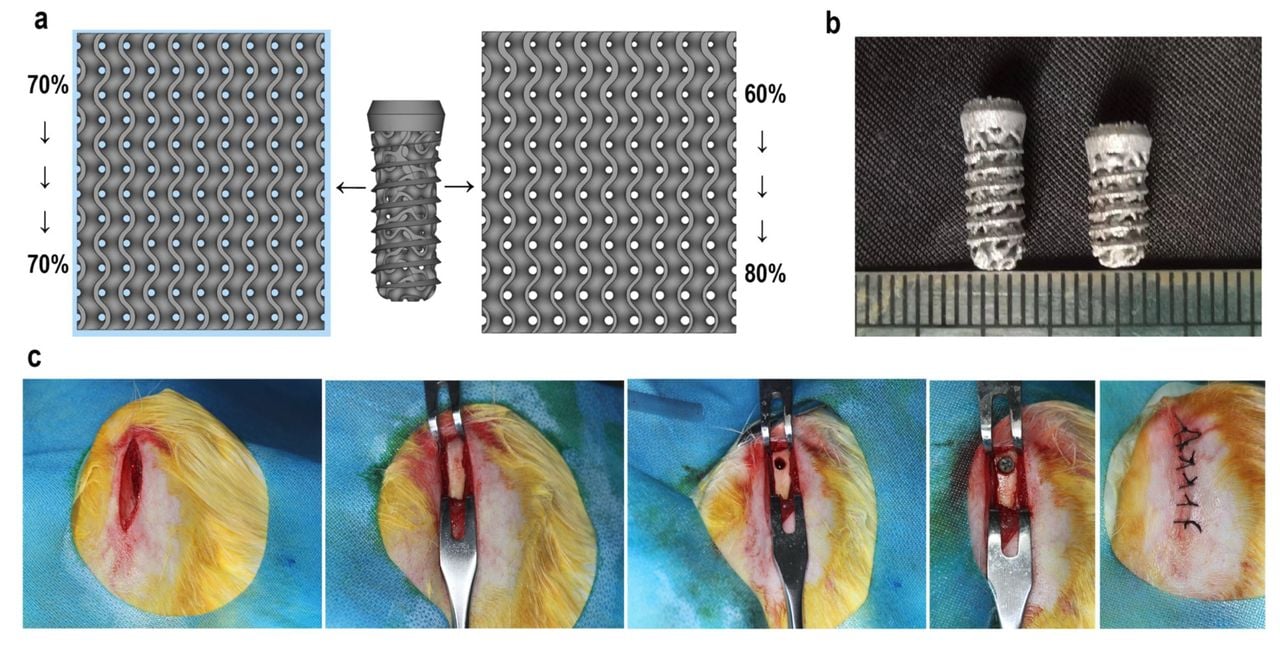
A new study evaluates the mechanical and biological behavior of 3D printed gyroid implants aimed at improving bone integration.
The paper, published in Frontiers in Dental Medicine, looks at a “bionic porous” gyroid structure and measures both its load bearing characteristics and how living tissue responds. Triply periodic minimal surface (TPMS) lattices like gyroids could provide bone friendly porosity without throwing away strength.
Why Gyroids Keep Turning Up In Implants
In AM, the gyroid is a go to for infill geometry because it delivers continuous surfaces, smooth stress flow, and highly interconnected pores. In other words, you can tune elastic modulus toward cancellous bone, open pathways for fluids and cells, and still keep compressive strength that a strut lattice might lose at similar porosity.
Laser Powder Bed Fusion (LPBF) is typically the process behind such parts, often using titanium alloys for biocompatibility and corrosion resistance.
This sounds great, but there is always a catch between lab results and clinic. LPBF lattices face tight tolerance demands, especially when pore geometry must be open enough for bone but also clean enough to remove unsintered powder. Post processing steps like heat treatment, HIP, and surface texturing can shift both strength and biology, sometimes in opposite directions.
Throughput is another lever. Custom gyroid implants are a natural fit for AM, but cost of quality is where programs often stall. You need validated design rules, robust build monitoring, and a cleaning and inspection workflow that proves no powder or loose debris remains inside the lattice. The study does not state any production economics, which is normal for academia, but it remains the a question before commercial adoption could happen.
Fatigue is another real test. Static compression numbers are helpful, yet cyclic loads in the mouth or joint are a big test. Lattice nodes concentrate stress, and surface roughness from LPBF can be both a biological benefit and a fatigue penalty. Without long horizon fatigue data, most manufacturers will not shift critical load paths to porous regions.
Regulatory evidence is the final mountain. Even excellent in vitro results need animal data and, eventually, controlled clinical outcomes. Traceability from design to print to post process to sterilization has to be airtight, and software used to generate the TPMS must be locked down in a validated workflow.
