
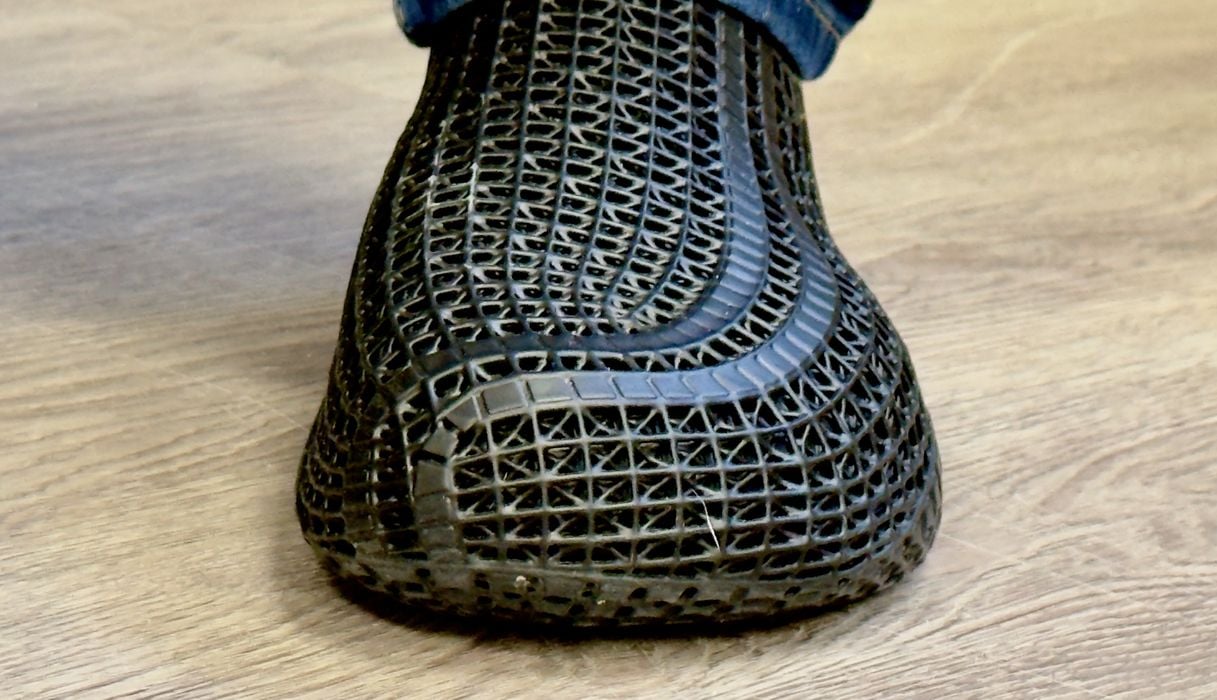
There seems to be something afoot in the footwear industry.
3D printed shoes have been around for almost forever. I recall seeing people walk around trade show floors wearing garishly coloured 3D printed slip-on shoes a dozen years ago. But it didn’t catch on.
Until now, it appears.
In the past year, and especially in the last few months, there has been a series of announcements that suggest 3D printed footwear is a viable business niche.
What are those clues? First, there are several companies now dedicated to the production of shoes using 3D printing. The most well-known, of course, is Zellerfeld. The German company has developed its own high-performance 3D printers optimized to produce footwear. Their marketing strategy seems to be to become the “App Store” of 3D printed shoes: designers would submit designs that appear in their online store, and they are printed whenever someone orders a pair.
Another company that has made a big splash more recently is PollyFab, a spinout brand of a materials company. PollyFab intends on producing a range of 3D printed consumer products, and their first big market is footwear. The company markets quite a few unusual designs that can be ordered immediately. Last week, we tested some 3D printed shoes from PollyFab, and were quite impressed.
Yet another company suddenly appeared doing much the same thing: Syntilay. They are using AI tools to create highly unusual and functional footwear designs, and seem to be using Zellerfeld as their production partner.
And for several years, Carbon has been working with major shoe brands to produce 3D printed midsoles. These are not fully 3D printed shoes like the other companies are doing, but they are still involved in the footwear industry.
In addition to the number of companies appearing in this niche, we have some companies producing 3D print materials specifically for the production of footwear. BIQU has developed a new filament, MorPhlex, specifically for printing footwear. The material is flexible, yet provides a suitable level of hardness, ideal for shoe printing.
Adding all this up, it would appear that there is a burgeoning 3D printed footwear industry. Or at least there are multiple parties that believe it will soon be so.
With the capabilities of desktop 3D printers increasing so much lately, combined with the availability of shoe materials and designs, we may see a lot more people wearing 3D printed shoes in coming years.
Via Zellerfeld, PollyFab, Carbon, Syntilay, and BIQU
