
A new review maps how additive manufacturing could deliver truly personalized oral medicines.
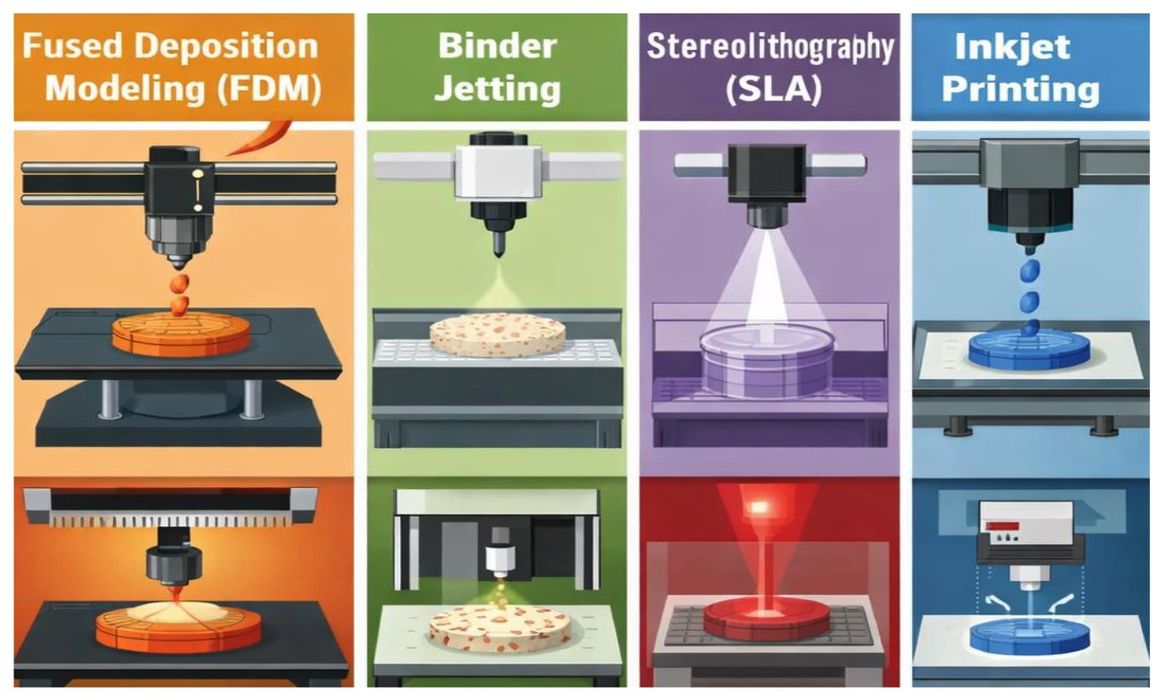
The paper, published open access, synthesizes recent progress in 3D printing of oral dosage forms and connects it to an emerging pharmacy workflow. The authors go through the main AM modalities used for pharmaceuticals — Fused Filament Fabrication (FFF), Selective Laser Sintering (SLS), Stereolithography/Digital Light Processing (SLA/DLP), binder jetting and Semi Solid Extrusion (SSE) — and set up where each fits for dose personalization, release control and patient adherence.
If you have followed this space since Aprecia’s Spritam — the first FDA approved 3D printed drug made via binder jetting — the process is familiar. What this review adds is a clear comparison of process tradeoffs and a realistic pathway from lab prototypes to regulated, in-pharmacy production. That makes it useful for those considering healthcare applications beyond devices and models.
Which Process For Which Pill?
FFF leverages Hot Melt Extrusion (HME) to embed active ingredients into a printable filament, then shapes tablets with tailored geometry to tune dissolution. It is solvent free and accessible, but heat limits the range of active pharmaceutical ingredients, and filament quality strongly affects dose uniformity. SLS similarly avoids solvents and can rapidly build highly porous orodispersible tablets, yet thermal exposure and powder handling are nontrivial in a pharmacy setting.
SLA/DLP offers crisp geometry and smooth surfaces, useful for complex release architectures, but ingestible, photopolymerizable resins are still a bottleneck. Binder jetting, proven by Spritam, prints fast and yields fragile, fast-disintegrating structures through porosity control, though post-print drying and the choice of binder systems introduce extra steps. SSE operates at low temperatures and is friendly to heat-sensitive actives, but throughput is modest and rheology must be carefully tuned to avoid variability.
From Prototype To Pharmacy Workflow
The review said that personalization is not just geometry; it is a digital thread. Dose calculators, patient data integration, print job recipes, and label generation all need to tie into a patient record. The authors call for Process Analytical Technology (PAT) — for example near-infrared spectroscopy — to verify dose and content uniformity inline, rather than relying on destructive sampling that destroys the economics of one-off tablets.
Quality by Design principles translate neatly into AM parameters: extrusion temperature, scan speed, hatch spacing, layer thickness and infill all become critical quality attributes. The paper highlights the opportunity for closed-loop control and machine learning to stabilize output as materials, geometries and doses shift patient to patient. It also flags real constraints: ingestible material portfolios remain narrow, validated post-processing is sparse, and most systems were not built with Good Manufacturing Practice (GMP) documentation in mind.
The near-term winners could be pediatric and geriatric care, clinical trial units, and hospital pharmacies managing complex polypharmacy. Polypills that combine multiple actives with staged release, microdosed pediatric tablets with palatable shapes, and on-demand refills that reduce waste are all within technical reach. Small build volumes are not a drawback here; the challenge is reliability, traceability and low touch time per dose.
Economically, 3D printing flips tablet production from scale-driven to demand-driven. That reduces inventory and cold-chain risk for niche therapies. But it shifts cost into validation, software integration and automated inspection. Few vendors currently offer a turnkey, GMP-ready package that spans printer, materials, PAT and electronic records, and the review notes that pricing and service models are largely unstated.
What Needs To Happen Next
Adoption will hinge on standards and data. Pharmacopeial monographs for printable excipients, drug master files for drug-loaded filaments or resins, and stability studies that validate printed geometries across humidity and temperature ranges are all essential. Regulators will also want robust serialization and audit trails per tablet.
Watch for pilot deployments in hospital pharmacies with SSE or binder jetting, where low-temperature processing and fast disintegration align with unmet needs. Another milestone will be the first compact, closed-loop platform that ships with validated materials, PAT hardware and workflow software, not just a modified lab printer.
If AM can produce flight-critical metal parts, it should eventually print a pill — but only when the digital paperwork is done!
Via Zenodo
