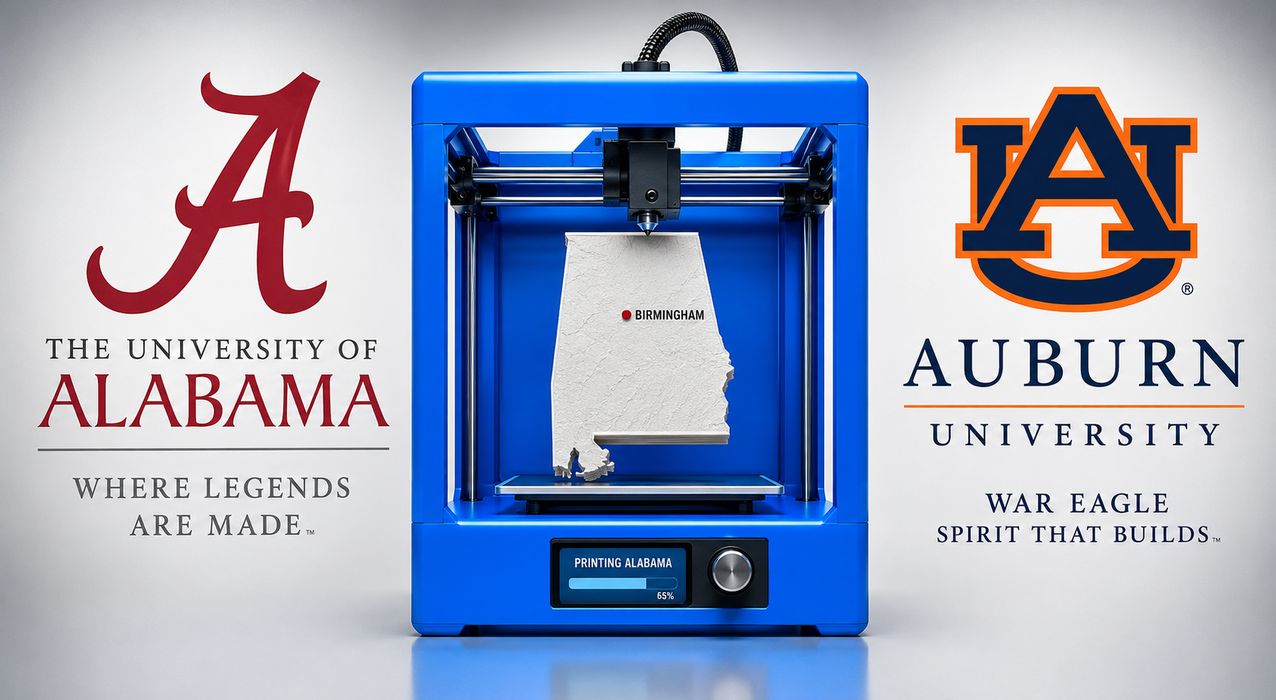
Charles R. Goulding and Preeti Sulibhavi compare the additive manufacturing initiatives at Auburn University and the University of Alabama, revealing how each institution is contributing to Alabama’s rise as an advanced manufacturing hub.
Alabama has quietly become an increasingly important hub for advanced manufacturing research. Home to roughly 5.2 million residents and generating a gross state product (GSP) of approximately US$330 billion, Alabama has built an economy around industries that are natural adopters of 3D printing, including aerospace, automotive manufacturing, defense, chemicals, metals, medical devices, and advanced materials. Major employers such as Airbus, Mercedes-Benz, Honda, Hyundai, Lockheed Martin, Boeing, Blue Origin, and numerous defense contractors have created sustained demand for advanced manufacturing technologies.
Against this industrial backdrop, Alabama’s universities have become major contributors to additive manufacturing research and workforce development. While both the University of Alabama (UA) and Auburn University are investing in 3D printing, their approaches differ considerably. UA has emphasized education, makerspaces, and engineering research, while Auburn has developed one of the country’s most prominent university-based additive manufacturing ecosystems, particularly for metal AM.
University of Alabama: Building Skills and Supporting Engineering Innovation
The University of Alabama has steadily expanded its additive manufacturing capabilities over the past decade, focusing on giving students and researchers access to modern prototyping technologies while supporting engineering research.
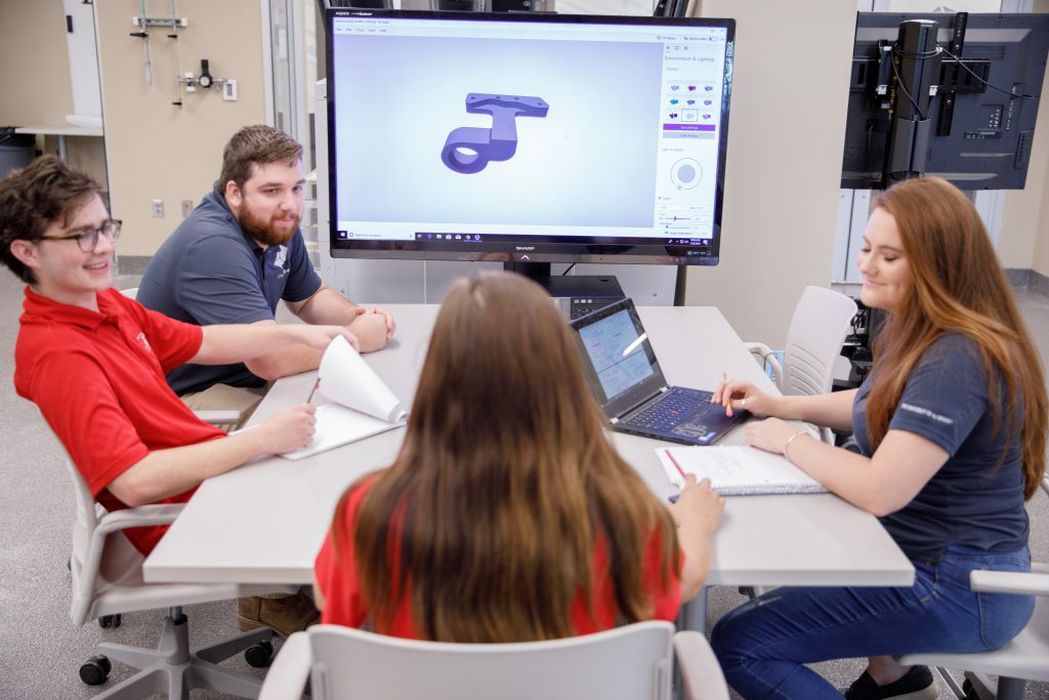
One of the university’s most visible resources is The Cube, the engineering makerspace housed within the College of Engineering. Rather than functioning solely as a student workshop, The Cube serves faculty researchers, entrepreneurs, multidisciplinary design teams, and members of the Alabama community. Students have access to multiple 3D printing technologies, 3D scanning, CAD support, and fabrication assistance that allows ideas to move rapidly from digital design to physical prototype. The makerspace supports everything from senior design projects to research prototypes and startup concepts. Recent university coverage highlights how the facility has become a central resource for innovation across campus rather than simply a laboratory for engineering students.
The Cube represents an important educational investment. Many engineering graduates entering Alabama’s aerospace and manufacturing industries now have direct experience with additive manufacturing workflows, including design for additive manufacturing (DfAM), rapid prototyping, iterative product development, and reverse engineering.
Beyond its makerspace, UA researchers continue applying additive manufacturing across several engineering disciplines. Faculty in mechanical engineering and materials science investigate manufacturing processes, advanced materials, lightweight structures, and design optimization. Biomedical engineering researchers also employ 3D printing for customized devices, laboratory equipment, and medical research applications.
UA’s strengths lie in interdisciplinary accessibility. Rather than concentrating additive manufacturing into a single research center, 3D printing has become a shared capability across engineering, architecture, product development, biomedical research, and entrepreneurship. This broad accessibility helps expose a large number of students to additive manufacturing regardless of their specialization.
The university also benefits from its close relationships with Alabama’s manufacturing sector. Birmingham has emerged as a rising steel sector (as we have previously covered).
Student projects frequently address real industrial problems while providing companies with access to rapid prototyping capabilities that can shorten product development cycles.
Although UA has developed strong educational infrastructure, its additive manufacturing portfolio remains centered primarily on prototyping, design education, and applied research rather than becoming a national center for metal additive manufacturing qualification or certification.
Auburn University: A National Leader in Additive Manufacturing Research
While the University of Alabama has built broad campus-wide capabilities, Auburn University has established itself as one of the leading additive manufacturing research institutions in the United States.
The centerpiece of Auburn’s efforts is the National Center for Additive Manufacturing Excellence (NCAME). Founded in partnership with ASTM International, NASA, the National Institute of Standards and Technology (NIST), and industry partners, NCAME has become internationally recognized for advancing qualification methods, materials characterization, standards development, and process reliability for metal additive manufacturing.
One reason NCAME stands out is its focus on solving one of additive manufacturing’s biggest barriers: qualification. Before aerospace or defense companies can deploy 3D printed components in critical applications, they must demonstrate repeatable manufacturing processes and predictable material properties. Auburn researchers specialize in understanding the relationships between processing parameters, microstructure, fatigue performance, and long-term reliability.
This expertise continues to attract significant federal investment. In 2025, the Defense Advanced Research Projects Agency (DARPA) awarded Auburn up to US$2.8 million through its SURGE program to accelerate qualification methods for metal additive manufacturing. Rather than relying on lengthy trial-and-error testing, the project seeks to dramatically reduce the time and cost required to certify printed parts for demanding applications.
Auburn also remains deeply involved with ASTM International’s Additive Manufacturing Center of Excellence (AM CoE). In 2025, NCAME hosted the sixth ASTM AM CoE Specialty Workshop, bringing together more than 100 researchers and industry leaders to discuss qualification methodologies, nondestructive evaluation, and model-assisted inspection techniques for additive manufacturing.
Research extends well beyond qualification science. Auburn’s Department of Mechanical Engineering supports multiple laboratories devoted specifically to additive manufacturing, including the Laboratory for Fatigue & Additive Manufacturing Excellence (FAME) and polymer additive manufacturing laboratories that investigate process optimization, materials behavior, and structural performance.
The university has also become increasingly active in distributed manufacturing, digital manufacturing, artificial intelligence, and machine learning for additive manufacturing. Previous National Science Foundation projects have explored federated deep learning approaches that could enable geographically distributed 3D printing facilities to share manufacturing intelligence while protecting proprietary data.
Another major development is Auburn’s rapidly expanding research presence in Huntsville. The Auburn University Applied Research Institute (AUARI) continues growing its research campus to strengthen collaborations with the Department of Defense and aerospace organizations located in Alabama’s Rocket City. The expanded campus supports advanced manufacturing programs alongside defense research initiatives.
A particularly notable recent investment came with AUARI’s acquisition of a Continuous Composites CF3D Enterprise Cell, described as the only system of its kind operating in Alabama. The advanced carbon fiber composite printer will support hypersonics research, aerospace structures, and defense applications by combining continuous fiber reinforcement with additive manufacturing.
Collectively, these activities demonstrate that Auburn’s additive manufacturing efforts extend from basic materials science through industrial qualification, standards development, workforce education, and direct collaboration with government agencies and manufacturers.
Comparing Alabama’s Two Major Universities
Both universities contribute meaningfully to Alabama’s additive manufacturing ecosystem, but they occupy different positions within it.
The University of Alabama excels at democratizing access to 3D printing. Its makerspace culture encourages innovation across disciplines while preparing students with practical design and prototyping skills. UA’s greatest strength is education, accessibility, and broad engineering engagement. Students from numerous disciplines encounter additive manufacturing as part of their normal educational experience.
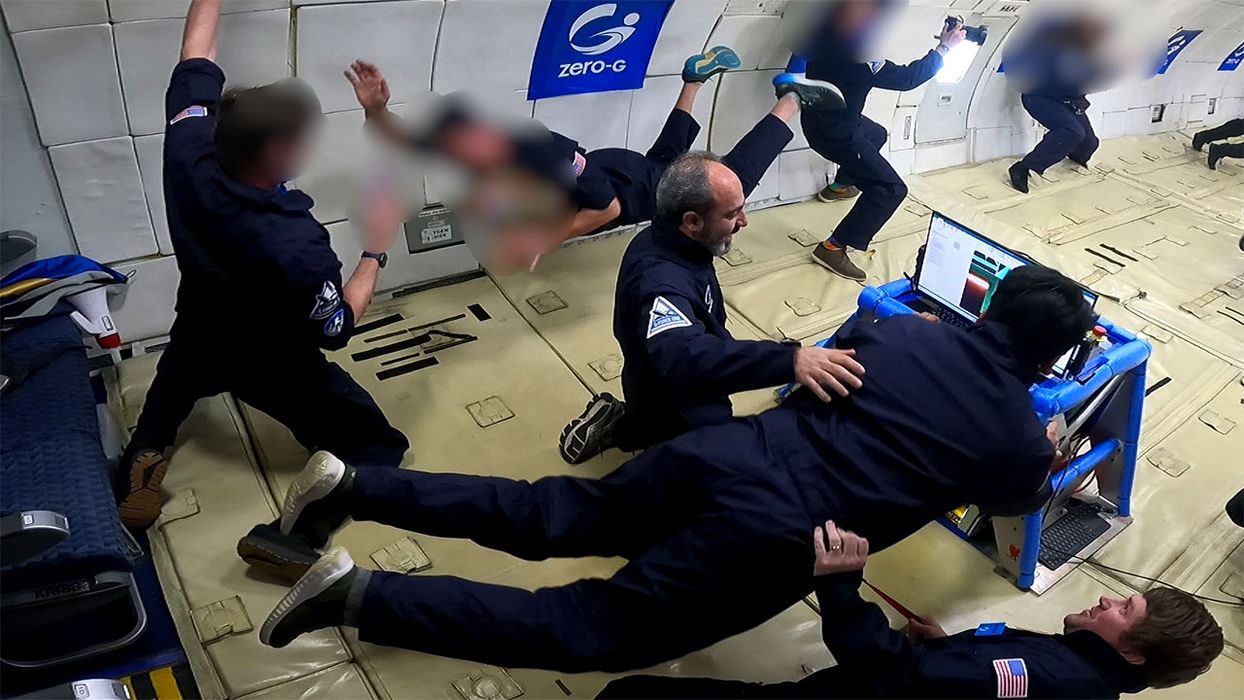
Auburn, by contrast, has built an internationally recognized research enterprise centered on industrial-scale additive manufacturing. Its strengths include metal AM, qualification science, fatigue analysis, standards development, aerospace applications, and large federally funded research programs. The university’s partnerships with ASTM International, DARPA, NASA, NIST, and defense organizations place it among the leading research institutions in the field.
Viewed strictly through the lens of additive manufacturing research, Auburn currently has the larger and more influential portfolio. Its specialized centers, national partnerships, and sustained federal investment create a depth that few universities can match. The concentration of expertise around NCAME gives Auburn a distinct advantage in advancing industrial adoption of metal additive manufacturing.
That said, the comparison is not zero-sum. Alabama benefits from having two universities that complement rather than duplicate each other’s capabilities.
3D Printing and IRC §41 Research and Development (R&D) Tax Credit Opportunities
The additive manufacturing developments described may create meaningful opportunities for companies to evaluate eligibility for the federal R&D tax credit under IRC §41. The University of Alabama’s capabilities in rapid prototyping, design for additive manufacturing (DfAM), iterative product development, and reverse engineering, as well as Auburn’s NCAME work on metal additive manufacturing qualification methods, materials characterization, standards development, and process reliability rely heavily on research and experimentation. These activities often align with the IRC §41 four-part test where companies incur domestic §174A research expenditures, rely on engineering or physical sciences, seek to develop a new or improved product, process, technique, or other business component, and conduct a process of experimentation to improve function, performance, reliability, or quality.
For example, projects involving metal AM process qualification, microstructure and fatigue analysis, nondestructive evaluation, model-assisted inspection, and process optimization may support experimentation aimed at resolving technical uncertainty around repeatability, material properties, and long-term reliability. Auburn’s DARPA SURGE funding for accelerating qualification methods, its AI/ML and distributed manufacturing research, and AUARI’s CF3D carbon fiber composite printer for hypersonics, aerospace, and defense applications further illustrate technically complex development environments that may generate credit-eligible activities.
Potential qualified research expenses may include employee wages, prototype materials and supplies, certain computer-use costs, and eligible contract research expenses. Companies should consult a professional tax advisor for help evaluating and documenting potential IRC §41 R&D tax credit claims.
Benefits for Alabama’s Economy and Communities
The combined impact of these programs extends well beyond university campuses.
For Alabama manufacturers, university research accelerates technology transfer, helping companies adopt additive manufacturing with lower technical risk. Aerospace and defense firms gain access to qualified research partners capable of solving difficult engineering problems while training future employees.
Students benefit through hands-on experience with technologies increasingly used throughout modern manufacturing, making Alabama graduates more competitive nationally.
Entrepreneurs also stand to gain. Accessible makerspaces like UA’s reduce barriers for product development, while Auburn’s advanced research infrastructure enables startups to collaborate on sophisticated manufacturing challenges that would otherwise require significant capital investment.
Ultimately, Alabama communities benefit through economic diversification. As additive manufacturing continues expanding into aerospace, healthcare, automotive production, construction, and defense, the state’s growing expertise positions Alabama to attract additional investment, create high-skilled jobs, and strengthen advanced manufacturing supply chains.
Taken together, the University of Alabama and Auburn University are helping transform Alabama from a traditional manufacturing state into an increasingly important center for advanced manufacturing innovation. Auburn currently leads in nationally recognized additive manufacturing research, while UA plays a critical role in educating the next generation of engineers and expanding practical access to 3D printing. Together, they provide complementary strengths that should continue benefiting Alabama’s economy, workforce, and industrial competitiveness for years to come.