
A new academic review dissects how 3D printed concrete behaves in earthquakes and where the technology must improve to earn code approval.
The authors survey extrusion-based construction printing and consolidate scattered findings on ductility, damping, stiffness, and energy dissipation. They frame 3D-printed concrete (3DPC) as a promising route to geometric freedom, material efficiency, and automation at the jobsite, yet they also catalog well-known pain points: anisotropy from layer-wise deposition, weak interlayer bonding, and difficult reinforcement integration. Reported compressive strengths sit around 20–70 MPa and elastic modulus in the 15–30 GPa range, but dynamic behavior is dominated by interfaces and print orientation.
Crucially, the paper brings numbers to the discussion. Specimens loaded perpendicular to bead direction can lose roughly thirty percent tensile strength; hysteresis tests often show 20–40 percent lower energy dissipation than cast concrete unless fibers or post-processing are added. Effective damping ratios are typically in the 3–6 percent range, with higher variability than conventional RC because interlayer microcracking adds frictional dissipation and uncertainty.
Why Printed Concrete Shakes Differently
In seismic demand, directionality matters. Layer planes act as preferred fracture paths, so crack initiation, delamination, and stiffness degradation tend to localize at interfaces. That plays poorly with the ductility assumptions baked into today’s RC design rules, which presuppose homogeneous material behavior and well detailed rebar. The review notes that reinforcement remains a bottleneck for 3DPC: printing around cages hurts automation, post-insertion adds labor, and FRP or fiber-only strategies do not yet deliver the ductility targets codified in ACI 318 and Eurocode 8.
Evidence comes from shake table, pseudo-dynamic, and quasi-static cyclic testing. While the methods capture different aspects of seismic response, they converge on two themes: print orientation and interlayer adhesion govern failure modes, and the gap between small-scale coupons and full-scale walls remains large. The authors also highlight modeling advances, from cohesive zone interfaces to anisotropic damage mechanics, but stress that calibration data are thin and lab protocols vary.
Optimization, Evidence, And The Road To Codes
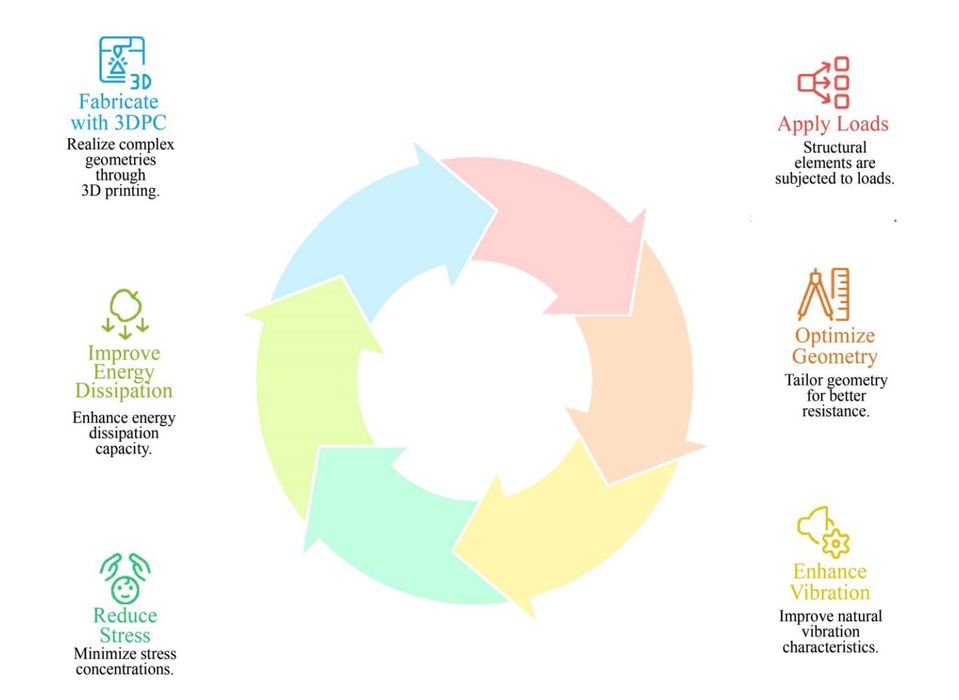
One encouraging thread is shape and topology optimization. Because 3DPC is unconstrained by formwork, designers can chase stiffness-to-weight and tuned dynamics directly. Case studies in the review report up to 25 percent higher lateral strength and 18 percent more energy absorption in optimized shear walls versus rectangles, as well as lattice columns that are about 30 percent lighter yet maintain period targets and improve damping. Curvilinear shells tuned away from dominant ground motion frequencies showed roughly 15 percent higher fundamental frequency and more uniform stress fields.
Those gains matter to economics too. Lower mass reduces inertial forces and concrete usage, and optimized forms align with robotic extrusion, nudging projects toward fewer human touch points. Still, the authors are careful: throughput is not quantified, printability constraints are not consistently embedded in optimization routines, and practical reinforcement layouts must co-evolve with geometry to avoid brittle failures.
Standardization is the other big milestone. There are no 3DPC-specific seismic provisions yet. The review points to early work at ASTM, RILEM, and ISO, and suggests pragmatic adaptations: orientation-dependent reduction factors for strength and ductility, minimum interlayer shear benchmarks, and acceptance criteria for stiffness retention under cyclic loading. Until such measures are formalized, engineers will continue to rely on project-specific testing and conservative assumptions.
What should readers watch next? Full-scale walls and frames with validated reinforcement strategies, consistent cyclic protocols across labs, and closed-loop quality control that measures interlayer bond in real time. The authors also argue for AI-assisted optimization tied to hybrid testing, and for embedding SHM sensors during printing so damping, cracking, and drift can be tracked in service.
Freedom of form is powerful, but earthquakes negotiate only with ductility.
