
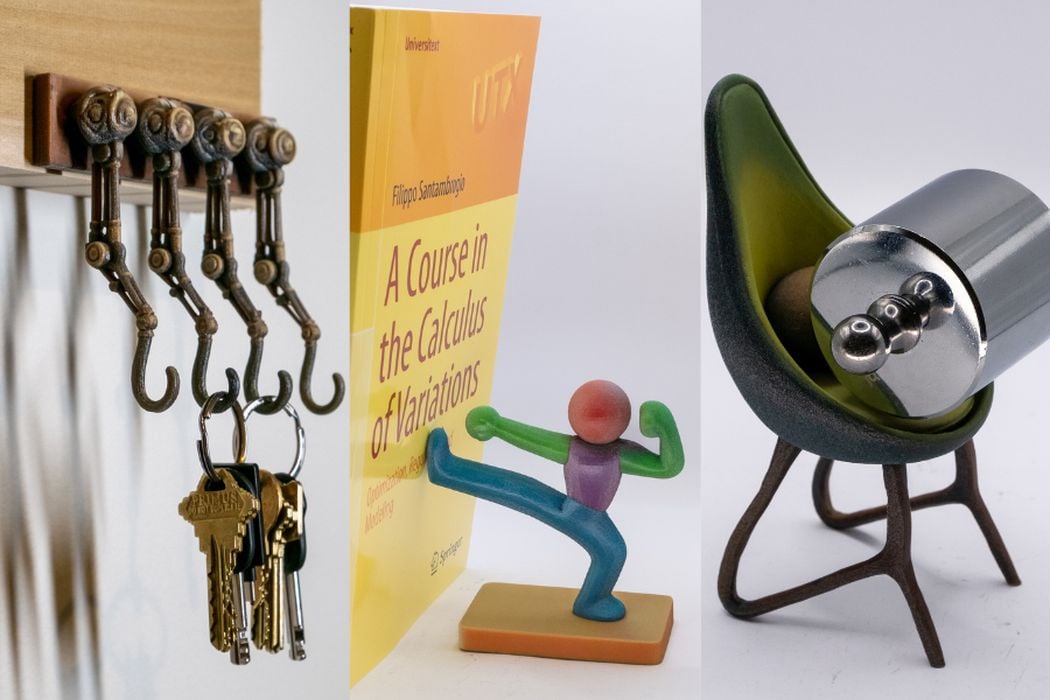
MIT researchers have developed a system to generate 3D models that can better function in real life when printed.
There are plenty of AI tools around these days that can very quickly produce a 3D model of, well, anything you want. While most of these 3D models are perfectly usable in video-based applications (e.g. gaming), the picture is less good when considering printability.
Generated models very often are challenging to print because they don’t account for overhangs, spindly structures, etc.
But even if you found a way around that problem, there’s another one: physical capabilities. For example, if you generated a shelf, would it actually hold the required weight? Or would it buckle because the design wasn’t sufficiently robust?
That’s the problem MIT’s CSAIL attempted to resolve. Their approach: use an AI model that was previously trained on existing, known-functional shapes. The AI model, which they named “PhysiOpt”, generates models based on this knowledge, which tends to result in more robust results.
How does it work? They explain:
“You can simply type what you want to create and what it’ll be used for into PhysiOpt, or upload an image to the system’s user interface, and in roughly half a minute, you’ll get a realistic 3D object to fabricate. For example, CSAIL researchers prompted it to generate a ‘flamingo-shaped glass for drinking,’ which they 3D printed into a drinking glass with a handle and base resembling the tropical bird’s leg. As the design was generated, PhysiOpt made tiny refinements to ensure the design was structurally sound.”
It’s unlikely PhysiOpt would be able to generate dimensionally precise parts to be used in an assembly, similar to CAD output, but for single-piece functional parts, it could be quite useful.
Many of the current text-to-3D services are designed to serve screen assets, rather than printable 3D models. However, since these services exist, many 3D printer operators use them to generate (hopefully) 3D printable models.
My hope is that one or more of these text-to-3D services catches on to the PhysiOpt concept and is able to integrate it into their service. I can imagine a service that allows you to select the model that best matches your goal: if intending to print, use the “robust” PhysiOpt model, for example.
But that will depend on the future of PhysiOpt. Will it be licensable? Can it be commercialized?
