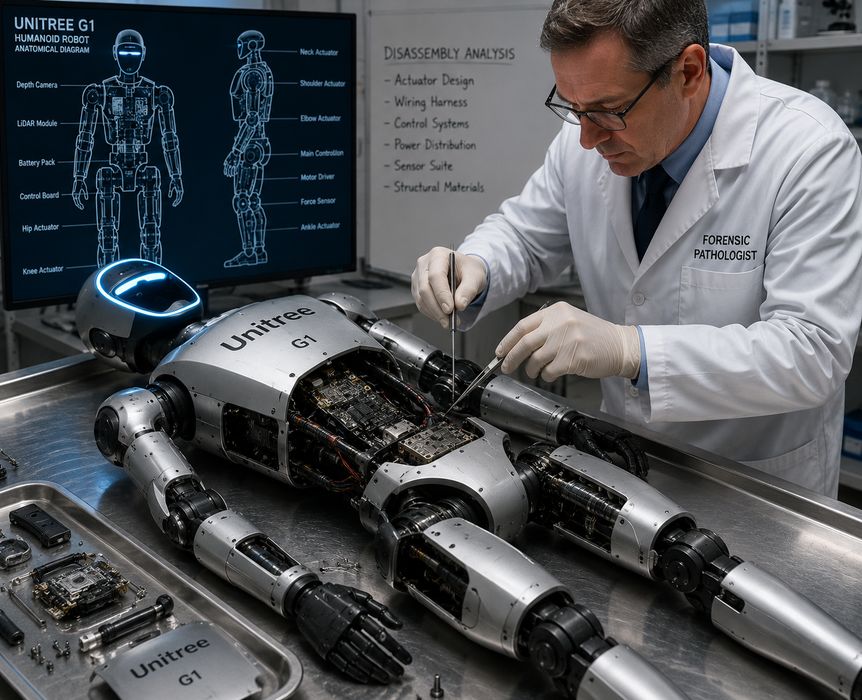

Charles R. Goulding and Preeti Sulibhavi analyze Japan’s resurgence in humanoid robotics, the engineering insights revealed by the Unitree G1 disassembly, and the growing importance of domestic manufacturing capabilities for technological leadership and national security.
After pioneering many of the world’s first humanoid robots, Japan ceded much of the commercial humanoid robotics market to rapidly expanding Chinese manufacturers over the past decade. Today, however, Japan is making a concerted effort to regain leadership through investments in artificial intelligence, advanced manufacturing, precision engineering, and robotics.
Recent analysis by Japanese engineers of a Chinese-made Unitree humanoid robot illustrates both the remarkable progress made by Chinese manufacturers and the importance of understanding the technologies that enable cost-effective, large-scale production. The exercise also highlights a broader strategic issue: nations seeking leadership in humanoid robotics must possess not only world-class software and AI capabilities, but also resilient domestic manufacturing ecosystems capable of producing the mechanical, electrical, and materials systems that make these robots possible.
Japan’s Return to Humanoid Robotics
Japan has long been a global leader in robotics. Companies including Honda, Toyota, FANUC, Yaskawa Electric, Kawasaki Heavy Industries, and Denso helped establish many of the technologies that define modern industrial automation.
Although Honda’s ASIMO became one of the world’s most recognizable humanoid robots, commercialization of humanoid platforms accelerated elsewhere during the past decade. Chinese companies such as Unitree Robotics, UBTech, AgiBot, Fourier Intelligence, and EngineAI have demonstrated an ability to rapidly iterate designs while significantly reducing manufacturing costs.
Recognizing both the economic opportunity and strategic importance of advanced robotics, Japan has substantially increased investment in next-generation robotics technologies.
Several trends illustrate Japan’s continued strengths:
- Japan remains one of the world’s largest producers of industrial robots, accounting for approximately 45 percent of global industrial robot production, according to the International Federation of Robotics (IFR).
- Japan maintains one of the highest manufacturing robot densities in the world, with approximately 419 industrial robots per 10,000 manufacturing employees, placing it among the global leaders in automation.
- The global humanoid robot market is projected to expand dramatically over the next decade, with numerous market forecasts estimating annual growth rates exceeding 35 percent as robots transition from research platforms into commercial manufacturing, logistics, healthcare, construction, and public service applications.
Japan’s competitive advantage remains its expertise in precision manufacturing, servo motors, bearings, machine tools, sensors, and industrial automation. Increasingly, policymakers view these capabilities as essential foundations for the emerging “physical AI” economy, in which intelligent machines perform real-world tasks alongside human workers.
Disassembly of the Unitree G1
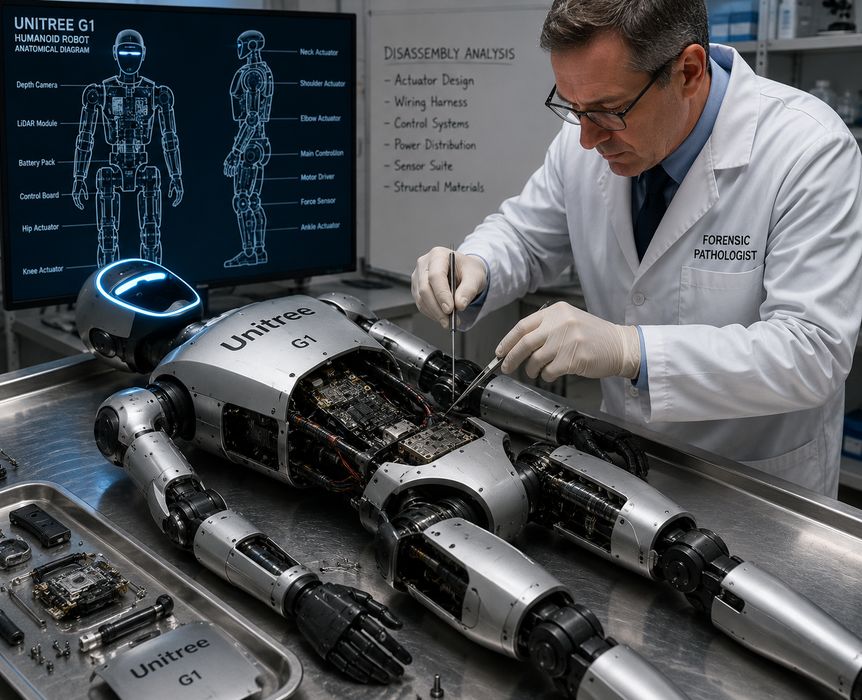
In 2026, Japanese technology publication Nikkei xTECH conducted a detailed teardown of the Chinese-developed Unitree G1 humanoid robot. The purpose was not simply to examine a competitor’s product, but to understand the engineering decisions, manufacturing methods, and supply chain strategies that enabled China to produce a capable humanoid platform at comparatively low cost.
Engineers systematically dismantled the robot into its major subsystems, documenting mechanical construction, actuator design, electronics integration, structural materials, wiring architecture, battery systems, and sensing technologies.
The analysis highlighted several characteristics increasingly common among commercially viable humanoid robots:
- Highly integrated actuator modules
- Lightweight structural construction
- Modular electronics
- Distributed control architecture
- Efficient cable routing
- Components designed for manufacturability and serviceability
Rather than revealing a single revolutionary innovation, the teardown demonstrated how incremental improvements across numerous engineering disciplines can collectively produce a highly competitive robotic platform.
Major Components Examined
Integrated Electric Actuators
The actuators are arguably the most critical component in any humanoid robot. Each actuator combines:
- Brushless permanent magnet electric motor
- Harmonic or planetary reduction gearbox
- Precision bearings
- Rotary encoder
- Torque sensing capability
- Embedded motor controller
Together, these components generate the torque, speed, and positional accuracy required for stable walking, manipulation, balancing, and dynamic movement.
High-performance actuators represent one of the most technically demanding and expensive portions of a humanoid robot.
Precision Bearings
Joint bearings support large dynamic loads while maintaining extremely tight positional tolerances.
Japanese manufacturers such as NSK, NTN, and THK have long been global leaders in precision bearings used throughout robotics, aerospace, and industrial machinery.
Sensor Systems
Modern humanoids rely on numerous sensors operating simultaneously, including:
- Inertial Measurement Units (IMUs)
- Joint encoders
- Force and torque sensors
- Vision cameras
- Depth sensors
- Foot pressure sensors
These systems provide continuous feedback necessary for maintaining balance and interacting safely with dynamic environments.
Battery System
Humanoid robots consume significant electrical power during locomotion.
Lithium-ion battery packs typically incorporate:
- Battery Management Systems (BMS)
- Thermal monitoring
- Over-current protection
- Cell balancing electronics
Energy density remains a major constraint affecting operating time and payload capacity.
Computing Hardware
Distributed embedded processors control each joint in real time while higher-level processors execute perception, motion planning, and AI inference.
Increasingly, these processors include specialized AI accelerators capable of running neural networks locally with minimal latency.
Structural Materials
One of the most visible aspects of the teardown involved the robot’s lightweight structural frame.
Many load-bearing components are manufactured from precision-machined aluminum alloys.
Aluminum remains the preferred structural material because it offers:
- High strength-to-weight ratio
- Excellent machinability
- Corrosion resistance
- Low overall mass
- Good fatigue performance
- Relatively low production cost
Depending on the application, components may be produced using CNC machining, precision casting, forging, or increasingly, additive manufacturing techniques.
Although aluminum itself is a common industrial metal material, the expertise required to transform raw aluminum into lightweight, high-strength robotic structures represents a significant manufacturing capability.
Supply Chain Considerations
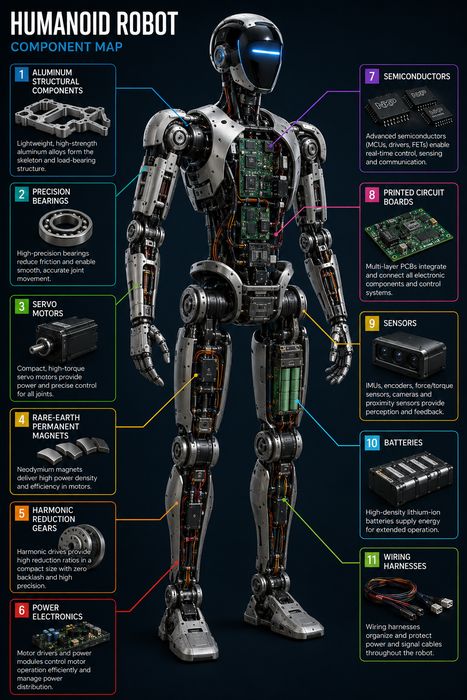
Humanoid robots integrate thousands of individual components originating from multiple industrial sectors.
Critical components include:
- Aluminum structural components
- Precision bearings
- Servo motors
- Rare-earth permanent magnets
- Harmonic reduction gears
- Power electronics
- Semiconductors
- Printed circuit boards
- Sensors
- Batteries
- Wiring harnesses
Few countries currently possess the complete industrial base required to manufacture every major subsystem domestically.
Dependence on foreign suppliers introduces risks associated with export controls, geopolitical tensions, transportation disruptions, and supply shortages. Even seemingly routine components, such as machined aluminum structures or precision gearboxes, may become bottlenecks if domestic production capacity is limited.
For strategic industries such as robotics, maintaining trusted and resilient supply chains is increasingly viewed as an element of national security alongside cybersecurity and software integrity.
Strategic Implications
The Japanese examination of the Unitree G1 reflects a broader reality: nations are competing not only to develop better humanoid robots but also to master the manufacturing ecosystems that support them.
Success in humanoid robotics depends upon far more than advances in artificial intelligence. It requires domestic expertise in materials science, precision machining, electronics manufacturing, battery technology, sensors, actuators, semiconductors, and systems integration.
The Unitree teardown demonstrates that technological leadership is achieved through the integration of these capabilities into scalable manufacturing processes capable of producing reliable, affordable robotic systems.
Developing a robust domestic humanoid robotics manufacturing ecosystem is therefore imperative. Such an ecosystem will accelerate technological innovation, strengthen industrial competitiveness, improve supply-chain resilience, and reduce dependence on foreign sources for critical components. As humanoid robots become integral to manufacturing, logistics, healthcare, emergency response, infrastructure maintenance, and defense support, maintaining domestic production capabilities will become increasingly important to both economic prosperity and national security.
The connection to the US domestic manufacturing ecosystem will be evident in the companion article to this one, regarding the recent White house announcement concerning the use of domestic components.