
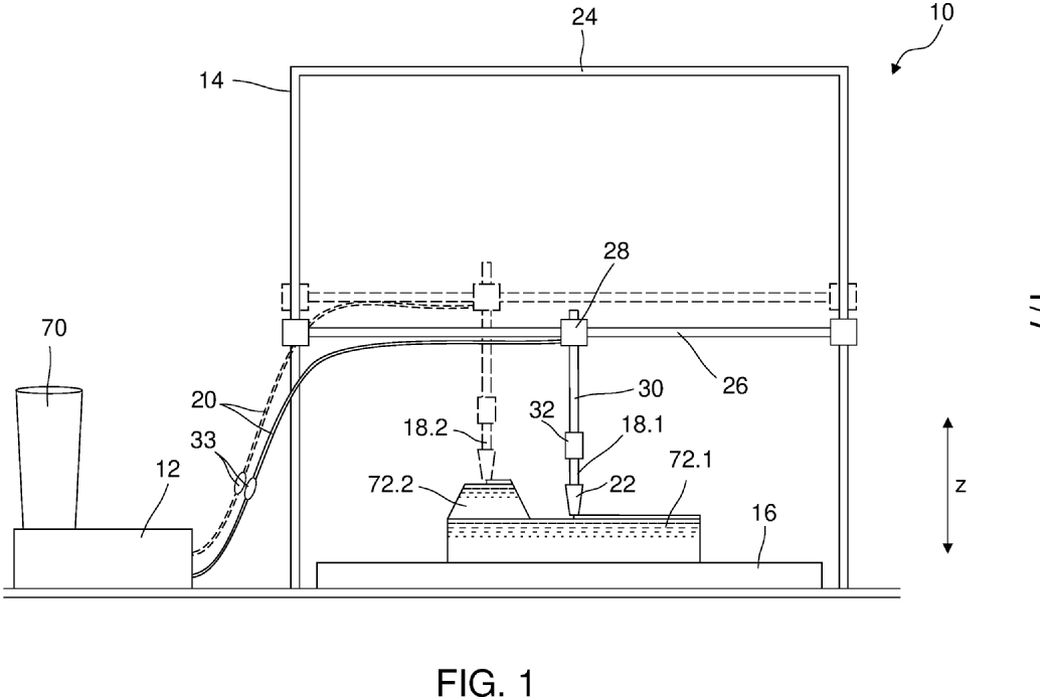
A new patent from Australia-based Hyperion Systems proposes a different way to build large format extrusion systems without dragging a heavy hot end around the machine.
Large scale material extrusion always runs into the same ugly tradeoff. If you mount a powerful extruder on the print head, you gain material flow but lose speed, agility and accuracy because the gantry has to throw around more mass. If you keep the head light, then material delivery usually becomes the bottleneck. Hyperion’s filing tries to break that compromise by separating the extrusion work from the motion work.
The basic concept is pretty straightforward. A centralized extruder heats and pressurizes source material, then sends that flowable build material through conduits to one or more independently moving print heads. Those heads do not need to carry the full extrusion system. Instead, they carry lighter nozzles and local flow control devices that meter material near the point of deposition. In principle, that should reduce moving mass while preserving high material throughput.
Hyperion goes well beyond a remote extruder concept, however. The patent describes piston based flow regulators, optional valves, heated conduits to maintain melt temperature, variable area iris style nozzle openings, and smoothing devices positioned beside the nozzle. The company also outlines multiple print heads operating from a single extruder, plus mechanisms to angle the nozzle and even print on diagonal planes rather than being locked to a conventional vertical deposition orientation.
The complexity of this approach suggests that it is intended for large scale extrusion systems, rather than simpler desktop systems.
Where The Patent Gets Interesting
The most interesting piece is not the remote feed by itself. We have seen variants of remote pellet and paste delivery before, particularly in large format additive systems where hose fed material is practical. The more notable step here is the combination of remote melt generation with fine control at the head. Hyperion is effectively trying to keep the head light while still giving it local authority over flow rate, bead width, and surface finishing.
A variable nozzle aperture could let the same machine lay down a fat bead for bulk fill and then switch to a narrower extrusion width for local detail. The smoothing devices are also notable because large nozzle systems often leave a ribbed, visibly coarse surface. If those side mounted smoothers actually work in practice, Hyperion could reduce one of the most obvious aesthetic weaknesses of large format extrusion.
The patent also describes making rib like structural forms by depositing spaced strands and then injecting a binding material into channels between them. That is an unusual twist. It suggests Hyperion is not thinking only about conventional solid wall extrusion, but also about engineered internal structures that lock together mechanically. If workable, that could offer a path to lighter structural parts with controlled reinforcement, although the filing leaves many material questions unanswered.
There are plenty of unknowns here, though. The patent does not provide throughput numbers, control accuracy data, or evidence that temperature can be held consistently across long conduits. Anyone who has worked with hot polymers knows that pressure lag, thermal drift, purge behavior, and clogging can ruin elegant concepts like this one. Multi head systems fed by one extruder also raise practical questions about synchronization, maintenance, and whether a fault in the central extruder stops the whole machine.
What Comes Next For Hyperion
At this stage, this is still a patent idea, not a commercial machine announcement, and a bit of a stretch idea at that. Can Hyperion maintain stable flow through hoses? Can the local regulators meter accurately enough for clean toolpaths? Can the variable iris nozzle survive real production use without becoming a maintenance nightmare?
If Hyperion can show that combination working on large parts, then the company may have a credible way to compete in the growing market for large format material extrusion. The broader idea is still pretty compelling: reduce the weight of the toolhead.
Via Patentscope
