
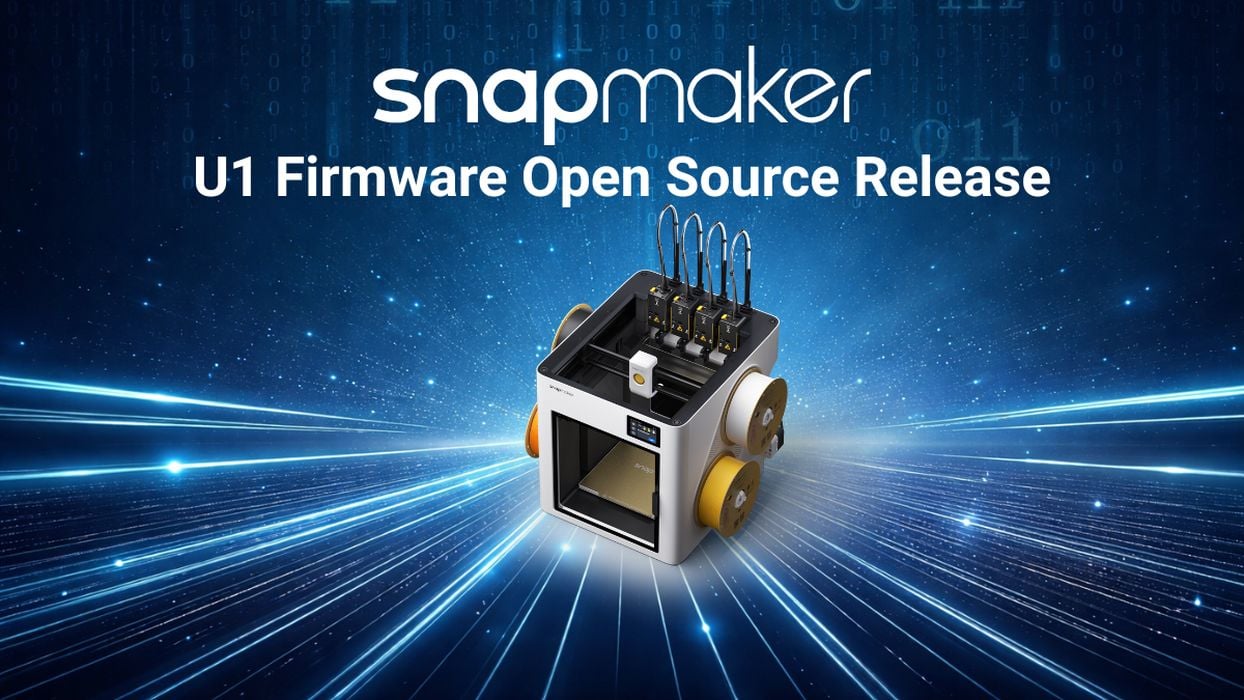
Snapmaker has published the Snapmaker U1 firmware modifications on GitHub, giving developers a clearer look at how the machine’s multi-toolhead functions are implemented.
The release covers Snapmaker-maintained forks of three common open-source components used by many Klipper-based 3D printers: Klipper (motion and device control), Moonraker (the API and orchestration layer), and Fluidd (a browser-based user interface). Snapmaker says these projects form the foundation of the U1 firmware system, and that the company “significantly extended and adapted” them to match the U1’s architecture.
This is a notable move because “open source” in desktop 3D printing often arrives as a promise without much useful code, or as a partial dump that is hard to build. Here, Snapmaker is pointing to specific repositories for each component. The announcement is also timely: Snapmaker says the U1 is one week away from being in stock globally, suggesting the software stack is now in its final shipping configuration. Snapmaker is being quite proactive here, as some other manufacturers tend to delay their open source releases.
The release also highlights an ongoing shift in the hobby and prosumer market: more 3D printer manufacturers are adopting Klipper’s split architecture rather than building everything around Marlin-style firmware. In Klipper, higher-level logic typically runs on a host computer while time-critical motion runs on microcontrollers. Snapmaker argues that this approach helped them bring the U1 “online quickly” while still delivering strong print quality early in development.
Why The U1 Needed Deep Klipper Changes
Snapmaker’s technical claim is the scale of its Klipper work: it says roughly 20% of the codebase was modified to support the U1’s “parallel multi-toolhead system”, which is quite significant. Multi-tool support exists in the Klipper ecosystem, but Snapmaker is describing something more coordinated than a simple toolchanger profile, and that is important for both reliability and throughput.
The company lists a long set of firmware-level features it added or reworked. These include a redesigned tool-switching workflow aimed at parallel multi-toolhead operation, custom probing workflows with eddy-current bed leveling, and multi-toolhead XYZ offset calibration. It also mentions high-precision CoreXY homing, power-loss recovery, automatic filament loading and unloading, filament tangle detection, and more extensive print job management and diagnostics.
Some additions read like table stakes for a today’s typical “appliance-like” machine, such as timelapse and better error handling. Other features are more revealing about the U1’s hardware direction: eddy-current probing suggests a sensor-driven calibration loop, while RFID-based filament recognition indicates a tightly managed materials workflow. Those are the kinds of features that tend to reduce operator efforts, but they can also tighten the relationship between firmware, hardware, and vendor ecosystem.
Connectivity, UI, And What Stays Closed
On the Moonraker side, Snapmaker says it modified over 15% of the codebase. The key items here are integration with Snapmaker Cloud services and support for downloading and processing 3MF files, along with local network client management and improvements to internal communication and file handling. This suggests that the U1 is designed to move jobs between local and cloud workflows without forcing the user to pick one model.
Fluidd changes are listed as: synchronizing device naming between the printer’s screen and the web interface, and improving consistency between local and remote control. That is not huge, but it is exactly the sort of user interface troubles that makes a machine feel “unfinished” when it ships.
Snapmaker is also pretty firm about boundaries. It says certain advanced U1 capabilities are delivered through independently developed modules that interface with the open-source stack through defined interfaces, but are not derived from Klipper, Moonraker, or Fluidd. The company specifically calls out intelligent flow rate auto-calibration and defect detection as system-level capabilities outside the open-source modifications. In other words, don’t expect to build a fully functional U1 on your own because of this open source release.
The GitHub release should help the community understand how U1-specific motion, calibration, and multi-tool coordination are structured, and it may allow forks or third-party extensions. But any closed modules could become the differentiator that is hardest to replicate, audit, or maintain if Snapmaker changes direction.
If the U1 sells in volume (likely), the more interesting question is whether Snapmaker’s open source release influences others projects, or whether it remains a product-specific branch that only U1 owners care about. Either way, publishing real code is the kind of transparency that should add some positive points to the perception of the company by open source advocates.
Via Snapmaker
