
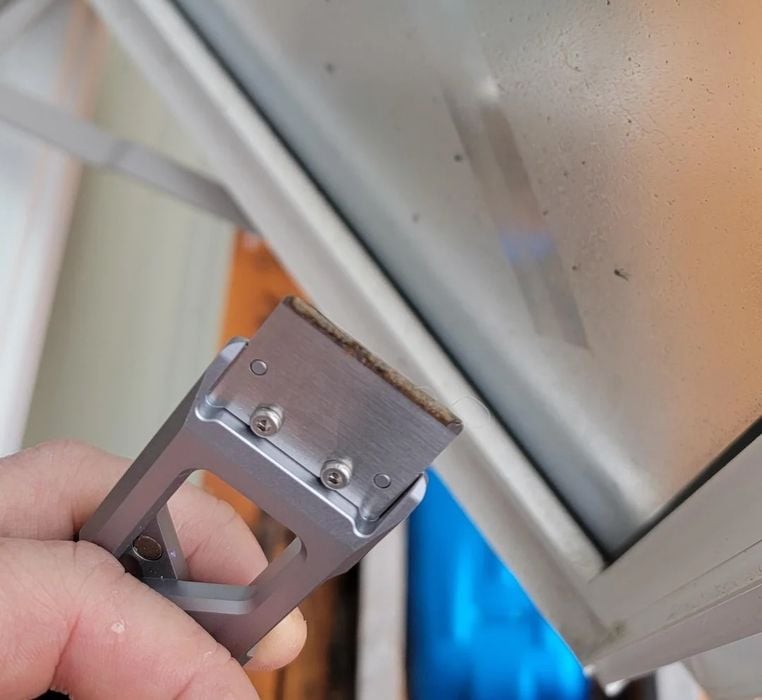
A Reddit photo showing heavy residue collected after more than 3,000 hours of ABS printing is a vivid reminder that printer emissions are a serious issue.
The image, posted to Reddit’s 3D printing community, shows what appears to be a significant buildup captured from the exhaust side of a long-running ABS setup. There is no lab data attached, and that’s important to note right up front: this is not a scientific paper, nor does it identify the exact chemistry of the deposits. But as a practical example, it demonstrates what’s really going on when you print materials like ABS.
If that much residue can accumulate in an exhaust path over time, then our usual casual attitudes toward indoor ABS printing deserves another look.
ABS has long been one of the more useful engineering thermoplastics in desktop-scale extrusion printing. It offers better heat resistance than PLA, is less brittle, can be machined reasonably well, and is often used for functional parts. We also know that ABS printing can emit ultrafine particles and volatile organic compounds, including styrene. The industry has known this for years based on mulitple studies, yet plenty of users still operate ABS machines in offices, bedrooms, classrooms, small workshops or even bedrooms with minimal or no ventilation.
It isn’t just that “ABS smells bad.” Everyone who has spent time around an unenclosed ABS machine already knows that. This is what really happens: emissions can condense, deposit, and accumulate in nearby areas. In other words, they are not simply diluted away in the air.
That has two implications. First, filtration and venting matter a lot more than many casual 3D print operators may assume. Second, maintenance matters. Filters clog. Fan performance changes. Ducting gets dirty. If you rely on an enclosure and extractor to make ABS use tolerable, then that setup is not a one-time purchase. It becomes part of the operational process and must be maintained.
You can also look at this image in another way: the “invisible” side of FFF printing is often ignored because the machine itself looks clean and controlled. A spool goes in, a part comes out, and the mess seems limited to failed supports and stray bits. But thermal decomposition products don’t present themselves as obvious scraps on the build plate. They show up in the air path, on surrounding surfaces, and potentially in your lungs if not properly dealt with.
This is also a very important for small print farms and schools. A single desktop machine running ABS occasionally is one thing. A room with multiple systems printing for long stretches is something else entirely. Exposure scales with time, throughput, and ventilation quality. That’s where the usual casual assumptions fail. “It seems fine” is not really a safety protocol.
While you can’t see it, you are breathing in ABS emissions that, just like that dirty window, are accumulating in your body. And once inside, it does not come out. Ever.
It may be that 3D printer manufacturers are already thinking about this issue. More desktop and professional systems now ship with enclosed chambers and some form of integrated filtration, and material choices have expanded to include options that are easier to manage indoors. But ABS remains common because it solves real part-performance problems, and because it’s not that expensive. That means the responsibility is in the operation: if you’re going to use ABS, treat the emissions as part of the print job, not as an afterthought.
The Reddit image makes this otherwise abstract hazard visible — and in 3D printing, like anything else, visible evidence usually changes behavior quickly.
Go take a long, hard look at those images.
Via Reddit
