
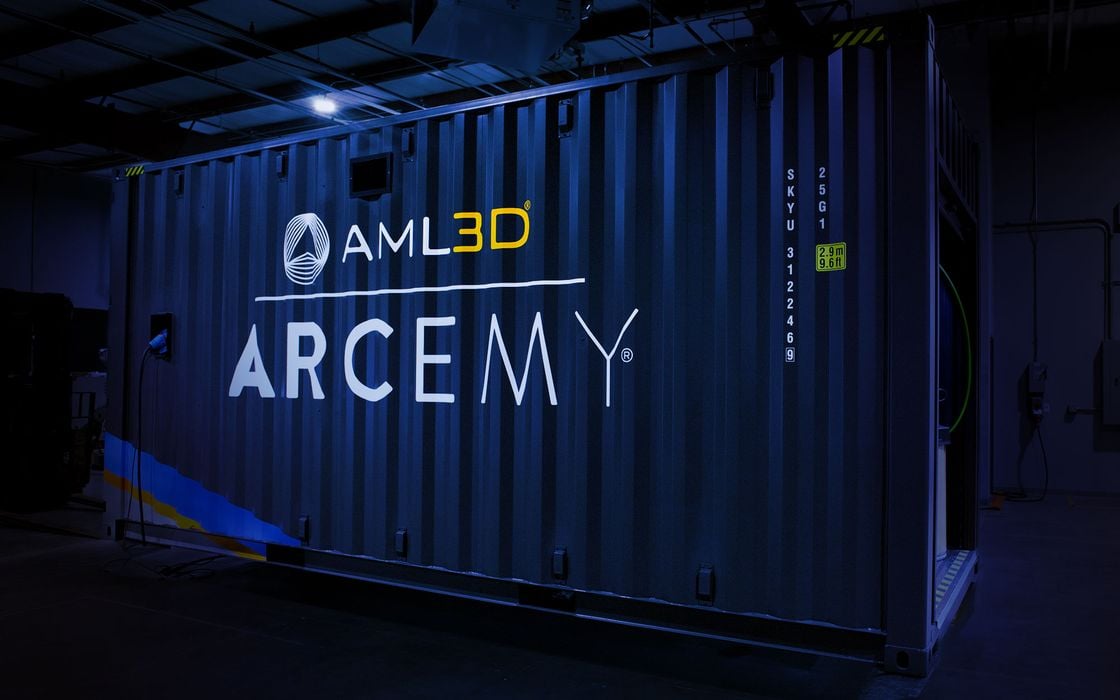
AML3D has installed its first portable, containerized ARCEMY metal 3D printing system at the US Navy’s Additive Manufacturing Centre of Excellence.
The system is now online at the Additive Manufacturing Centre of Excellence (AM CoE) in Danville, Virginia, which is run by Austal USA. AML3D says the portable ARCEMY small edition is mounted inside a 20-foot (about 6 meter) shipping container, aiming to make the hardware faster to deploy and easier to relocate than a fixed installation.
This is important because large-format metal additive manufacturing often sits in dedicated facilities with specialized power, safety controls, and staffing. For defense and maritime users, those requirements are not always possible with ship maintenance activities and locations. A containerized approach tries to close the gap between “capable in theory” and “useful under pressure.”
From Lab Asset To Deployable Capability
ARCEMY is AML3D’s industrial system built around its Wire Additive Manufacturing (WAM) process, a wire-fed directed energy approach typically suited to larger metal components. Wire-based systems are often attractive in heavy industry because wire feedstock is widely available, and deposition rates can be high compared to powder-bed processes. It is also far simpler because no powder handling special hardware or procedures are required. The tradeoff is that parts usually need machining after printing to hit final tolerances and surface finish requirements.
Danville is not getting its first ARCEMY, however. Austal USA already operates two custom large-scale ARCEMY X systems at the AM CoE, and the new portable unit brings its on-site “fleet” to three. AML3D positions the portable unit as a way to accelerate both technology development and component manufacturing, while also enabling redeployment as Austal’s additive operations expand.
The company also tells of a commercial milestone: completion of factory acceptance testing and installation triggers the final 50% payment on an order valued at about AU$1.2M (US$0.89M).
Why A Shipping Container Is A Big Deal
The big thing here is time-to-field. AML3D says reinstalling the portable system can take as little as one to two days of field service time, versus two to three weeks for a fixed system. That difference is not about printing faster; it is about reducing downtime and project friction when a site needs to move equipment, set up capacity at a new facility, or demonstrate capability in places where the work is actually happening.
“Portable” here really means “deployable with infrastructure planning,” not “roll it off a truck and print immediately.” Wire-fed metal systems have power demands, fume extraction, shielding gas, wire logistics, and safety procedures, etc. The container can standardize some of that with packaging, but it does not eliminate the normal operational requirements that make metal directed energy systems more complex than, say, polymer FFF.
Austal USA believes the containerized system is a supply-chain tool: demonstrate production at the point of need and reduce delays caused by external sourcing. AML3D adds that ARCEMY technology is already used to manufacture components meeting US military specifications, suggesting the program is past the “interesting demo” stage and into qualification-driven manufacturing. What remains unclear is which types of applications are being targeted for this portable unit: prototyping, spares, tooling, or end-use hardware?
Strategically, AML3D also points to an earlier US Navy Letter of Intent indicating a need for up to 100 additive manufacturing systems and 3,400 additively manufactured parts by 2030. That is not an order, but it is a pretty strong directional indicator that the Navy is thinking at fleet scale, not one-off pilots. If even a small portion of that becomes funded procurement, containerized deployments could become a standard way to distribute capacity across multiple sites and missions.
Via AML3D
