
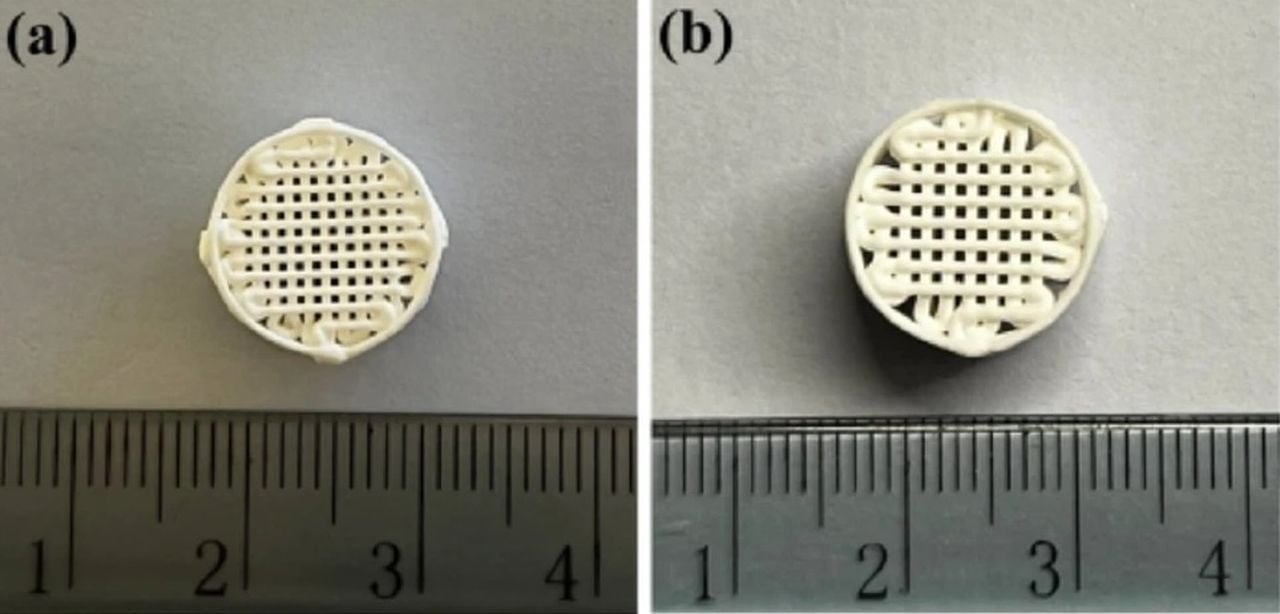
New research directly compares DIW and DLP for alumina honeycomb substrates, showing how nozzle and layer choices control strength and accuracy.
A joint team from Tampere University and Belgium’s VITO put two widely used ceramic AM methods — Direct Ink Writing (DIW) and Digital Light Processing (DLP), a Vat Photopolymerization (VPP) approach — head to head. They printed identical alumina honeycomb geometries and then sintered them under the same conditions to isolate the effect of the printing method and parameters.
This matters for the many catalysis applications that rely on ceramic monoliths. Honeycomb substrates are all about surface area, flow behavior, and crush strength. AM lets designers tune channel size and wall thickness, but the build physics still decides how those details translate into real strength, shrinkage, and dimensional fidelity after sintering.
The team varied DIW nozzle diameter (six hundred and eight hundred micrometers) and DLP layer thickness (twenty five and fifty micrometers). They also probed binder effects, including a photopolymer binder used in both processes — an unusual cross-platform control in ceramic 3D printing — to separate feedstock chemistry from process physics.
Strength Versus Resolution: The Tradeoffs
For DIW, the concept is simple: smaller nozzle, stronger part. Moving from eight hundred to six hundred micrometers roughly doubled compressive strength before normalization, and the advantage held even after normalizing by relative density. The likely reason is structural — more load-bearing struts in the same footprint mean better stress distribution, not just a density effect.
There is a catch. When the team pushed the DLP-style photopolymer binder through the smaller DIW nozzle, they saw signs of shear-induced phase separation and rougher extrudates. In other words, you can make it work, but the rheology window gets narrow as features shrink.
DLP had different results. Thinner layers delivered smoother surfaces, less stair-stepping, and higher compressive strength in most cases. The mechanism is intuitive to anyone running resin systems: more vertical overcuring overlap improves interlayer bonding. But there is a catch — lateral overcuring. At twenty five micrometers, struts oversized by up to about twenty three percent, versus near zero to five percent at fifty micrometers.
Binder chemistry mostly played second fiddle, with effects showing up more in fine features and thin layers. Notably, the bio-based 70/30 formulation matched conventional binders mechanically in many DLP cases, which is encouraging for sustainability claims — provided green strength and processing stability are adequate.
Implications For Ceramic AM Users
Economics and throughput were also quantified. Under the team’s settings, DIW produced twelve samples in about one hour; DLP needed roughly five hours for six samples at twenty five micrometers, or about two hours at fifty. That is not a universal metric, but it reinforces the rule of thumb: DIW wins on speed and robustness; DLP wins on detail control — if you tame overcuring and handling.
Dimensional control differs, too. DIW parts shrank during sintering by roughly twenty to thirty seven percent depending on ink and geometry, which is harder to compensate precisely. DLP’s shrinkage can be scaled in CAD, but the lateral cure halo becomes the limit unless photoabsorbers, exposure tuning, or process recipes are dialed in.
If the requirement is rugged supports, fast iteration, and forgiving post-processing, DIW with smaller nozzles is the obvious starting point. If you need tight tolerances or fine features, DLP with thinner layers can compete on strength while delivering cleaner geometry — just expect more tuning around overcuring and green-part handling.
